Zero-Based Budgeting: How to Allocate Every Dollar to Build True Financial Velocity
An exhaustive tactical playbook for zero-based budgeting (ZBB). Learn how to eliminate cash leaks, structure digital sinking funds, and force every incoming dollar into wealth-building velocity.
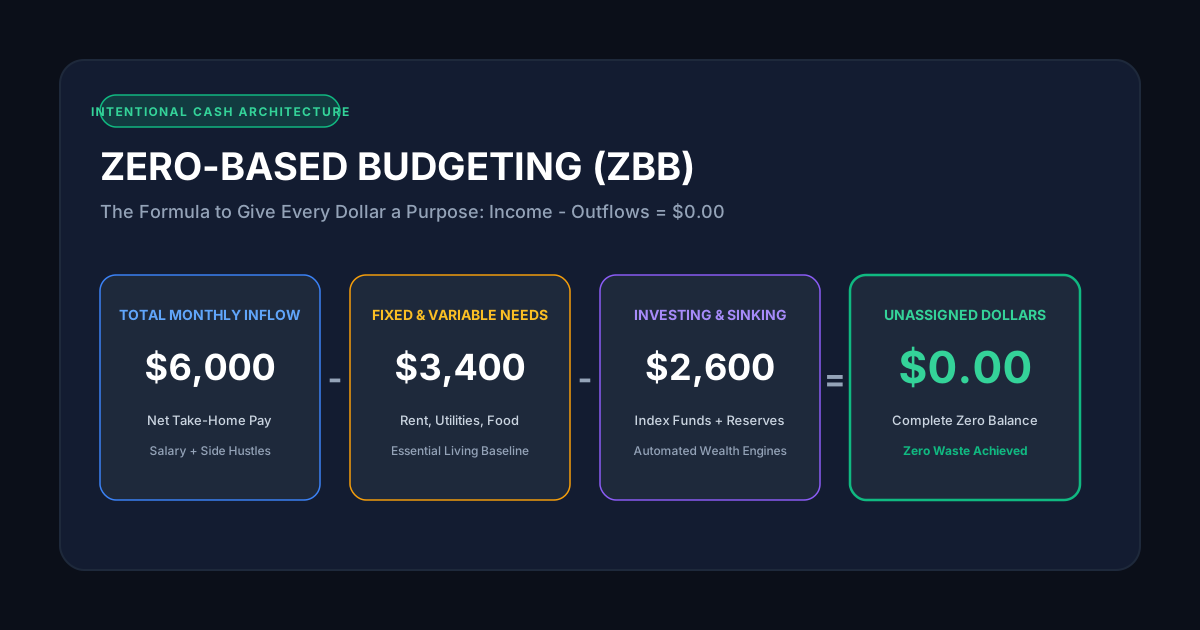
Zero-Based Budgeting: How to Allocate Every Dollar to Build True Financial Velocity
Most traditional budgeting systems fail due to passive accounting. Tracking expenses after they occur simply logs financial mistakes rather than preventing them. When an individual checks their bank balance at the end of the month and wonders where their money went, they have surrendered control of their primary financial engine: their income.
The proven framework utilized by corporations and high-velocity savers is Zero-Based Budgeting (ZBB). Under a zero-based model, your net income minus every planned outflow (expenses, debt payoff, sinking reserves, and investments) must equal mathematically exactly zero: $$ ext{Total Inflow} - ext{Fixed Overhead} - ext{Variable Expenses} - ext{Wealth Accumulation} = $0.00$$
Having a zero balance does not mean you have an empty bank account; it means that every single cent is assigned an explicit, intentional mission before the calendar month begins.
Figure 1: The core equation of Zero-Based Budgeting. Giving every incoming dollar an explicit purpose ensures that zero cash leaks into untracked, impulse consumption.
1. Why Conventional Budgets Fail: The "Unassigned Cash" Trap
Traditional budgeting relies on static category caps (e.g., "I will spend $500 on groceries and $300 on entertainment"). The remaining unallocated cash sits in checking, creating a false psychological sense of abundance.
Financial behavioral psychologists refer to this as the Parkinson's Law of Money: Expenditures rise to meet income unless structural barriers are erected. When unassigned dollars sit in checking:
- They are spent on incremental micro-purchases (subscription upgrades, food delivery, impulse online shopping).
- Emergency repairs trigger credit card balances because no sinking funds were designated.
- Investing becomes an afterthought consisting of "whatever is left over" at month's end—which is usually nothing.
Zero-based budgeting inverts this dynamic. By allocating every single dollar into purposeful buckets prior to the first day of the month, unassigned cash ceases to exist.
 Figure 2: The step-by-step cash waterfall. Income cascades through survival overhead and automated investing into dedicated sinking funds, leaving exactly zero unassigned dollars.
2. The 5-Tier Zero-Based Allocation Hierarchy
To construct an airtight zero-based budget, categorize your monthly cash flow into five sequential tiers:
Tier 1: Fixed Survival Baseline (The Four Walls)
The essential infrastructure required to live and work. These obligations are non-negotiable:
- Shelter: Mortgage or rent, property taxes, HOA fees.
- Utilities: Electricity, water, natural gas, essential internet.
- Basic Nutrition: Staple groceries prepared at home (excluding alcohol, dining out, and specialty takeout).
- Basic Mobility: Auto loan, insurance, fuel, or public transit pass.
- Minimum Debt Service: Contractual minimum payments across student loans, personal loans, and credit cards to preserve credit integrity.
Tier 2: Wealth Acceleration (Pay Yourself First)
Before planning lifestyle or dining out, fund your future self:
- Employer 401(k) match capture.
- Maxing out annual Roth IRA contributions ($583/month).
- Health Savings Account (HSA) contributions.
- Automatic deposits into low-cost index funds (VOO, VTI).
Tier 3: Digital Sinking Funds (Irregular Expense Smoothing)
The secret weapon that separates successful budgeters from perpetual debt cyclers. Sinking funds account for predictable, irregular expenses spread across monthly increments (detailed in Section 3).
Tier 4: Variable Lifestyle & Discretionary Flexibility
Controlled, guilt-free lifestyle expenses:
- Dining out, coffee shops, and social outings.
- Fitness memberships and personal care.
- Streaming subscriptions and gaming.
- Hobbies and personal projects.
Tier 5: The Checking Account Buffer
To prevent accidental overdrafts caused by timing mismatches between paycheck deposits and bill auto-debits, establish a permanent $500 to $1,000 checking buffer. This buffer is treated as the account's structural zero line.
3. Mastering Digital Sinking Funds
The number one reason budgets collapse is not the daily latte; it is the unexpected, but entirely predictable, large expense: an annual car insurance premium, a set of replacement tires, holiday gifting, or quarterly property taxes.
When an unexpected $800 car repair occurs without a sinking fund, the average consumer calls it an "emergency" and swipes a 24% APR credit card. In reality, cars require maintenance every 10,000 miles. It is not an emergency; it is an unbudgeted certainty.
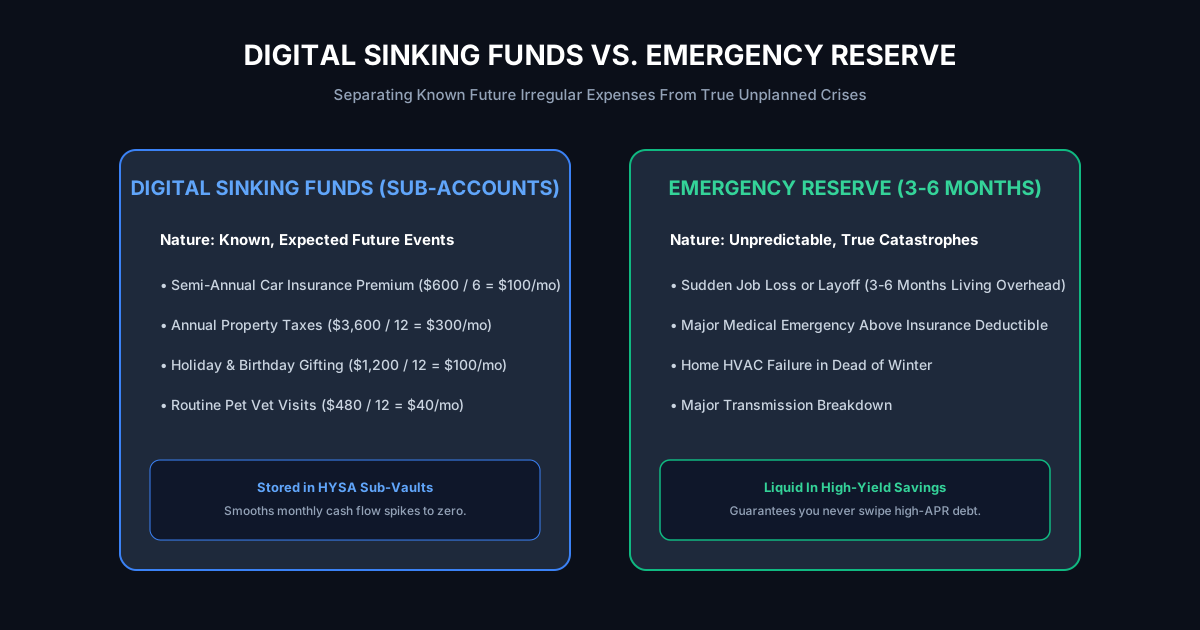 Figure 3: Demarcating sinking funds from emergency reserves. Sinking funds smooth predictable annual expenses, leaving your 3-6 month emergency fund intact.
The Sinking Fund Calculation Formula
$$ ext{Monthly Sinking Allocation} = rac{ ext{Anticipated Total Cost}}{ ext{Months Until Expense Occurs}}$$
| Sinking Fund Sub-Account | Target Annual Outlay | Monthly Allocation | Where Kept |
|---|---|---|---|
| Auto Maintenance & Tires | $1,200 / Year | $100 / Month | HYSA Sub-Vault |
| Semi-Annual Car Insurance | $900 / 6 Months | $150 / Month | HYSA Sub-Vault |
| Holiday & Family Gifting | $1,200 / 12 Months | $100 / Month | HYSA Sub-Vault |
| Annual Amazon & Tech Subs | $480 / 12 Months | $40 / Month | HYSA Sub-Vault |
| Pet Veterinary Care | $600 / 12 Months | $50 / Month | HYSA Sub-Vault |
Modern online institutions (such as Ally Bank, SoFi, or Capital One) offer built-in "Buckets" or "Vaults" inside a single High-Yield Savings Account. When the semi-annual $900 car insurance bill arrives, you pay it from the dedicated sub-account with zero impact on that month's take-home pay.
4. Zero-Based Budgeting for Irregular or Freelance Incomes
A frequent critique of zero-based budgeting is that it requires a predictable salary. However, freelance professionals, commission sales representatives, and gig economy operators can deploy the Baseline Buffer Model to execute ZBB flawlessly:
The Hill-and-Valley Account Setup
- Open a Dedicated Business/Holding Checking Account: All variable client payments and 1099 revenue deposit directly into this account.
- Calculate Your Baseline Survival Number: Calculate the minimum monthly cash required to fund Tiers 1, 2, and 3 (e.g., $4,200).
- Pay Yourself a Fixed W-2 Style Salary: On the 1st of every month, transfer exactly $4,200 from the Holding Account to your Personal Spending Checking Account. Run your zero-based budget against that exact $4,200.
- Accumulate During Surplus Months: In a great month where you bill $7,500, the excess $3,300 remains inside the Holding Account, building a cash reservoir.
- Draw Down During Lean Months: In a slow month where you bill only $2,800, the accumulated reservoir covers the difference, allowing you to transfer your full $4,200 salary without disruption.
5. Month-End Reconciliation and Cash Audits
Zero-based budgeting is a living discipline. A budget drafted on the 28th of the preceding month will rarely match reality down to the exact penny. Unplanned expenses happen, grocery prices fluctuate, and utility bills vary seasonally.
The key to sustainability is the Sunday 10-Minute Audit:
- Open your tracking portal or spreadsheet.
- Review transactions cleared over the prior seven days.
- Balance categories: If your grocery spend was $60 higher than planned, immediately subtract $60 from dining out or personal discretionary.
- The golden rule: You may adjust category balances freely throughout the month, provided the net outcome remains zero. You never add unassigned debt; you trade between categories.
6. Recommended Zero-Based Budgeting Tech Stack
You do not need expensive software to run a world-class zero-based budget. Select the tool that matches your operational preference:
1. You Need A Budget (YNAB)
The premier commercial application built strictly around zero-based budgeting principles ("Give Every Dollar a Job", "Embrace Your True Expenses", "Roll With the Punches", "Age Your Money"). Syncs automatically with banks, supports split transactions, and tracks sinking funds effortlessly.
2. EveryDollar
Developed specifically around the zero-based framework. Highly intuitive interface, excellent for beginners seeking rapid monthly setup.
3. Google Sheets / Excel Custom Ledger
For total privacy, zero subscription fees, and custom data control. A simple three-column sheet (Category, Budgeted, Actual) updated weekly provides 100% of the mathematical benefits of zero-based budgeting.
7. The Psychology of Financial Velocity
When retail spenders attempt restrictive budgeting diets, they inevitably rebel. Zero-based budgeting succeeds because it is not restrictive; it is intentional.
Under ZBB, you are not forbidden from spending $300 on an upscale dinner with friends. If dining out is a genuine priority, you allocate $300 to Tier 4 during your monthly planning session. When you swipe your card at the restaurant, there is zero financial guilt, because you know that your rent is funded, your Roth IRA is maxed, your car insurance sinking fund is accumulating, and your balance is mathematically in balance.
You trade anxiety for absolute clarity. Every dollar is working with purpose, driving your net worth forward with maximum financial velocity.
8. Behavioral Economics and the Friction Method
The fundamental flaw of modern consumer spending is the total elimination of transaction friction. Contactless payments, autofill credit card forms, and one-click purchasing disconnect the human brain from the emotional reality of spending capital.
Under Zero-Based Budgeting, we reintroduce intentional strategic friction:
- The 72-Hour Waiting Rule: For any non-essential purchase exceeding $100, enforce a mandatory 72-hour cooling-off period. If the item is truly a priority, you will allocate funds for it in next month's zero-based planning session. In over 80% of cases, the impulsive urge evaporates.
- The "Hours of Life" Conversion: When considering a discretionary expense, convert the price into hours of post-tax labor: $$ ext{Hours Worked} = rac{ ext{Item Cost}}{ ext{Net Hourly Wage}}$$ If you take home $30 per hour, a $300 designer jacket requires ten hours of your life sitting at a desk. Evaluating purchases through the lens of human mortality alters spending priorities instantly.
9. Zero-Based Cash Management for Couples: The Three-Account Architecture
Financial arguments are the leading cause of relationship stress. Most conflicts arise because partners operate out of a single mixed checking account with conflicting spending philosophies, or maintain entirely separate accounts with zero transparency.
The optimal zero-based framework for couples is the Joint Operational Waterfall (The Three-Account System):
- Account 1: Joint Operational Checking: Both partners deposit their income into this account. 100% of shared household overhead (rent/mortgage, utilities, groceries, childcare, sinking funds, and joint investments) is funded directly from this central hub.
- Account 2: Partner A Discretionary Vault: A fixed, equal dollar amount (e.g., $300/month) transfers automatically into Partner A's personal checking account.
- Account 3: Partner B Discretionary Vault: An identical $300/month transfers into Partner B's personal checking account.
The Freedom of Guilt-Free Autonomy
Inside their individual discretionary vaults, each partner enjoys 100% unilateral spending autonomy. If Partner A wants to buy video games or collectibles, Partner B has zero reason to complain, because all household obligations, investments, and emergencies are already funded in Account 1. This system eliminates financial friction while maintaining absolute household alignment.
10. The Annual Vendor Audit: Slashing Fixed Overhead
The easiest way to accelerate your zero-based savings rate is not cutting daily conveniences; it is renegotiating high-ticket recurring fixed overhead. Once per year, conduct an Annual Contract Audit:
| Overhead Category | Actionable Strategy | Average Annual Savings |
|---|---|---|
| Auto & Home Insurance | Shop independent brokers; bundle policies; increase deductibles from $500 to $1,000. | $450 - $900 / Year |
| Mobile Carrier Service | Switch from legacy carriers to Mobile Virtual Network Operators (MVNOs) like Mint Mobile or US Mobile running on identical towers. | $600 - $1,200 / Year |
| Home Internet | Call retention department; quote competing fiber or 5G home internet promotional rates. | $240 - $480 / Year |
| Streaming & Subscriptions | Audit credit card statements; cancel inactive software and unviewed services. | $300 - $600 / Year |
Executing this audit over a single weekend routinely recovers $1,500 to $3,000 in annual recurring cash flow, which is immediately channeled into Tier 2 wealth acceleration.
11. Frequently Asked Questions: Zero-Based Budgeting
Does Zero-Based Budgeting take hours of manual data entry every week?
Only during the first 30 days while you map your recurring bills and establish sinking fund baselines. Once your categories are set and recurring bills are automated, maintaining a zero-based budget requires only 10 to 15 minutes per week during your Sunday financial check-in.
What should I do when unexpected income arrives (such as a bonus or gift)?
Apply the zero-based rule immediately: every single dollar of that unexpected windfall must be allocated before it enters your primary spending stream. A balanced institutional formula is the 80/20 Windfall Rule: allocate 80% directly into wealth acceleration (extra debt payoff, index funds, or sinking reserves) and allocate 20% to guilt-free celebratory spending.
How does Zero-Based Budgeting differ from the 50/30/20 Budget?
The 50/30/20 rule is a high-level macro allocation guideline (50% needs, 30% wants, 20% savings). Zero-Based Budgeting is a micro-level operational execution system. In fact, the two systems complement each other: you can use 50/30/20 as your strategic target percentages while using zero-based allocation to manage every individual dollar within those buckets down to zero.
12. The Cash Flow Velocity Ratio: Measuring Your True Progress
Traditional personal finance focuses on net worth, but net worth can be distorted by home equity and volatile market valuations. Zero-based budgeters track their Cash Flow Velocity Ratio (CFVR): $$ ext{Cash Flow Velocity Ratio} = rac{ ext{Monthly Debt Payoff} + ext{Monthly Sinking Allocations} + ext{Monthly Investments}}{ ext{Total Monthly Net Take-Home Income}} imes 100$$
Benchmarking Your Velocity Tier:
- Baseline Tier (< 15%): Vulnerable cash flow. A single tire replacement or minor medical deductible destabilizes the monthly plan, forcing reliance on consumer debt.
- Velocity Tier (20% – 35%): Resilient financial foundation. Sinking funds absorb all routine life friction, while automated retirement contributions build sustained compound growth.
- Hyper-Velocity Tier (40%+ ): Financial independence accelerator. At a 40%+ velocity ratio, an individual accumulates one full year of living expenses for every fifteen months worked, achieving complete career autonomy within 10 to 12 years.
13. Case Study: Eliminating $18,000 in Consumer Debt in 14 Months
Consider a dual-income household earning a combined net take-home salary of $6,800 per month, carrying $18,000 in revolving credit card debt at an average 22.4% APR.
Before Zero-Based Budgeting:
- Fixed Overhead: $3,800
- Unbudgeted Discretionary Spends & Subscriptions: $1,600
- Credit Card Minimum Payments: $550 (with $336 lost to interest monthly)
- Savings/Investing: $850 (randomly deposited, often transferred back to cover bills)
- Net Result: Zero progress over two years; debt balance fluctuated between $17,000 and $19,000.
After Implementing Zero-Based Cash Waterfall:
- Fixed Overhead Streamlined: Renegotiated auto insurance, eliminated unused streaming tiers, reduced grocery waste through meal planning ($3,250 fixed).
- Controlled Discretionary Cap: Established $500 monthly personal cash allowances ($250 per partner).
- Sinking Fund Reserve: Allocated $400/month into an HYSA sub-vault for car and health maintenance.
- Targeted Debt Payoff Allocation: Every remaining dollar—exactly $2,650 per month—was assigned as a contractual obligation toward the highest-APR credit card balance.
- Outcome: The entire $18,000 debt balance was eliminated in 14 months, saving over $4,200 in interest charges and freeing up $2,650 per month in permanent investing capacity.
14. The Psychological Transition: From Scarcity Mindset to Sovereign Wealth
One of the least discussed dimensions of budgeting is the emotional transition from financial survival to long-term wealth stewardship. When individuals grow up in households characterized by financial insecurity, unallocated money triggers subconscious stress. They either hoard cash in 0.01% checking accounts out of fear or spend it rapidly before an unforeseen disaster claims it.
Zero-Based Budgeting rewires this neurological response through systematic structural certainty. Because every upcoming obligation—from your annual vehicle registration to your dental deductible—is pre-funded in cash vaults, your baseline stress drops to zero. You no longer view money through the prism of scarcity, but as a sovereign tool for personal liberty, career autonomy, and generational wealth creation.