0% APR Balance Transfer Cards: The Step-by-Step Playbook to Freeze and Eliminate Interest
An authoritative mathematical playbook on using 0% intro APR balance transfer credit cards to halt high-interest debt compounding, save thousands in fees, and accelerate total payoff velocity.
0% APR Balance Transfer Cards: The Step-by-Step Playbook to Freeze and Eliminate Interest
With average commercial credit card interest rates exceeding 24% APR nationwide, consumer debt compounding represents the single greatest wealth destroyer in personal finance. When high-interest revolving balances accumulate, more than half of each minimum monthly payment is consumed by finance charges, trapping borrowers in a mathematical treadmill that can take decades to escape.
The most potent financial weapon available to halt this compounding destruction is a 0% Intro APR Balance Transfer Credit Card. By transferring existing high-APR balances to an institution offering a 0% introductory promotion for 15 to 21 months, 100% of every payment is applied directly toward debt principal.
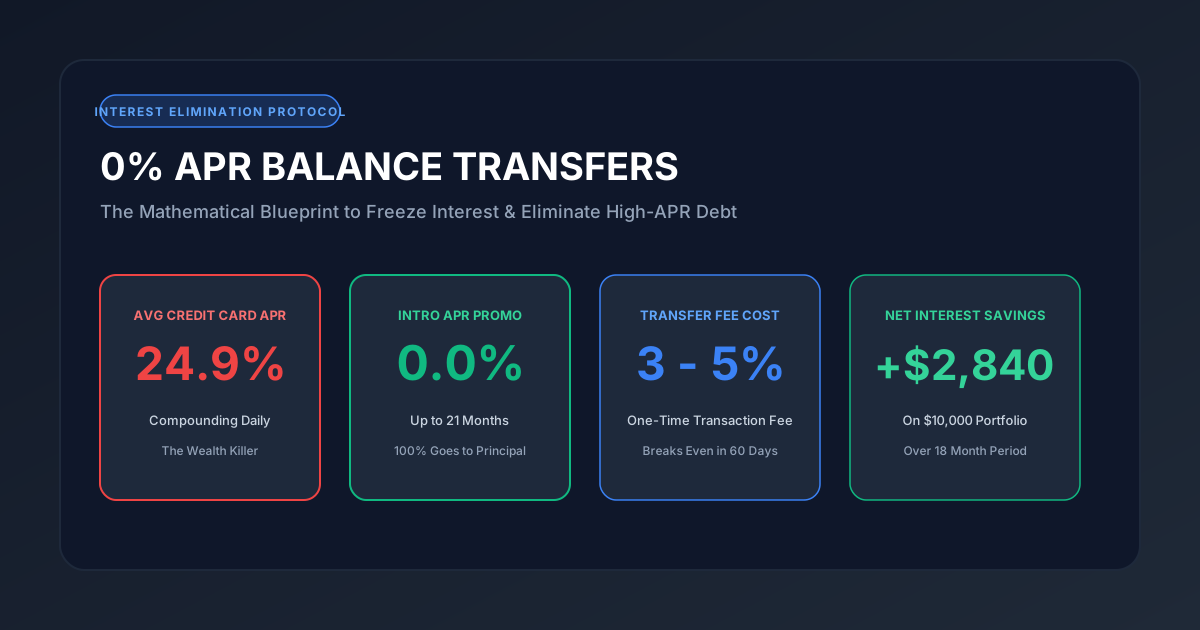
Figure 1: Core economic metrics of balance transfers. Freezing the interest clock across 15 to 21 promotional months redirects cash flow away from bank profits and directly toward balance elimination.
1. The Anatomy of Revolving Compound Interest
To appreciate the financial impact of a balance transfer, consider how credit card issuers calculate interest charges. Credit card interest compounds daily, utilizing the Average Daily Balance (ADB) formula: $$ ext{Daily Periodic Rate (DPR)} = rac{ ext{Annual Percentage Rate (APR)}}{365}$$ $$ ext{Monthly Finance Charge} = ext{Average Daily Balance} imes ext{DPR} imes ext{Billing Cycle Days}$$
At a standard commercial APR of 24.99%, the Daily Periodic Rate is roughly 0.06846%. On a $10,000 balance:
- The issuer assesses approximately $208.25 in pure interest every single month.
- If the borrower submits a minimum monthly payment of $250, only $41.75 reduces the actual debt. The remaining $208.25 is retained by the bank.
- At that rate, eliminating the $10,000 balance requires over 14 years and $12,400 in cumulative interest payments—more than doubling the original cost of purchases.
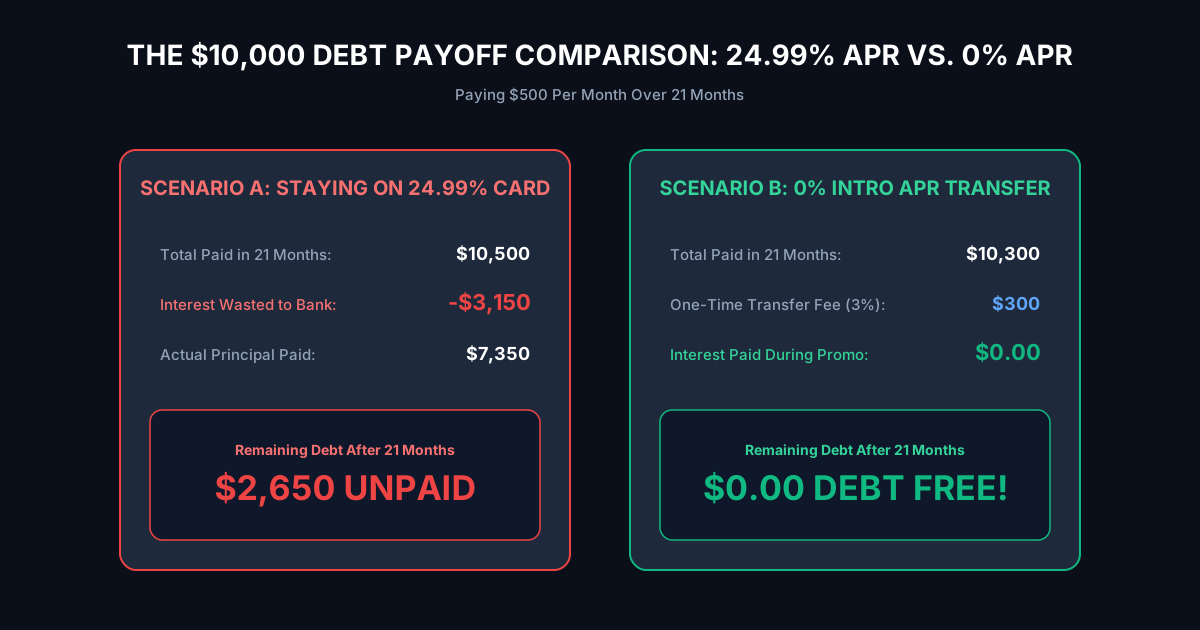 Figure 2: Comparing a $10,000 debt portfolio paid down at $500/month. The 0% balance transfer eliminates the balance entirely in 21 months while the standard card leaves $2,650 in unpaid principal.
2. The Balance Transfer Mechanism Explained
A balance transfer is a transaction where a new credit card issuer issues a payment directly to your existing creditors, consolidating the balances onto your new promotional card account.
The Trade-Off: Upfront Fee vs. Avoided Interest
In exchange for granting zero interest for 12 to 21 months, the issuing institution assesses a one-time Balance Transfer Fee, typically 3% to 5% of the total amount transferred ($30 to $50 per $1,000).
To determine whether a balance transfer is mathematically sound, apply the Break-Even Test: $$ ext{Break-Even Months} = rac{ ext{Transfer Fee Cost}}{ ext{Monthly Interest Incurred on Existing Card}}$$
Consider transferring a $10,000 balance incurring $208 per month in finance charges:
- Upfront 3% Fee: $300 (New starting balance becomes $10,300).
- Monthly Savings: $208 saved on avoided interest every month.
- Break-Even Point: $$300 div $208 = 1.44 ext{ months}$ (roughly 44 days).
 Figure 3: Timeline of fee recovery. A 3% upfront fee breaks even by Day 60; the subsequent 19 months deliver pure cash savings directly into your net worth.
After just 44 days, the fee is completely recovered. Over an 18-month promotional window, the borrower avoids over $3,400 in compound interest charges, yielding net savings of $3,100 after factoring in the upfront fee.
3. Strict Institutional Rules to Protect the 0% Promotion
While balance transfers deliver immense savings, card agreements contain contractual triggers that can terminate the promotion if violated. To execute this strategy safely, you must observe four non-negotiable rules:
Rule 1: The Same-Bank Transfer Prohibition
You cannot transfer balances between accounts issued by the same banking institution.
- Example: You cannot transfer a balance from a Chase Sapphire card to a Chase Slate Edge card, or from a Citi Double Cash to a Citi Simplicity.
- Solution: Always transfer cross-institutionally (e.g., from Chase to Citi, from Capital One to Wells Fargo, or from Discover to Bank of America).
Rule 2: Never Swipe the Transfer Card for New Purchases
The balance transfer card must be treated strictly as a passive debt-elimination vault. Do not make everyday purchases (groceries, gas, coffee) on the promotional card. While many cards offer 0% APR on new purchases as well, payment allocation laws (under the Credit CARD Act of 2009) dictate that payments above the minimum apply to higher-rate balances first. Mixing new purchases complicates accounting and risks forfeiting the promotional grace period.
Rule 3: Autopay the Minimum Payment Without Exception
Missing a single monthly due date—even by 24 hours—constitutes a contractual breach of the promotion. The issuer reserves the legal right to revoke the 0% APR immediately and apply the standard penalty APR (frequently 29.99%).
- Set up an automated recurring payment for the Statement Minimum Payment the day the card is activated.
- Manually pay additional principal weekly or bi-weekly via manual transfer.
Rule 4: Understand Deferred Interest vs. True 0% Intro APR
Always verify that the card offers True 0% Intro APR, not Deferred Interest.
- Deferred Interest (common on retail store credit cards): If a single dollar remains unpaid when the promotional period expires, the issuer retroactively assesses interest on the entire original balance from Day 1.
- True 0% Intro APR (standard on bank cards): If a balance remains after the intro period, the standard APR applies only to the remaining unpaid portion going forward. Never utilize deferred interest financing.
4. Top Institutional Balance Transfer Cards
When surveying the market, evaluate cards based on the length of the promotional period and the fee percentage:
| Credit Card | Intro 0% APR Duration | Balance Transfer Fee | Key Strategic Advantage |
|---|---|---|---|
| Citi Simplicity® Card | 21 Months | 3% ($5 min) in first 4 months, then 5% | Longest promotional payoff runway on the market; zero late fees. |
| Wells Fargo Reflect® Card | Up to 21 Months | 5% ($5 min) | Extended intro period with on-time payment extension features. |
| BankAmericard® Credit Card | 18 Months | 3% ($10 min) in first 60 days | Lower 3% transfer fee paired with solid 18-month duration. |
| Discover it® Balance Transfer | 18 Months | 3% intro fee, then 5% | Top-rated customer service portal; transparent fee disclosures. |
5. Step-by-Step Tactical Execution Workflow
Follow this precise protocol to ensure smooth execution from initial credit audit to final payoff:
Step 1: Check Your FICO Score Before Applying
Balance transfer cards require good to excellent credit (typically a FICO score of 670 or higher, with optimal terms unlocking at 720+). Review your credit report at AnnualCreditReport.com to ensure there are no erroneous collections or late marks depressing your score.
Step 2: Calculate the Exact Monthly Payoff Number
Divide your total debt plus the estimated transfer fee by the number of promotional months minus one (to create a 30-day margin of safety).
- Example: Transferring $9,000 on an 18-month card with a 3% fee ($270). $$ ext{Total Balance} = $9,270$$
$$ ext{Target Payoff Horizon} = 17 ext{ Months}$$ $$ ext{Required Monthly Payment} = rac{$9,270}{17} = $545.29/ ext{month}$$
Commit to paying that exact amount each month.
Step 3: Submit the Application and Balance Request
Apply through the card issuer's secure portal. Most applications include a field to enter balance transfer details immediately:
- Name of existing creditor (e.g., Capital One).
- 16-digit account number.
- Requested transfer amount.
Step 4: Continue Paying the Old Card Until Funds Clear
A balance transfer is not instantaneous; it typically takes 5 to 14 business days for the new bank to issue payment to the old bank.
- Continue making all scheduled minimum payments on the old card until you see a confirmed $0.00 balance.
- Once cleared, keep the old card open (with zero balance) to preserve your credit history length and overall utilization capacity.
6. What If the Approved Credit Limit Is Too Low?
Occasionally, an issuer approves an applicant for a $5,000 limit when they requested a $10,000 transfer. If this occurs:
- Execute the Partial Transfer: Transfer the maximum allowed balance up to roughly 90% of the new credit limit. Freezing 50% of your high-interest debt is infinitely better than freezing 0%.
- Deploy the Debt Avalanche on the Remainder: Focus every excess dollar of cash flow toward aggressively attacking the remaining balance on the original card, while paying the minimum on the 0% card.
- Request a Credit Limit Reallocation: If you hold an existing card with the same new issuer, call customer service and ask to transfer credit line from your secondary card to your new promotional card.
7. The Post-Transfer Wealth Acceleration Pivot
The greatest danger of a balance transfer is behavioral relapse. When an individual sees $0 balances on their old credit cards, the human brain perceives financial relief and risks swiping those cards again, resulting in double the debt.
To ensure permanent financial independence:
- Physically lock away or freeze old cards: Remove saved card credentials from Apple Pay, Google Wallet, Amazon, and online stores.
- Automate the debt payoff schedule: Ensure the monthly transfer clears on payday before discretionary spending occurs.
- Transition to investing the moment the debt hits zero: Once Month 18 concludes and your balance is $0, immediately redirect that $545 monthly payment into a broad-market index fund (VOO or VTI) or High-Yield Savings Account.
By repurposing your cash flow velocity from paying interest to compounding wealth, you transform a former financial vulnerability into an automated wealth-building engine.
8. Credit Score Dynamics: Utilization Ratios and Inquiry Impact
Executing a balance transfer triggers short-term fluctuations in your FICO scoring profile. Understanding the mathematical weighting prevents unnecessary anxiety:
The Credit Utilization Benefit
Credit utilization accounts for 30% of your total FICO credit score. When you open a new balance transfer card with a $10,000 credit limit:
- Your total available credit across all cards increases.
- If you had $8,000 in debt across $16,000 in total limits (50% utilization), adding a new $10,000 limit expands your total ceiling to $26,000.
- Your aggregate revolving utilization instantly drops from 50.0% to 30.7%, which frequently boosts your FICO score by 15 to 35 points within 60 days.
The Hard Inquiry Factor
Applying for a new card generates a single hard inquiry (credit pull), which accounts for 10% of your score under "New Credit". A single inquiry typically causes a temporary dip of 3 to 5 points, which fully recovers within three to six months of on-time payments. The massive mathematical benefit of interest elimination far outweighs a minor, short-term credit score blip.
9. Contractual Fine Print: Traps Inside the Cardholder Agreement
Before submitting an application, locate the Schumer Box on the issuer's website. Review these three clauses carefully:
1. The Promotional Balance Transfer Deadline
Most issuers do not grant the 0% rate indefinitely. You must initiate all balance transfers within a strict window—typically the first 60 to 120 days from account opening. Transfers requested on Day 121 are assessed standard interest rates and fees.
2. Penalty APR Triggers
Under the card agreement, defaulting on minimum payments allows the bank to elevate your rate to the Penalty APR (typically 29.99%). Furthermore, this penalty rate can remain in effect indefinitely until you demonstrate six consecutive months of on-time payments.
3. Grace Period Mechanics on Purchases
If you carry a balance transfer on your card, you generally lose the standard 21-day interest-free grace period on any new retail purchases unless the card specifically includes a matching 0% intro APR on purchases. This is why keeping the card strictly for the transferred balance is essential.
10. Alternative Debt Payoff Vehicles: Consolidation Loans vs. 401(k) Loans
Borrowers should evaluate whether an intro APR card is superior to competing debt-relief options:
Fixed-Rate Personal Consolidation Loans
- Structure: Unsecured fixed-term loan (typically 36 to 60 months) with fixed monthly payments.
- Interest Rates: Typically 8% to 15% APR for prime borrowers.
- When to Use: If your total debt is greater than $25,000 or your credit score is below 660, making it impossible to qualify for a balance transfer limit large enough to cover the balance.
401(k) Retirement Loans
Borrowing against your employer retirement account allows you to pay interest back to yourself. However, it carries catastrophic downside risks:
- If you leave your employer or are laid off, the entire outstanding balance is often due within 60 to 90 days.
- Failure to repay triggers income tax and a 10% early withdrawal penalty.
- Taking money out of the market permanently stunts long-term compound growth.
A 0% balance transfer card is vastly superior because it carries zero interest and zero retirement exposure.
11. Frequently Asked Questions: Balance Transfer Execution
Can I transfer debt from a personal loan or auto loan to a balance transfer card?
Most credit card balance transfers are intended strictly for revolving credit card debt from other card issuers. However, select institutions (such as Discover and certain federal credit unions) issue "Convenience Checks" linked to your 0% promotional APR. You can deposit these checks directly into your checking account to pay off personal loans, medical debt, or auto financing. Be aware that convenience checks carry the same 3% to 5% transfer fee.
What should I do with my old credit cards once the balance is paid off?
Do not close the old accounts. Closing old credit cards lowers your total available credit limit and shortens your average age of accounts (which comprises 15% of your FICO score). Keep the cards open with a zero balance. Place a recurring $5 monthly utility or streaming subscription on the card with autopay enabled to prevent the bank from closing the account due to inactivity.
Can I do multiple balance transfers onto the same card?
Yes, provided the cumulative sum of the transferred balances plus the transfer fees does not exceed your approved credit limit. For example, if you are approved for an $8,000 credit limit, you can transfer $3,000 from Bank A and $4,000 from Bank B, paying a separate 3% fee on each transaction.
12. Strategic Balance Transfer Stacking: Multi-Card Debt Workouts
When an individual carries a substantial debt burden—such as $35,000 across multiple high-rate retail and bank cards—a single balance transfer card will rarely provide a credit limit sufficient to absorb the entire portfolio. In these scenarios, financial planners deploy Strategic Multi-Card Balance Stacking.
The Staggered 60-Day Application Protocol
Issuers evaluate debt-to-income (DTI) and recent credit inquiries when determining credit line limits. Submitting four applications simultaneously triggers multiple hard inquiries that can cause automatic declines. Instead, execute applications sequentially:
- Week 1 (Primary High-Limit Card): Apply for the longest-duration card (e.g., Citi Simplicity or Wells Fargo Reflect) while your credit profile is cleanest. Request maximum transfer up to the approved limit.
- Week 4 (Secondary Tier Card): After the first transfer completes and begins reporting to the credit bureaus, apply for a secondary institution (e.g., Discover it or BankAmericard). Because aggregate revolving utilization on the first card has lowered the overall portfolio pressure, secondary approval odds remain favorable.
- The Consolidation Cascade: By splitting $35,000 across two cards offering 18 to 21-month promotional windows, the total monthly finance charge drops from over $700 per month down to $0.00, allowing every available dollar of monthly savings to aggressively eliminate the debt balances before any promotion expires.
Emergency Contingency: The Step-Down Transfer
If Month 18 approaches and an unexpected medical emergency or job disruption leaves $3,000 in unpaid promotional balance:
- Do not let the card reprice to standard 24.99% APR.
- Apply for a secondary balance transfer card 60 days before expiration.
- Execute a "Step-Down Transfer" moving the remaining $3,000 onto a fresh 12 to 15-month 0% card. While paying a 3% fee ($90) is required, it insulates you completely from thousands in renewed interest charges.