Roth IRA vs. 401(k): Which Retirement Account Should You Fund First?
Compare the tax advantages of a Roth IRA and a Traditional 401(k). Learn the mathematical priority order for contributions, income limits, and early withdrawal rules.
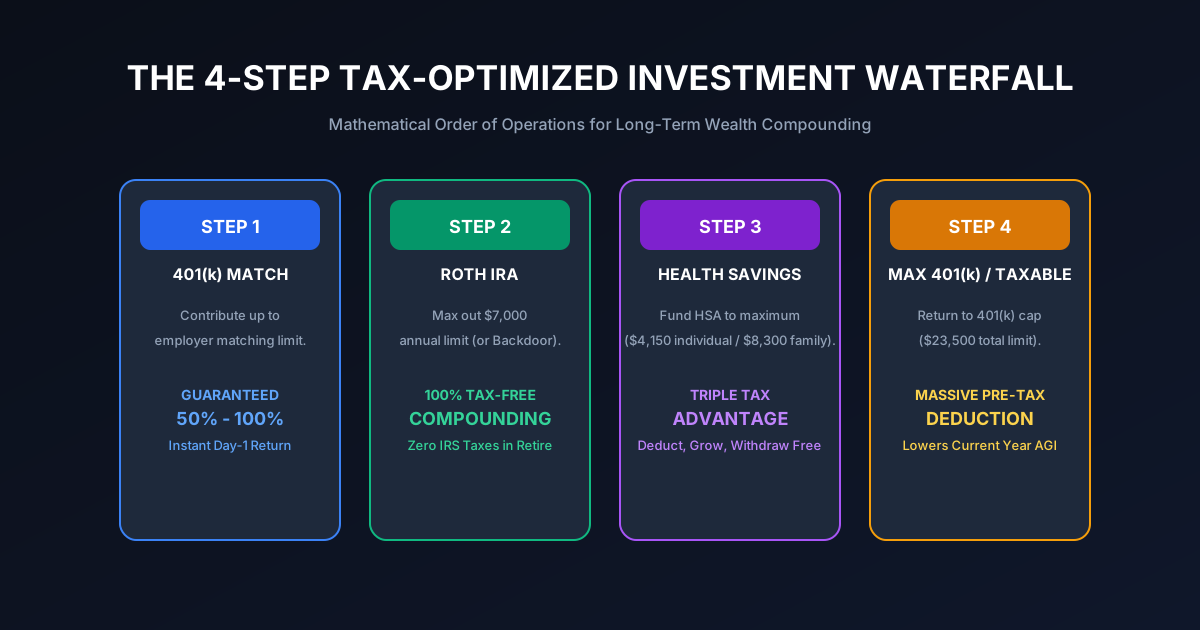
When building generational wealth, the vehicles you choose to house your investments matter almost as much as the investments themselves. Two individuals investing identical amounts in the exact same index fund over 30 years can experience an after-tax wealth differential of more than $400,000, solely due to the tax sheltering efficiency of their accounts.
The two foundational pillars of American retirement architecture are the employer-sponsored 401(k) and the individual Roth IRA. Yet among savers, the most persistent dilemma remains:
"Should my next dollar go into my company 401(k) to lower my taxes today, or into a Roth IRA to lock in 100% tax-free growth forever?"
The answer is rarely an "either/or" choice. Sophisticated investors execute a strategic, mathematical Investment Waterfall that captures 100% employer matching dollars, optimizes marginal tax brackets, exploits the Backdoor Roth mechanism, and preserves liquidity for life events.
Below, we break down the statutory legal frameworks, updated 2026 IRS contribution thresholds, the pro-rata tax rule, early withdrawal escape hatches, and the exact step-by-step waterfall to maximize your compound returns.
1. Architectural Anatomy: Traditional 401(k) vs. Roth IRA
To understand which account to prioritize, you must understand how the Internal Revenue Service (IRS) taxes capital at three distinct chronological points: Contribution, Compounding, and Distribution.
Tax Treatment Across Account Lifecycles:
┌─────────────────────┬───────────────────────┬────────────────────────┐
│ Stage               │ Traditional 401(k)    │ Roth IRA               │
├─────────────────────┼───────────────────────┼────────────────────────┤
│ 1. Contribution     │ PRE-TAX (Tax Break Now│ POST-TAX (No Deduction)│
│ 2. Compounding      │ TAX-DEFERRED          │ 100% TAX-FREE          │
│ 3. Distribution     │ TAXED as Ordinary Inc │ 100% TAX-FREE FOREVER  │
└─────────────────────┴───────────────────────┴────────────────────────┘
The Traditional 401(k) (IRC § 401(k))
- Contribution Mechanism: Dollars are deducted directly from your gross paycheck before federal, state, or local income taxes are calculated.
- Immediate Benefit: Lowers your current adjusted gross income (AGI) dollar-for-dollar. If you earn $100,000 and contribute $15,000, you are taxed as if you earned $85,000.
- The Future Tax Liability: When you withdraw funds in retirement (after age 59½), every dollar withdrawn—both your original principal and all accumulated compound growth—is taxed at your future ordinary income tax bracket.
The Roth IRA (IRC § 408A)
- Contribution Mechanism: Dollars are contributed after you have paid standard income taxes on your paycheck.
- Immediate Benefit: None. You receive zero tax deductions in the year of contribution.
- The Lifetime Compounding Superpower: Every single cent of capital gains, dividends, and interest compounds 100% tax-free forever. When you withdraw funds in retirement, you pay zero dollars to the IRS.
2. Updated 2026 Contribution Caps & Income Restrictions
Every autumn, the IRS issues cost-of-living adjustments for retirement plans under Internal Revenue Code Section 415. The benchmarks for the current tax year:
| Feature | Employer 401(k) Plan | Roth IRA |
|---|---|---|
| Annual Elective Deferral Limit | $23,500 ($31,000 if age 50+) | $7,000 ($8,000 if age 50+) |
| Combined Additions Limit (415c) | $69,000 (Employee + Employer Match) | N/A (Individual Limit Only) |
| Income Restrictions (MAGI) | None (Earners at any level qualify) | Phase-out applies above threshold |
| Single Filer Phase-Out Window | No Income Ceiling | $146,000 to $161,000 MAGI |
| Married Joint Phase-Out Window | No Income Ceiling | $230,000 to $240,000 MAGI |
| Investment Menu Variety | Limited to Employer Plan Menu | Unlimited (Any ETF, stock, index fund) |
The High-Earner Reality: If your Modified Adjusted Gross Income (MAGI) exceeds the phase-out limit, you are legally prohibited from making direct contributions to a Roth IRA. However, high earners can legally bypass this restriction using the Backdoor Roth IRA technique detailed in Section 5.
3. The 4-Step Investment Waterfall: Mathematical Priority Order
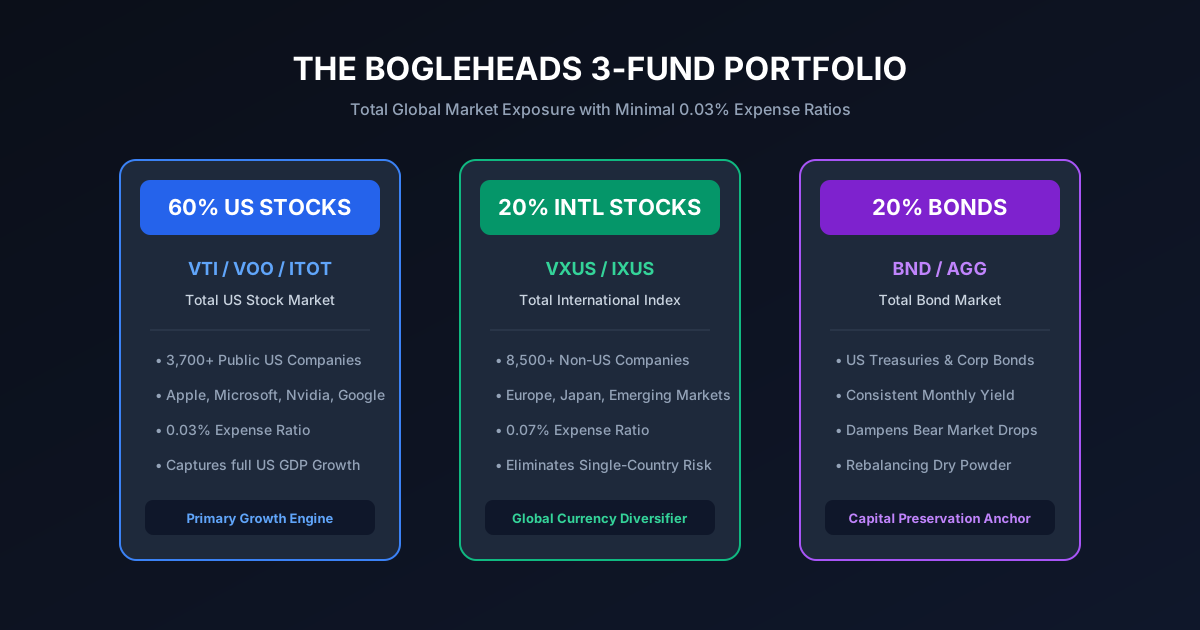 Figure 1: Asset location optimization: Housing high-growth equity index funds inside a Roth IRA eliminates 100% of future capital gains taxes across decades of compounding.
Never guess where your next dollar should go. Execute this proven 4-step sequence:
flowchart TD
    Step1["Step 1: 401(k) Up to Employer Match (Free 100% Instant Return)"] --> Step2["Step 2: Max Out Roth IRA ($7,000 Cap via Direct or Backdoor)"]
    Step2 --> Step3["Step 3: Max Out Health Savings Account - HSA (Triple Tax Advantage)"]
    Step3 --> Step4["Step 4: Return to 401(k) to Max Out Remaining Cap ($23,500 Total)"]
Step 1: Capture 100% of Your Employer 401(k) Match
If your employer offers a matching contribution (e.g., matching 50% of your contributions up to 6% of your salary, or a dollar-for-dollar match up to 4%), this is an instant, guaranteed 50% to 100% return on capital.
There is no investment in the global capital markets that guarantees a risk-free 50% to 100% return on day one. Failing to contribute enough to capture the full company match is literally leaving earned compensation on the table.
Step 2: Max Out Your Roth IRA ($7,000 Annual Cap)
Once you have captured every cent of the employer match, pause further 401(k) contributions and direct your next dollars into a Roth IRA.
Why the Roth IRA Takes Priority Over Surplus 401(k) Dollars:
- Fee Compression: Typical employer 401(k) plans carry administrative recordkeeping fees and lock you into mutual funds with expense ratios of 0.30% to 0.85%. A self-directed Roth IRA at Vanguard, Fidelity, or Schwab gives you access to broad-market index ETFs like VOO or VTI at a near-zero 0.03% expense ratio.
- Tax-Free Compounding & Hedging: Funding a Roth IRA creates tax diversification, ensuring you have a tax-free pool of capital to draw upon in retirement, protecting you against future statutory income tax hikes.
- Liquidity Flexibility: Unlike a 401(k), the IRS allows you to withdraw your original Roth IRA principal contributions at any time, for any reason, with zero taxes and zero penalties.
Step 3: Max Out a Health Savings Account (HSA)
If you are enrolled in a qualifying High-Deductible Health Plan (HDHP), fund your Health Savings Account (HSA) up to the annual limit ($4,150 for individuals, $8,300 for families).
The HSA is the only financial vehicle in the Internal Revenue Code featuring a Triple Tax Advantage:
- Contributions are 100% tax-deductible (pre-tax).
- Growth, dividends, and interest compound 100% tax-free.
- Withdrawals for qualified medical expenses are 100% tax-free at any age.
- Bonus: After age 65, you can withdraw funds for non-medical expenses subject only to ordinary income tax, functioning identically to a Traditional 401(k).
Step 4: Return to Your 401(k) to Max Out the Full Limit
If you have maxed out your Roth IRA and HSA and still possess surplus savings, return to your employer 401(k) and ramp up contributions until you hit the maximum annual elective deferral limit ($23,500).
4. Traditional vs. Roth: The Marginal Tax Bracket Decision Matrix
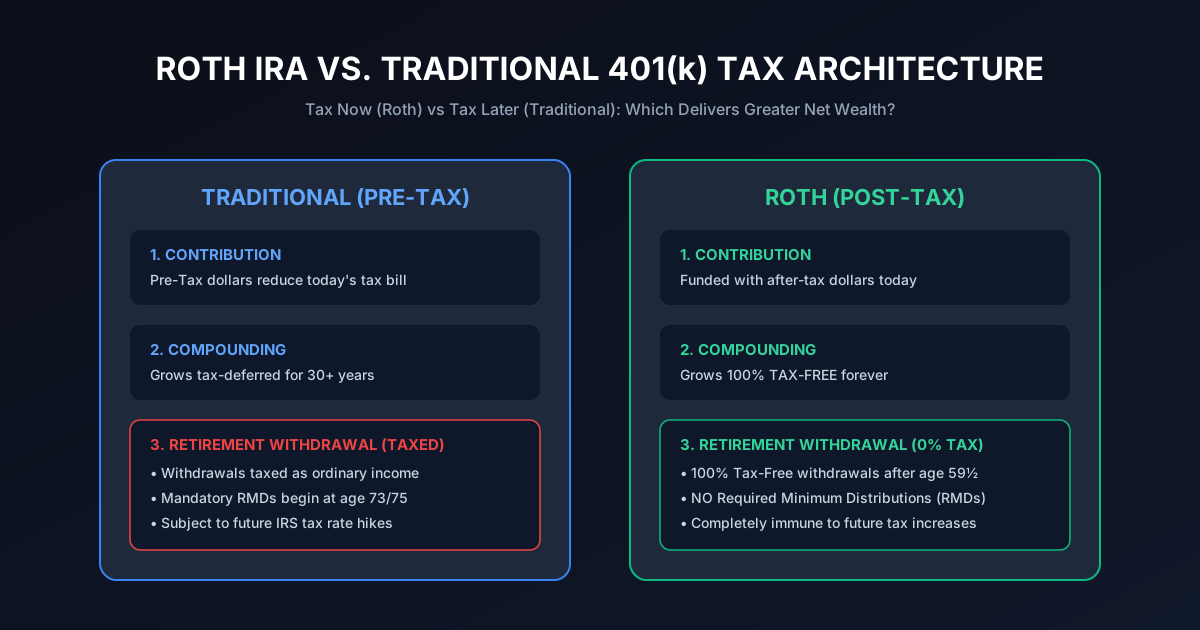 Figure 2: Traditional Pre-Tax vs. Roth Post-Tax mechanisms: evaluating current tax rates versus expected retirement tax brackets to maximize lifetime after-tax purchasing power.
A common question is: Should I make Traditional (pre-tax) or Roth contributions inside my 401(k)?
The decision hinges on a comparison between your Current Marginal Tax Rate today versus your Expected Effective Tax Rate in retirement:
$$\text{Decision Rule: If Current Marginal Tax Rate} > \text{Future Retirement Tax Rate} \implies \text{Traditional (Pre-Tax)}$$ $$\text{Decision Rule: If Current Marginal Tax Rate} < \text{Future Retirement Tax Rate} \implies \text{Roth (Post-Tax)}$$
| Income & Career Phase | Federal Bracket | Recommended 401(k) Strategy | Primary Rationale |
|---|---|---|---|
| Early Career / Entry Level | 10% to 12% Bracket | 100% Roth 401(k) | Taxes will likely never be lower in your lifetime. Lock in 0% future taxes. |
| Mid-Career / Moderate Earner | 22% to 24% Bracket | Balanced Split (50/50) | Captures moderate current deductions while accumulating tax-free Roth buckets. |
| Peak Earning Years / High Earner | 32%, 35%, 37% Bracket | 100% Traditional 401(k) | Massive tax deduction today (saving $0.32 to $0.37 on every dollar contributed). |
5. Advanced Strategy: The Backdoor Roth IRA & The Pro-Rata Trap
If your income exceeds the IRS income phase-out thresholds ($161,000 single / $240,000 married), you cannot contribute directly to a Roth IRA. High earners utilize the Backdoor Roth IRA:
The 2-Step Backdoor Mechanism
- Make a non-deductible contribution of up to $7,000 into a Traditional IRA (there are no income limits on non-deductible Traditional IRA contributions).
- As soon as the deposit clears (within 1 to 2 business days), execute a Roth Conversion inside your brokerage dashboard, converting the non-deductible Traditional IRA funds into your Roth IRA.
- Because the contribution was made with after-tax dollars and converted before generating investment gains, the conversion incurs $0 in taxes.
flowchart LR
    A["After-Tax Cash ($7,000)"] --> B["Traditional IRA (Non-Deductible Contribution)"]
    B -->|"Immediate Conversion (Form 8606)"| C["Roth IRA (100% Tax-Free Forever)"]
The Pro-Rata Rule Trap (IRC § 408(d)(2))
Before executing a Backdoor Roth, you must check for existing pre-tax balances in any Traditional IRA, SEP IRA, or SIMPLE IRA:
- The IRS views all your non-Roth IRAs as a single collective pool.
- If you hold $63,000 in existing pre-tax Traditional IRA rollover balances and contribute $7,000 in non-deductible cash to do a Backdoor Roth, your total IRA balance is $70,000.
- Your after-tax basis is only 10% ($7,000 / $70,000).
- Under the Pro-Rata rule, 90% of your conversion will be subject to ordinary income taxes, triggering a surprise tax bill.
The Pro-Rata Solution: If you have existing pre-tax Traditional IRA balances, execute a Reverse Rollover to roll those funds into your current employer 401(k) plan. Employer 401(k) balances are completely excluded from the IRA pro-rata calculation, clearing the runway for clean, tax-free Backdoor Roth conversions.
6. Early Withdrawal Mechanics: The Roth Flexibility Advantage
One of the greatest fears among young investors is that retirement accounts lock their capital up until age 59½. Understanding early withdrawal rules dispels this myth:
Roth IRA Contribution Liquidity
The IRS operates under strict ordering rules for Roth IRA distributions (IRC § 408A(d)(4)):
- Regular Contributions are always distributed first.
- Conversions are distributed second (subject to a 5-year aging clock).
- Earnings / Growth are distributed last.
Because you have already paid taxes on your original contributions, you can withdraw your regular contributions at any time, at any age, for any reason, 100% tax-free and penalty-free. If you contribute $7,000 per year for five years ($35,000 total) and your account grows to $50,000, you can withdraw up to $35,000 tomorrow without paying a penny in taxes or penalties.
The 401(k) "Rule of 55"
Under Internal Revenue Code Section 72(t)(2)(A)(v), if you leave or separate from your employer during or after the calendar year in which you turn age 55, you can begin taking penalty-free distributions from that specific employer's 401(k) plan immediately, without waiting until age 59½.
7. The Two Roth IRA 5-Year Rules Decoded
The IRS enforces two distinct "5-Year Rules" that investors frequently confuse:
1. The 5-Year Rule for Earnings Distributions
To withdraw investment earnings/growth from a Roth IRA completely tax- and penalty-free, two criteria must be satisfied:
- You must be at least age 59½ (or qualify for a statutory exemption like disability or first-time home purchase).
- It must be at least 5 taxable years since January 1 of the tax year in which you made your very first contribution to any Roth IRA.
- Strategy: Open a Roth IRA today with even a tiny $10 deposit. This officially starts your 5-year clock ticking immediately, qualifying your future distributions.
2. The 5-Year Rule for Conversions (Backdoor Roth)
Each individual conversion from a Traditional IRA to a Roth IRA carries its own independent 5-year clock:
- If you convert $7,000 in 2026, that specific $7,000 converted principal must remain in the account for 5 tax years before it can be withdrawn penalty-free prior to age 59½.
- If withdrawn before the 5 years elapse, the IRS assesses a 10% early withdrawal penalty on the converted taxable amount.
8. Real-World Case Studies: Mathematical Execution
 Figure 3: Long-term projection of $7,000 annual Roth IRA contributions compounded at 8% real returns, accumulating over $850,000 completely free of federal and state taxes.
Case Study A: Sarah (Age 26, Salary $65,000, 22% Federal Bracket)
- Employer Match: 50% match up to 6% of salary ($1,950 free company money on $3,900 contributed).
- Strategy:
- Contributes 6% ($3,900/yr) to Employer 401(k) to capture the full $1,950 match (Immediate 50% return).
- Directs next $7,000/yr into a self-directed Roth IRA (VOO/VTI index funds).
- Residual savings of $1,500 placed into a High-Yield Savings Account.
- Outcome at Age 60: Assuming an 8% historical return, Sarah accumulates $1.8+ million, with over $1.1 million 100% tax-free in her Roth IRA.
Case Study B: David & Elena (Married Age 42, Household Income $285,000)
- Challenge: Income exceeds direct Roth IRA limits ($240,000 MAGI ceiling). High current federal tax bracket (24% to 32%).
- Strategy:
- Both maximize Traditional 401(k) plans ($23,500 × 2 = $47,000 total pre-tax deferral).
- This reduces their taxable household income from $285,000 down to $238,000, saving over $12,000 in immediate federal taxes.
- Execute Backdoor Roth IRAs ($7,000 × 2 = $14,000/yr) using Form 8606 after rolling old IRAs into 401(k) plans to eliminate pro-rata exposure.
- Outcome: Captures immediate maximum tax relief today while funneling $14,000 annually into permanent tax-free compounding.
9. RMD Rules Under the SECURE 2.0 Act
A final critical advantage of the Roth IRA involves Required Minimum Distributions (RMDs):
- Traditional 401(k) and Traditional IRA: Under the SECURE 2.0 Act, the IRS mandates that you must begin withdrawing minimum taxable distributions from pre-tax accounts starting at age 73 (increasing to age 75 in 2033). These mandatory distributions can push retirees into higher tax brackets and trigger higher Medicare Part B/D premiums (IRMAA surcharges).
- Roth IRA: Roth IRAs have zero Required Minimum Distributions during the owner's lifetime. You can leave 100% of your capital compounding tax-free until death and pass the entire tax-free asset to your heirs.
The Roth Conversion Ladder: Early Retirement Financial Engineering
For FIRE (Financial Independence, Retire Early) practitioners seeking to retire before age 59½, the Roth IRA is not merely an investment bucket; it is a liquidity bridge. The Internal Revenue Code imposes a 10% early withdrawal penalty on traditional pre-tax retirement accounts accessed before age 59½. However, savvy investors utilize the "Roth Conversion Ladder" strategy to access pre-tax 401(k) wealth completely penalty-free years ahead of statutory retirement age.
The mechanics of the ladder operate as follows: Upon leaving an employer, the individual rolls their Traditional 401(k) into a Traditional IRA. Each year during early retirement (when earned income is near zero and the individual sits in the lowest 10% or 12% marginal federal tax bracket), they convert a portion of the Traditional IRA balance—say $45,000—into a Roth IRA. The converted amount is treated as ordinary taxable income for that calendar year, incurring minimal tax. Exactly five years after each conversion takes place (under the 5-Year Conversion Rule), that specific principal tranche becomes available for withdrawal 100% tax-free and 100% penalty-free, regardless of the investor's chronological age. By executing consecutive annual conversions, the early retiree establishes a continuous annual pipeline of penalty-free liquidity to fund living expenses decades before age 59½.
Asset Location Optimization: Where to Hold Equities vs. Fixed Income
Maximizing terminal after-tax wealth requires understanding not just asset allocation (what percentage to invest in stocks vs. bonds), but asset location (which legal account wrapper holds each specific asset class). Because Roth IRA withdrawals in retirement are 100% tax-exempt, the mathematical imperative is to populate the Roth IRA with the highest expected-return assets in your total portfolio.
Holding low-yield bonds or fixed-income assets inside a Roth IRA squanders its most valuable attribute: tax-free compounding. If an aggressive total stock market index fund compounds at 9% annually over 30 years inside a Roth IRA, every dollar of that massive capital gain escapes taxation forever. Conversely, high-turnover bond funds, REITs, or interest-bearing assets that throw off ordinary income should be housed within pre-tax Traditional 401(k)s or tax-deferred accounts where ordinary income tax was already going to be levied upon eventual distribution. Aligning aggressive growth equities with Roth accounts is the single most mathematically effective tax arbitrage available to retail investors.
10. Comprehensive Frequently Asked Questions (FAQ)
Can I have both a 401(k) and a Roth IRA simultaneously?
Yes. You can fully fund an employer 401(k) up to $23,500 while simultaneously maxing out a Roth IRA up to $7,000 in the same calendar year, maximizing both pre-tax and post-tax compound growth.
What is the "Mega-Backdoor Roth"?
The Mega-Backdoor Roth is an advanced strategy available in select corporate 401(k) plans (such as Google, Microsoft, and Amazon) that allow after-tax non-Roth contributions up to the full Section 415(c) limit ($69,000) combined with in-plan Roth conversions, allowing high earners to shelter an additional $30,000 to $40,000+ in tax-free Roth accounts annually.
What happens to my 401(k) when I leave my job?
When you separate from an employer, you have four choices:
- Leave the balance in your former employer's plan (if permitted).
- Roll the balance into your new employer's 401(k) plan.
- Roll the balance into a self-directed Rollover IRA at Vanguard, Fidelity, or Schwab (provides broader investment choices and lower fees).
- Liquidate the account (not recommended due to immediate 10% penalty plus ordinary income taxes).