7 Realistic Side Hustles to Make $1,000 to $3,000 a Month
High-margin side business models you can launch alongside your full-time job. Includes client acquisition tactics, service pricing formulas, and self-employment tax tips.
The internet is flooded with generic "side hustle" guides recommending that you fill out online surveys for $1.50 per hour or deliver fast food in your personal vehicle. These recommendations reflect a fundamental misunderstanding of financial economics.
Delivering food or driving rideshare trades your irreplaceable time and vehicle equity for low hourly wages. When you factor in accelerated automobile depreciation, commercial auto insurance riders, maintenance (tires, brakes, oil), fuel costs, and mandatory 15.3% Self-Employment (FICA) taxes, the true net hourly return of food delivery frequently collapses below federal minimum wage.
To generate an extra $1,000 to $3,000 every single month without working 40 extra hours per week, you must build high-leverage ventures characterized by pricing power, low upfront capital, high gross margins, and scalability.
Below, we break down the practical economics of economic leverage, 7 vetted solo business models operating in 2026, client acquisition funnels, and the critical tax deductions that allow solopreneurs to keep more of what they earn.
1. The Mathematics of Side Hustle Leverage
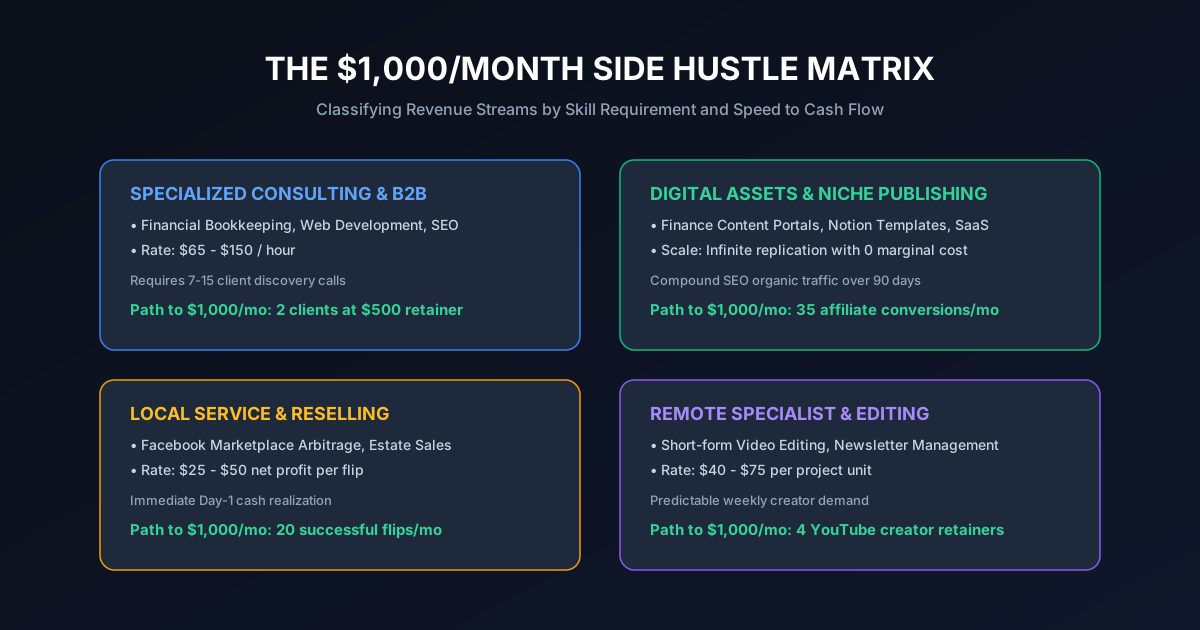
Figure 1: Strategic evaluation matrix evaluating side hustle models by technical skill barriers, speed to first dollar, and gross margin profit retention.
To earn $1,000 per month, evaluate the unit economics of your business model:
$$\text{Monthly Revenue Target} = $1,000 = \text{Price per Unit} \times \text{Volume}$$
- Low-Leverage Approach (Rideshare/Delivery): Requires 100 orders at $10 profit each $\implies$ Demands 50 to 80 hours of physical labor.
- Medium-Leverage Approach (Freelance Services): Requires 4 clients paying a $250 monthly retainer $\implies$ Demands 8 to 10 hours of remote work.
- High-Leverage Approach (Specialized Digital Systems): Requires 1 client paying $1,000 for an automated workflow setup, or 22 sales of a $47 digital asset with zero marginal cost of reproduction.
flowchart LR
    Low["Low Leverage (Gigs)"] -->|"100 Tasks @ $10"| M1["$1,000 (80 Hours of Exhaustion)"]
    High["High Leverage (B2B Retainers)"] -->|"4 Clients @ $250/mo"| M2["$1,000 (8 Hours of Strategic Work)"]
Targeting B2B (Business-to-Business) clients or specialized technical niches allows you to escape commodity pricing and capture premium hourly returns.
2. Model 1: Local B2B Workflow & AI Automation Consulting
The Core Problem
Small business owners (such as plumbing contractors, accountants, dental clinics, and roofers) are overwhelmed by administrative chaos. They miss customer phone calls after 5:00 PM, fail to follow up on web form leads, and spend hours manually typing customer data into QuickBooks.
The Solution You Provide
Build automated workflows using zero-code tools like Make.com or Zapier:
- When a homeowner submits a quote request on a contractor's website, an automated SMS confirmation is immediately sent to the lead within 60 seconds.
- The lead's contact information is automatically populated into a Google Sheets CRM.
- An automated reminder alert is sent to the business owner's mobile device.
The Pricing Math:
- One-Time Setup Fee: $500 to $1,000 per business.
- Ongoing Maintenance Retainer: $150 to $250 per month (includes minor adjustments and API monitoring).
- To Hit $1,000/Month: Secure just 4 small business clients on a $250/month maintenance retainer.
3. Model 2: Remote Bookkeeping & Financial Reporting
The Core Problem
Independent contractors, digital creators, and small eCommerce store owners dread bookkeeping. Come tax season, their financial records are an unorganized mess of personal and business bank statements, resulting in massive tax preparation fees and missed deductions.
The Solution You Provide
You do not need to be a Certified Public Accountant (CPA) to perform baseline monthly reconciliation. Complete the free online certification for QuickBooks Online or Xero:
- Categorize monthly bank and credit card transactions.
- Reconcile account balances at month-end.
- Generate three clean PDF financial statements for the business owner: Balance Sheet, Profit & Loss (P&L), and Cash Flow Statement.
The Pricing Math:
- Monthly Retainer: $300 to $500 per month for small businesses with under 150 monthly transactions (typically requires 2 to 3 hours of work per client each month).
- To Hit $1,000/Month: Just 2 to 3 ongoing bookkeeping clients.
4. Model 3: Commercial Niche Arbitrage & Surplus Reselling
The Core Problem
Large corporations, research facilities, and medical offices frequently upgrade equipment and liquidate operational inventory for pennies on the dollar through municipal and bankruptcy auctions. Most retail consumers ignore these auctions because they only recognize consumer electronics.
The Solution You Provide
Specialize in high-margin commercial and industrial items with consistent demand:
- Commercial kitchen equipment (stainless steel prep tables, Hobart commercial mixers, commercial ice machines).
- Office ergonomics (Herman Miller Aeron chairs, Steelcase Gesture chairs purchased for $50 at corporate liquidations and resold for $350-$450).
- Commercial turf equipment, utility trailers, and estate maintenance gear.
The Pricing Math:
- Sourcing 2 to 4 high-margin items each month with an average net profit of $250 to $500 each generates $1,000 clean cash flow with minimal total hours.
5. Model 4: Specialized Digital Operating Systems (Templates & Dashboards)
The Core Problem
Professionals want organized operating dashboards in tools like Notion, Airtable, and Excel, but lack the technical expertise or time to build complex relational databases and formulas from scratch.
The Solution You Provide
Engineer hyper-targeted digital operational templates designed for specific professions:
- "The Independent Real Estate Agent Lead & Commission Tracker"
- "Subcontractor Bidding, Job Costing & Materials Estimator"
- "Freelance Designer Project Milestones & Retainer Dashboard"
The Pricing Math:
- Sell a comprehensive template kit for $47 to $97 via Gumroad, Etsy, or a direct Stripe storefront.
- At a $47 price point, you need 22 sales per month to exceed $1,000.
- The Compounding Advantage: Once engineered, digital software templates have zero marginal cost of reproduction. Every sale after the initial build carries a 95%+ net profit margin.
6. Model 5: Technical Ghostwriting & Executive B2B Content
The Core Problem
Founders, venture capitalists, corporate consultants, and agency executives understand that maintaining a strong personal brand on LinkedIn and industry newsletters drives high-value client leads. However, running their core business leaves them zero hours per week to write in-depth content.
The Solution You Provide
Interview the executive for 45 minutes once per month, record the conversation, and distill their raw insights into:
- 4 to 8 authoritative LinkedIn posts per month.
- A bi-weekly thought-leadership email newsletter.
The Pricing Math:
- Charge a flat monthly retainer of $1,000 to $1,500 per executive client.
- Just one client fulfills your monthly four-figure income goal for approximately 5 hours of total monthly work.
7. Model 6: Mobile Commercial Equipment & Vehicle Detailing
The Core Problem
Busy high-income professionals and commercial fleet managers do not have time to drive vehicles to a detail shop and sit in a waiting room for three hours.
The Solution You Provide
Invest $300 to $500 in commercial-grade detailing equipment (a portable wet/dry extractor, orbital buffer, and specialty ceramic sealants). Bring the service directly to customer driveways or office parking complexes while they work.
The Pricing Math:
- Standard full interior/exterior detail: $175 to $250 per vehicle.
- Complete two vehicles on a Saturday morning $\implies$ $350 to $500 weekly profit $\implies$ $1,400 to $2,000 per month in physical cash flow.
8. Model 7: Paid Niche Industry Newsletters & Curated Research
The Core Problem
Busy professionals in specific vertical sectors (such as renewable energy, biotech patents, supply chain logistics, and commercial real estate zoning) spend 10+ hours a week sifting through trade publications and government filings to stay informed.
The Solution You Provide
Curate the top 5 regulatory changes, deal transactions, and market benchmarks into a crisp, weekly 5-minute email newsletter using platforms like Substack or Beehiiv:
- Publish a free edition every Tuesday to build an organic subscriber base.
- Launch a premium, paid tier at $15/month or $150/year offering proprietary deal trackers, financial models, and deep-dive case studies.
The Pricing Math:
- At a $15/month subscription fee, you need 67 active paid subscribers to generate $1,005 in predictable monthly recurring revenue (MRR).
- In specialized B2B industries, corporate employers frequently expense this subscription on corporate credit cards under professional development budgets.
9. Word-for-Word Cold Outreach Scripts That Land $1,000 Clients
Avoid spammy, generic sales pitches. Use these high-converting, relationship-first outreach templates:
Template A: The Local Business Workflow Pitch (Email / LinkedIn)
Subject: Quick question regarding [Business Name]'s after-hours customer inquiries
Hi [First Name],
I was looking at your website earlier today while researching local [industry, e.g. roofing contractors] in [City]. Your recent customer project reviews on [Platform] are outstanding.
I noticed that when a customer submits an inquiry after 5:00 PM, there is no instant automated text confirmation or calendar booking link, which often leads homeowners to immediately call the next contractor on Google.
I put together a quick 2-minute video demonstrating how an automated 60-second SMS response flow connects directly to your calendar so you never lose an after-hours lead to competitors. No pitch or sales pressure—would you be open to me sending the link over?
Best regards,
[Your Name]
Template B: The Executive LinkedIn Ghostwriting Pitch
Hi [First Name],
I've been following your updates on [Industry Topic]—your recent perspective on [Specific Post Topic] was one of the sharpest breakdowns I've read this quarter.
Many founders in your space struggle to maintain consistent weekly thought leadership because running day-to-day operations consumes 60+ hours.
I specialize in turning a single 45-minute monthly voice memo from executives into 8 comprehensive, data-backed LinkedIn insights and a bi-weekly newsletter.
I drafted two sample post concepts tailored to your recent announcement. May I share them with you to see if the tone resonates?
10. Comparative Matrix of the 7 Models
| Model | Startup Capital | Weekly Time | Gross Margin | Pricing Leverage | Scalability |
|---|---|---|---|---|---|
| B2B Automation | $0 - $50 | 4 - 6 hrs | 95% | High ($250/mo retainer) | High |
| Remote Bookkeeping | $50 - $100 | 5 - 8 hrs | 90% | High ($350/mo retainer) | High |
| Commercial Arbitrage | $200 - $500 | 4 - 6 hrs | 60% - 75% | Medium (Per item margin) | Medium |
| Digital Templates | $0 - $20 | 2 - 4 hrs | 98% | Medium ($47/sale) | Infinite |
| Executive Ghostwriting | $0 | 4 - 6 hrs | 98% | Highest ($1,000+/mo) | High |
| Mobile Detailing | $300 - $500 | 6 - 8 hrs | 75% - 85% | High ($200/car) | Medium |
9. Tax Strategy for Solopreneurs: Maximizing Schedule C Deductions
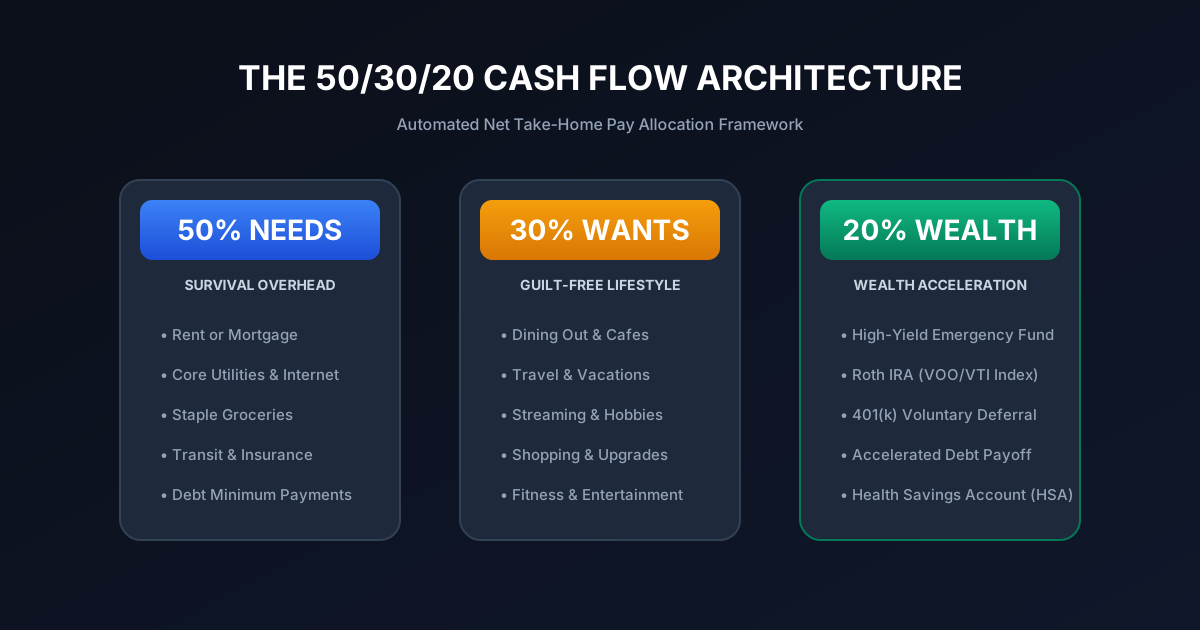 Figure 2: Channeling net 1099 freelance profits directly into automated investments and wealth acceleration within the 50/30/20 financial architecture.
When earning independent 1099 side income, you are classified by the IRS as a Sole Proprietorship. Failing to plan for taxes will result in an unpleasant surprise come April 15.
The Self-Employment Tax Reality
As an independent earner, you are subject to the Self-Employment (SE) Tax of 15.3% (comprising 12.4% for Social Security and 2.9% for Medicare), alongside your standard federal and state income tax brackets.
Essential Deductions to Slash Taxable Profit
Under Internal Revenue Code Section 162, you can deduct all "ordinary and necessary" business expenses on IRS Schedule C, reducing your net taxable income dollar-for-dollar:
- Home Office Deduction (IRC § 280A): If you use a designated portion of your home exclusively and regularly for business, deduct a proportional share of your rent, mortgage interest, utilities, and internet. (The simplified method allows $5 per square foot up to 300 sq ft = $1,500 deduction).
- Hardware & Software Subscriptions: Deduct 100% of computers, monitors, software subscriptions (Notion, Zapier, QuickBooks, Adobe), web hosting, and domain registrations.
- Vehicle Mileage (Standard IRS Rate): Track business mileage using apps like MileIQ. The IRS allows an official deduction of $0.67+ per mile driven for business purposes.
- Professional Development: Books, courses, and educational material directly related to your service offerings are fully deductible.
- The Solo 401(k) / SEP IRA: As a solopreneur, you can open a Solo 401(k) or SEP IRA and shield up to 20% of your net self-employment earnings from federal income taxes.
10. The 30-Day Client Acquisition Playbook
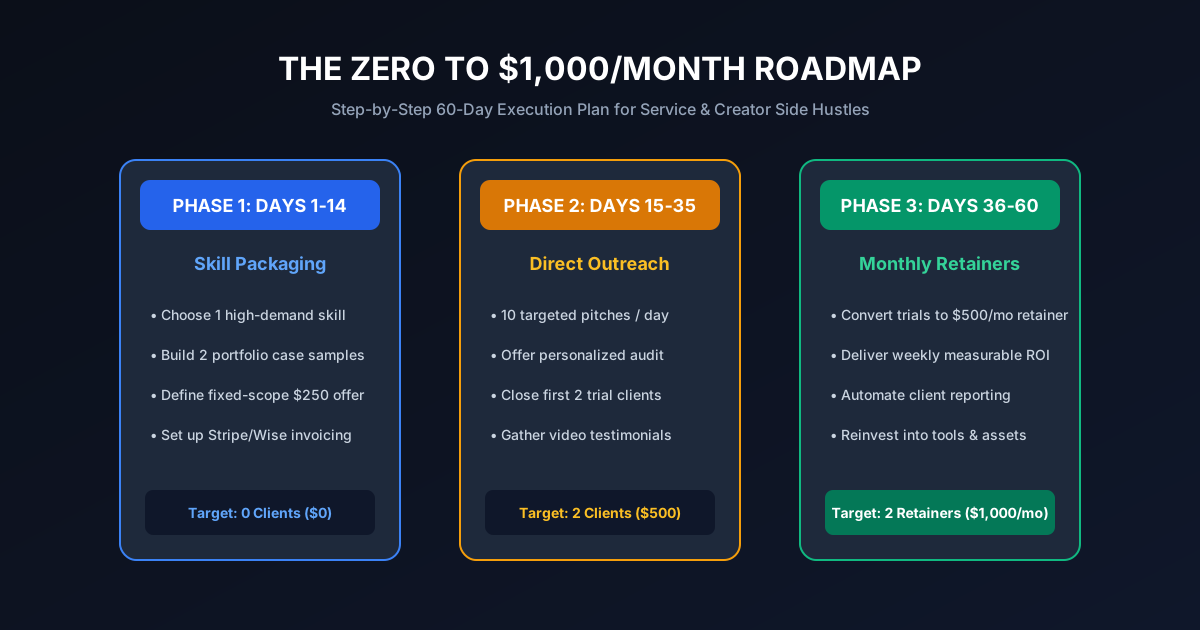 Figure 3: Tactical 60-day roadmap from service packaging and personalized cold outreach to closing two $500/month recurring monthly retainer clients.
To land your first paying client within 30 days, avoid spending weeks designing logos or business cards. Execute this direct outreach protocol:
- Days 1 to 5: Identify the "Dream 30" Target List: Identify 30 local small businesses or 30 corporate executives who exhibit clear bottlenecks in their current workflows or social profiles.
- Days 6 to 15: Create the "Loom Video Audit": Record a free, value-packed 3-minute video showing the prospect an exact bottleneck in their business and the step-by-step fix. Give away the solution with zero sales pressure.
- Days 16 to 25: Follow Up with a Frictionless Offer: Offer to implement the solution for a discounted initial pilot fee or a 100% satisfaction-guaranteed retainer.
- Days 26 to 30: Onboard & Overdeliver: Execute the project with elite communication, deliver early, and request a written testimonial and referral.
Unit Economics and Profit Margin Comparison: Service vs. Physical Product
When beginners attempt to generate their first ## 11. Comprehensive Frequently Asked Questions,000 of supplemental monthly income, they frequently gravitate toward capital-intensive or low-margin models such as e-commerce dropshipping, print-on-demand merchandise, or rideshare driving. A rigorous analysis of the unit economics reveals why service-based micro-enterprises achieve profitability drastically faster:
- Rideshare & Food Delivery: While gross earnings may appear to average $20 to $25 per hour, factoring in fuel consumption ($4.50/hr), commercial vehicle wear and tear ($0.67/mile IRS rate), commercial auto insurance riders, and self-employment payroll tax (15.3%) reduces true net economic earnings to ## 11. Comprehensive Frequently Asked Questions1.50 to ## 11. Comprehensive Frequently Asked Questions4.00 per hour. Generating ## 11. Comprehensive Frequently Asked Questions,000 net requires 75 to 85 hours of grueling physical labor per month.
- Physical E-commerce / Dropshipping: Gross product margins typically average 30% to 40%. After deducting digital advertising costs per acquisition (Facebook/TikTok CAC), platform merchant fees (Shopify, Stripe), return rates (8-12%), and shipping charges, net profit margins routinely collapse into the 8% to 15% range. Generating ## 11. Comprehensive Frequently Asked Questions,000 net requires processing $7,000 to ## 11. Comprehensive Frequently Asked Questions2,000 in gross inventory sales, requiring substantial upfront advertising risk.
- B2B Knowledge & Technical Services: Producing bookkeeping setups, SEO technical audits, workflow automation integrations, or executive content assets involves zero cost of goods sold (COGS). Software overhead (Notion, Zapier, Google Workspace) rarely exceeds $50 per month. Net operating margins routinely exceed 90% to 95%. Generating ## 11. Comprehensive Frequently Asked Questions,000 net requires delivering value to merely two clients at a $500 monthly retainer, requiring under 12 hours of monthly execution time.
Establishing the Legal and Banking Moat for Freelance Cash Flow
To treat a side business as a legitimate wealth generation asset, solopreneurs must immediately separate personal finances from commercial operations. Opening a dedicated free business checking account (using platforms such as Mercury, Relay, or Novo) and obtaining a free Employer Identification Number (EIN) from the IRS website establishes financial clarity.
Directing 100% of freelance gross billings into the business account and automatically sweeping 30% into a separate high-yield tax reserve account ensures that estimated quarterly federal and state taxes (Form 1040-ES) are fully funded without financial stress. The remaining 70% can then be distributed to your personal checking account as a clean owner's draw, ready to be deployed into high-yield investments and index portfolios.
11. Comprehensive Frequently Asked Questions (FAQ)
Do I need to register an LLC before taking on my first client?
No. In the beginning, you can operate legally as a Sole Proprietorship using your legal name and Social Security Number. Once your side venture consistently generates $1,000+ per month, form a Limited Liability Company (LLC) with your state's Secretary of State to separate personal assets from business liabilities and open a dedicated business checking account.
How do I balance a demanding full-time job with a side hustle?
Block out one focused 90-minute "Golden Hour" before your primary workday begins (e.g., 6:30 AM to 8:00 AM) or designate Saturday mornings from 8:00 AM to 12:00 PM. Guard this time ruthlessly from distractions. Four hours of deep, uninterrupted execution per week is sufficient to build and maintain a $1,000 to $2,000 monthly venture.
What should I do with my side hustle profits?
Avoid the trap of "lifestyle inflation." Do not use side venture income to finance dining out or luxury leases. Funnel 100% of net profits directly into your High-Yield Emergency Fund or broad-market S&P 500 index funds (VOO). Treating your side income as an accelerated wealth compounding engine allows you to achieve financial independence decades ahead of schedule.
Pro Tip on Financial Segregation: Never mix personal and side hustle revenue in the same checking account. From day one, open a dedicated checking account exclusively for your venture deposits and business expenses. This establishes a clean bookkeeping audit trail, makes Schedule C deductions effortless, and prevents accidental co-mingling of funds.