High-Yield Savings Accounts (HYSA): Maximize Your APY & Protect Your Cash
Everything you need to know about high-yield savings accounts. Learn compound interest formulas, FDIC insurance sweep networks, tax rules, and how to pick the right bank.
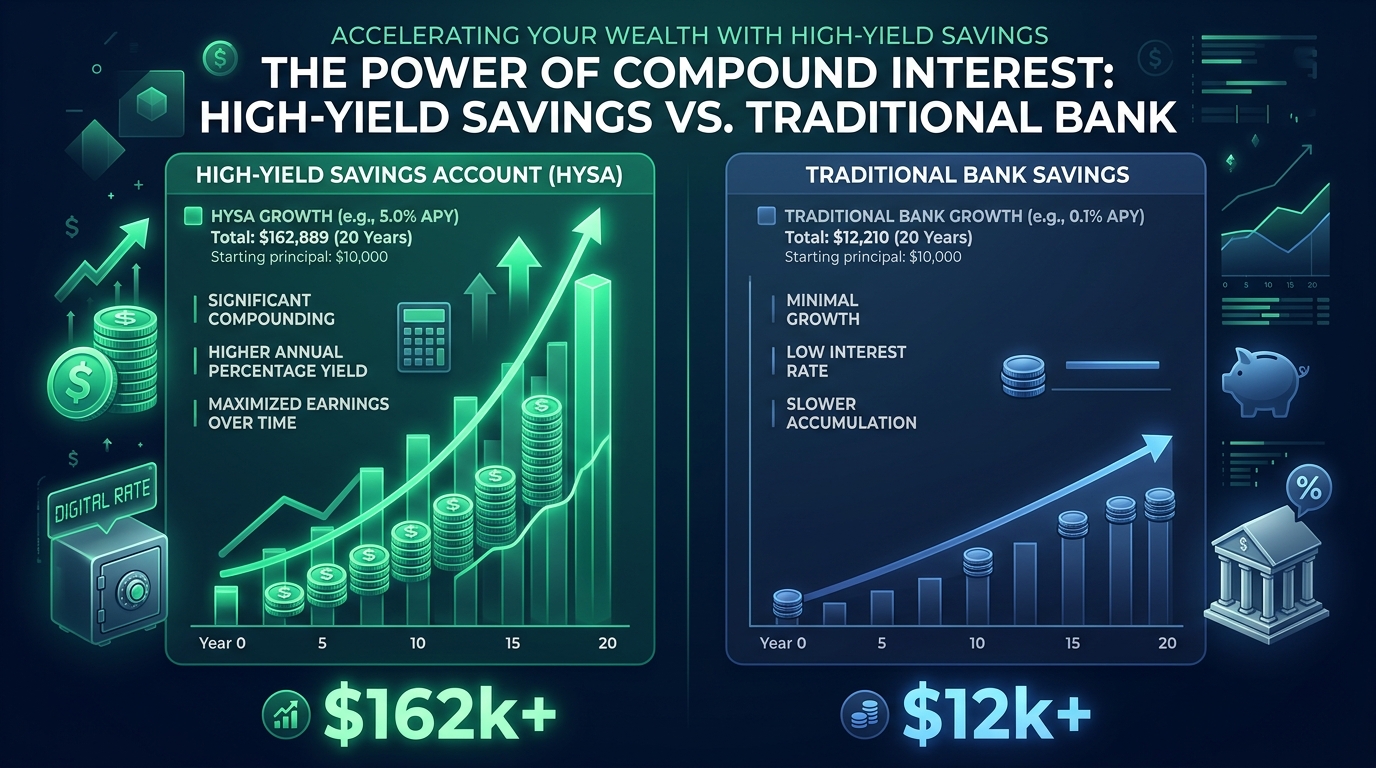
Leaving liquid cash in a traditional checking or brick-and-mortar savings account earning 0.01% APY is one of the most widespread and expensive wealth-eroding mistakes in personal finance today. According to Federal Deposit Insurance Corporation (FDIC) national rate benchmarks, the average American savings account pays just 0.45% APY, while the four largest commercial megabanks still pay a negligible 0.01%.
If you hold a $25,000 emergency fund in an account paying 0.01%, your deposit generates a mere $2.50 in total interest over an entire 12-month period. That same $25,000 deposit held in a top-tier High-Yield Savings Account (HYSA) yielding 5.00% APY generates $1,250.00 in passive, risk-free interest annually—all while maintaining complete liquidity and full federal government protection.
Below, we break down the mathematical mechanics of annual percentage yields, how digital banking infrastructure allows online institutions to distribute outsized returns, how FDIC multi-bank sweep networks provide millions in insurance coverage, and the exact steps to migrate your capital without losing a single day of accrued yield.
1. The Mathematical Mechanics: APR vs. APY and Compounding Frequencies
 Figure 1: Compounding divergence: Storing cash in a 5.05% APY digital account compounds wealth steadily, while traditional 0.01% accounts suffer guaranteed purchasing power loss to inflation.
To evaluate cash preservation accounts accurately, you must understand the distinction between Annual Percentage Rate (APR) and Annual Percentage Yield (APY).
- APR (Annual Percentage Rate): Represents the simple stated interest rate without accounting for intra-year compounding.
- APY (Annual Percentage Yield): Represents the true annual rate of return, incorporating the effect of compound interest—interest earned on previously accumulated interest.
The mathematical formula governing compound interest is expressed as:
$$A = P \left(1 + \frac{r}{n}\right)^{nt}$$
Where:
- $A$ = Final accumulated balance
- $P$ = Principal deposit amount
- $r$ = Nominal annual interest rate (as a decimal)
- $n$ = Compounding frequency per year ($n = 365$ for daily, $n = 12$ for monthly)
- $t$ = Number of years the capital remains deposited
Why Daily Compounding Beats Monthly Compounding
Most premier digital banks calculate interest daily based on your end-of-day ledger balance and credit that interest to your account monthly.
When interest is calculated daily, each day's fractional payout is added to the principal balance for tomorrow's calculation. Over multi-year horizons, daily compounding provides an compounding edge over monthly or quarterly compounding institutions.
2. Multi-Year Growth Projections: The Cost of Complacency
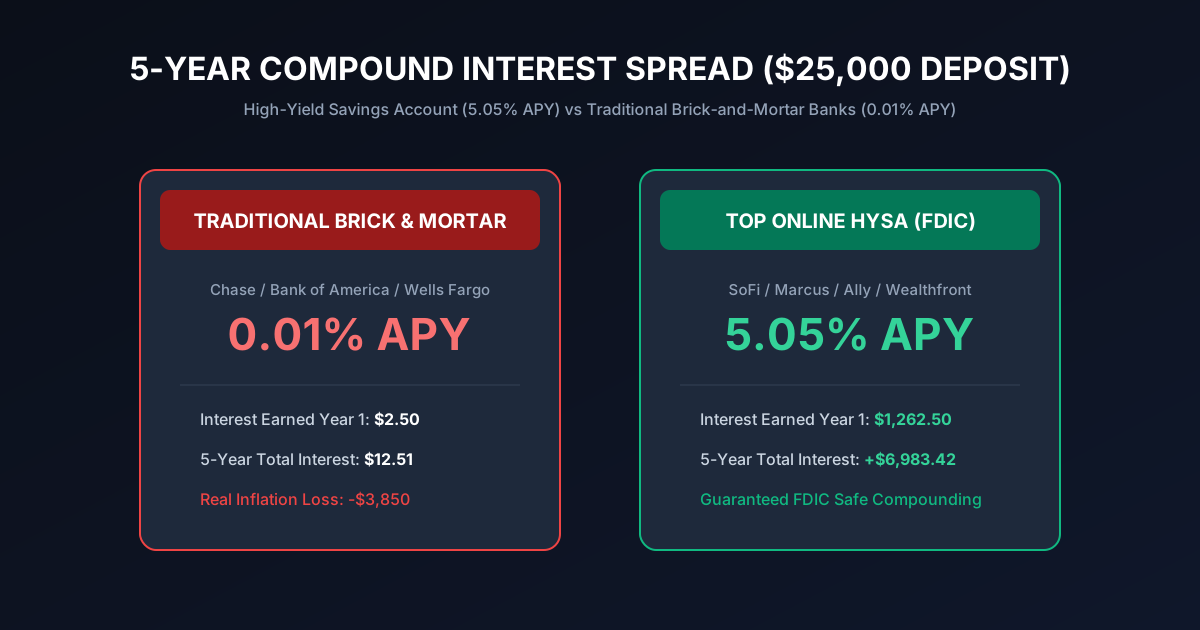 Figure 2: Head-to-head 5-year yield spread on a $25,000 cash balance: $6,983+ earned in a 5.05% APY online high-yield account versus just $12.51 in a traditional 0.01% savings account.
To understand the real-world opportunity cost of staying with a traditional bank, consider the compounding trajectories of various cash reserves over 1, 3, 5, and 10 years at a 5.00% APY compared to the 0.01% national megabank rate:
Scenario A: $10,000 Emergency Fund
| Horizon | Traditional Bank (0.01% APY) | High-Yield Account (5.00% APY) | Real Cash Advantage |
|---|---|---|---|
| 1 Year | $10,001.00 | $10,500.00 | +$499.00 |
| 3 Years | $10,003.00 | $11,576.25 | +$1,573.25 |
| 5 Years | $10,005.00 | $12,762.82 | +$2,757.82 |
| 10 Years | $10,010.00 | $16,288.95 | +$6,278.95 |
Scenario B: $25,000 Liquid Reserve
| Horizon | Traditional Bank (0.01% APY) | High-Yield Account (5.00% APY) | Real Cash Advantage |
|---|---|---|---|
| 1 Year | $25,002.50 | $26,250.00 | +$1,247.50 |
| 3 Years | $25,007.50 | $28,940.63 | +$3,933.13 |
| 5 Years | $25,012.51 | $31,907.04 | +$6,894.53 |
| 10 Years | $25,025.03 | $40,722.37 | +$15,697.34 |
Scenario C: $50,000 Cash Stash (House Down Payment Fund)
| Horizon | Traditional Bank (0.01% APY) | High-Yield Account (5.00% APY) | Real Cash Advantage |
|---|---|---|---|
| 1 Year | $50,005.00 | $52,500.00 | +$2,495.00 |
| 3 Years | $50,015.01 | $57,881.25 | +$7,866.24 |
| 5 Years | $50,025.02 | $63,814.08 | +$13,789.06 |
| 10 Years | $50,050.06 | $81,444.73 | +$31,394.67 |
Key Financial Takeaway: Keeping a $50,000 house down payment in a legacy bank over five years leaves nearly $14,000 in free compound interest on the table. That is capital that could pay for furniture, property taxes, or moving expenses.
3. How Can High-Yield Banks Afford Such High Rates?
Many savers are understandably skeptical when first discovering rate differentials of 400x to 500x. The natural question arises: Is this a scam, or are these institutions taking dangerous speculative risks with my capital?
The answer lies in structural cost efficiency, not increased risk.
1. The Cost Structure of Brick-and-Mortar Megabanks
Legacy banks maintain massive physical footprints. Consider what a traditional bank pays for:
- Leases and property taxes on thousands of prime urban and suburban retail corners.
- Utility bills, branch security guards, teller salaries, and onsite branch managers.
- Legacy mainframe IT systems maintained over decades.
These physical branch expenses consume tens of billions of dollars annually. To subsidize this overhead, legacy banks pay depositors near-zero interest on cash while lending those same deposits out to mortgage and credit card borrowers at 6% to 24%.
2. The Pure Digital FinTech Infrastructure
Digital banks (such as Ally, Marcus by Goldman Sachs, SoFi, Discover, and Capital One 360) operate with centralized engineering hubs:
- Zero public walk-in retail branches.
- Automated customer onboarding via digital Know-Your-Customer (KYC) algorithms.
- Fractional administrative overhead per customer account.
Because online banks operate with overhead efficiency ratios that are 60% to 80% lower than traditional banks, they can afford to share the interest margin directly with depositors in the form of a 4.50% to 5.05% APY to aggressively capture market share.
4. The Federal Safety Net: FDIC Insurance & Multi-Bank Sweep Networks
Security of principal is the foremost objective of cash preservation. Understanding how federal deposit insurance operates is mandatory before depositing large sums.
Standard FDIC & NCUA Protection Rules
Under the Federal Deposit Insurance Act, deposits placed in an insured institution are protected by the full faith and credit of the United States government:
- Coverage Limit: Up to $250,000 per depositor, per insured bank, per ownership category.
- NCUA Equivalent: Credit unions feature identical $250,000 protection under the National Credit Union Share Insurance Fund (NCUSIF).
Ownership Categories That Expand Protection
If you hold more than $250,000 in liquid capital, you can legally expand your single-bank protection across distinct legal ownership categories:
- Single Account (Individual): Insured up to $250,000.
- Joint Account (e.g., Spouses): Insured up to $250,000 per co-owner ($500,000 total coverage on that specific account).
- Revocable Trust Account (POD / Beneficiaries): Insured up to $250,000 per unique beneficiary (up to five beneficiaries, providing up to $1,250,000 in coverage).
Advanced: Multi-Bank Sweep Networks ($1M - $5M+ Coverage)
Modern digital wealth platforms (such as Betterment, Wealthfront, and Robinhood Cash Management) utilize intra-bank deposit sweep networks.
When your cash deposit exceeds $250,000, their algorithm automatically sweeps excess increments into a network of 4 to 20 partner program banks (such as Citibank, Wells Fargo, and HSBC). Each partner bank holds an increment under $250,000, providing you with $1,000,000 to $5,000,000+ in aggregate FDIC insurance through a single unified dashboard.
5. High-Yield Accounts vs. Certificates of Deposit (CDs) vs. Money Market Funds vs. Treasury Bills
Savers frequently confuse High-Yield Savings Accounts with other short-term cash management instruments. Here is a definitive comparative matrix:
| Financial Vehicle | Typical Yield Potential | Liquidity & Withdrawals | Interest Rate Guarantee | State Tax Exemption? | Primary Use Case |
|---|---|---|---|---|---|
| High-Yield Savings (HYSA) | 4.50% - 5.05% | Instant (1-2 Days ACH) | Variable (Moves with Fed) | No (Fully Taxable) | Emergency Fund & Immediate Reserves |
| Certificate of Deposit (CD) | 4.20% - 4.90% | Locked (Early Penalty) | Fixed for Designated Term | No (Fully Taxable) | Known Future Expense (e.g. 6-12 Months) |
| Money Market Fund (MMF) | 4.80% - 5.25% | High (Settlement T+1) | Variable (Market Driven) | Partial (if Treasury based) | Brokerage Cash Reserves (SIPC Protected) |
| Short-Term US Treasuries (T-Bills) | 4.75% - 5.15% | High (Secondary Market) | Fixed for Bill Duration | Yes (100% State/Local Tax Free) | High-Income Earners in CA, NY, NJ |
The T-Bill Arbitrage for High State-Tax Earners
If you reside in a state with a high state income tax bracket (such as California at 9.3%-13.3% or New York at 6.85%-10.9%), interest earned from high-yield bank accounts is subject to both Federal and State income taxes.
In contrast, interest earned from 4-Week to 26-Week US Treasury Bills is 100% exempt from all state and local income taxes. For top-bracket residents, a 5.00% Treasury Bill often yields a higher after-tax return than a 5.25% bank savings account.
6. Tax Optimization: How Interest Income is Treated by the IRS
Many depositors are surprised when they receive an unexpected tax liability in April following their first full year with a high-yield account.
- Ordinary Income Classification: The IRS does not treat savings account interest as preferential capital gains (which are taxed at 0%, 15%, or 20%). Instead, bank interest is classified as ordinary income and is taxed at your highest marginal federal income tax bracket (10%, 12%, 22%, 24%, 32%, 35%, or 37%).
- Form 1099-INT: By January 31 of each calendar year, any financial institution that paid you $10.00 or more in interest will issue IRS Form 1099-INT (Box 1: Interest Income) and transmit a copy directly to the federal government.
- Underreporting Penalties: Failing to report Form 1099-INT interest triggers automated IRS CP2000 mismatch notices, accompanied by statutory interest and accuracy-related penalties. Always verify that all online bank 1099 forms are downloaded during tax filing.
7. The 7-Step Due Diligence Checklist Before Opening an Account
Before transferring your liquid capital into any digital bank, audit the provider against these seven strict operational standards:
1. Direct FDIC / NCUA Membership
Confirm that the institution is a direct member of the FDIC using the official FDIC BankFind Suite (banks.data.fdic.gov). If the platform is a FinTech neo-bank rather than a chartered bank, verify the exact names of its underlying partner sweep banks.
2. Absence of Tiered Balance Traps
Beware of predatory marketing where a bank advertises "7.00% APY," but fine print reveals the 7.00% applies exclusively to the first $500 or $1,000, with all balances above that tier dropping to 0.10%. A legitimate high-yield account pays its top-tier yield across the entire deposit balance.
3. Fee Structure Audit
Review the Fee Schedule document for:
- Monthly maintenance or low-balance charges (Must be $0).
- Inactive or dormant account penalties (Must be $0).
- External outgoing ACH transfer fees (Must be $0).
4. Transfer Latency & Liquidity Channels
Test the speed of outbound automated clearing house (ACH) transfers. Quality digital banks support Next-Day or Same-Day ACH transfers. Be cautious of institutions that enforce 5-to-7 business day holds on electronic withdrawals.
5. Mobile Interface & Security Infrastructure
Ensure the banking portal mandates Hardware-Based Multi-Factor Authentication (MFA), biometric device recognition, and customizable transaction notification thresholds via SMS and email.
6. Regulation D Enforcement
During the COVID-19 pandemic, the Federal Reserve amended Regulation D, eliminating the historic federal cap of six monthly savings withdrawals. While federal law no longer enforces the 6-withdrawal limit, individual banks retain the right to impose internal transfer caps. Verify your bank's internal policy if you plan to make frequent monthly disbursements.
7. Customer Support Accessibility
Verify whether customer assistance is restricted exclusively to automated AI chatbots or whether licensed human phone representatives are accessible during standard business hours.
8. Step-by-Step Capital Migration Playbook
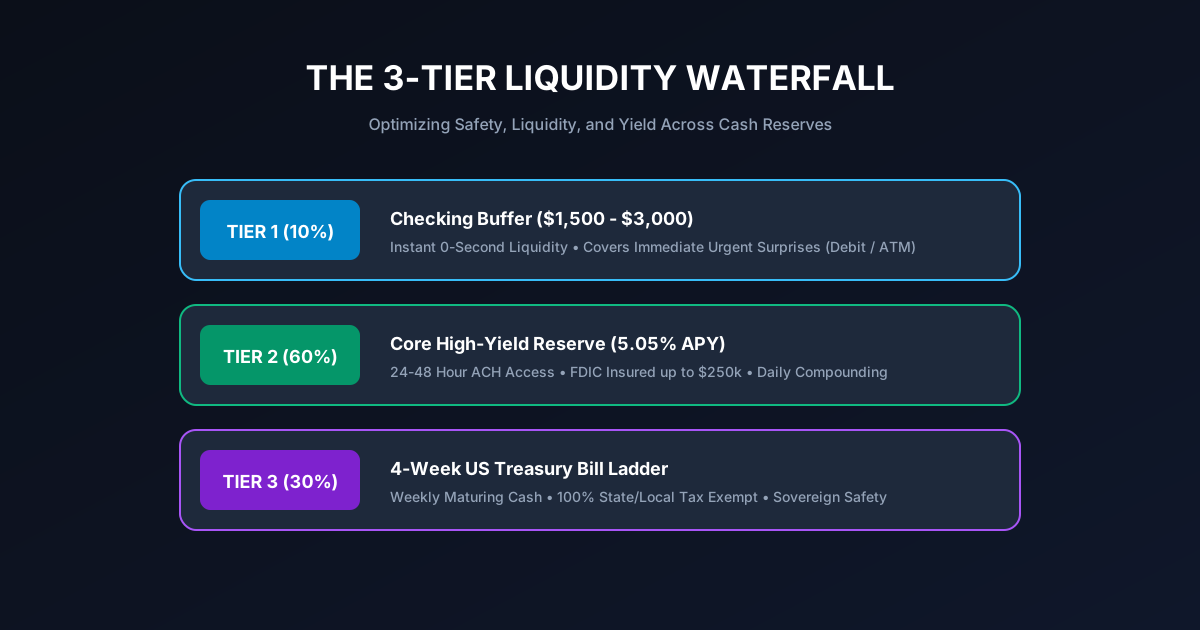 Figure 3: Multi-tiered liquidity deployment: maintaining operating transaction buffers in everyday checking while parking all surplus emergency cash in high-yield reserves.
Migrating your liquid savings from a legacy megabank to a digital high-yield platform without experiencing transfer friction or missed interest can be accomplished in five straightforward steps:
```mermaid flowchart TD A["Step 1: Open & Verify New High-Yield Account (Day 1)"] --> B["Step 2: Link Legacy Checking via Micro-Deposits or Plaid (Day 1-2)"] B --> C["Step 3: Execute Test Transfer of $50 (Day 2-3)"] C --> D["Step 4: Transfer Full Liquid Reserve via ACH (Day 4)"] D --> E["Step 5: Maintain $500 Buffer in Legacy Checking for Bill Pay"] ```
- Submit Digital KYC Application (10 Minutes): Complete the digital application using your legal name, physical address, Social Security Number, and date of birth.
- Authenticate External Bank Linkage: Connect your primary checking account using instant credential verification (e.g., Plaid) or standard automated micro-deposits (two small deposits under $1.00 verified within 48 hours).
- Execute an Initial Pilot Transfer: Transfer a small nominal amount (such as $50) to verify proper routing and clearing pathways.
- Initiate Full Balance Migration: Once the test deposit clears, initiate the transfer of your primary emergency fund. Interest begins accruing on the effective business day the deposit is posted.
- Establish an Automated Funding Pipeline: Configure an automated recurring transfer on each payday (e.g., $250 to $1,000 per bi-weekly pay cycle) to continuously feed your compound growth engine.
In-Depth Analysis: The Real Cost of Bank Loyalty (The "Convenience Tax")
A pervasive behavioral cognitive bias in personal finance is the unwarranted loyalty depositors demonstrate toward traditional retail mega-banks. A 2024-2025 consumer banking study revealed that the median American depositor has maintained an active relationship with their primary checking institution for over 14.3 years. During that decade and a half, the Federal Reserve transitioned through multiple zero-interest-rate policy (ZIRP) eras and quantitative tightening cycles. While mega-banks instantly hiked prime mortgage rates and credit card APRs past 22% during rate hikes, their standard passbook savings yields remained cemented at 0.01%.
Financial economists refer to this economic inefficiency as the "deposit beta lag" or the "convenience tax." Brick-and-mortar financial institutions possess trillions of dollars in sticky, non-interest-bearing corporate and retail deposits. Because they enjoy massive branch networks and physical ATM brand awareness, they face zero institutional incentive to compete for retail cash balances. When you leave a $30,000 cash reserve in a legacy savings account earning $3.00 annually while core consumer price inflation averages 3.1%, you are suffering a guaranteed real purchasing power loss of approximately $927 every twelve months. In contrast, routing that identical liquidity through an FDIC-insured digital bank earning 5.05% APY yields ## 9. Comprehensive Frequently Asked Questions,515.00 in passive interest—completely offsetting inflation and preserving sovereign purchasing power with zero stock market volatility.
Advanced Cash Management: Sweep Networks and Million-Dollar FDIC Protection
For high-net-worth investors, family offices, or solo enterprise entrepreneurs holding balances exceeding the standard statutory $250,000 FDIC coverage limit, modern financial technology platforms utilize automated "deposit sweep networks." Instead of forcing the account holder to manually open and monitor ten separate bank accounts at ten distinct institutions, sweep platforms partner with chartered member banks across the country.
When your deposits exceed $245,000 in your primary digital account, the platform's proprietary routing algorithm automatically sweeps the excess funds across insured partner institutions (such as Evolve Bank & Trust, Cross River Bank, or Customers Bank) behind the scenes in $240,000 increments. This institutional mechanism extends full, legally binding pass-through FDIC insurance protection up to $2,000,000 to $5,000,000 per depositor while presenting a single unified dashboard, single tax statement, and 24-hour ACH liquidity.
9. Comprehensive Frequently Asked Questions (FAQ)
Can the APY interest rate drop after I deposit my money?
Yes. High-yield savings accounts feature variable annual percentage yields. Unlike fixed-term Certificates of Deposit (CDs), digital banks reserve the contractual right to adjust their yield at any time in response to shifts in the Federal Reserve's Federal Funds Target Rate. When benchmark rates rise, HYSA yields rise; when the central bank eases rates, yields decrease accordingly.
Is my money locked up for any minimum period?
No. Funds stored in a high-yield savings account remain 100% liquid. You may initiate an electronic transfer back to your external checking account at any time without incurring early withdrawal penalties or interest forfeitures.
Are online-only banks safe during a banking crisis?
Yes, provided they are FDIC-insured. In the event an FDIC-insured institution becomes insolvent, federal law requires the FDIC to disburse depositor insurance payments (or facilitate an orderly acquisition by another solvent institution) within two business days. In the history of the FDIC (established in 1933), no depositor has ever lost a single cent of insured funds.
What is the difference between an HYSA and a Checking Account?
Checking accounts are designed for transactional velocity (daily debit card swipes, ATM withdrawals, check writing, and bill pay). High-yield savings accounts are engineered for capital preservation and compound interest accumulation. The optimal structure is to keep 1 to 2 months of operating expenses in your primary checking account and sweep all remaining emergency cash into your high-yield savings account.
How much cash should I actually keep in a high-yield savings account?
The consensus institutional standard for personal balance sheets is 3 to 6 months of non-negotiable living expenses (housing, essential groceries, utilities, debt minimums, and medical insurance). Self-employed individuals, 1099 contractors, or single-earner households with volatile income should expand this liquid buffer to 9 to 12 months of baseline cash needs. Any surplus capital beyond this threshold should generally be channeled into tax-advantaged retirement accounts (Roth IRA, 401(k)) and broad-market index funds to counter long-term monetary inflation.