Debt Snowball vs. Debt Avalanche: Which Payoff Method Saves More Money?
Compare the Debt Snowball and Debt Avalanche methods side by side. See payoff timelines, interest calculations, and psychological strategies to eliminate debt permanently.
High-interest consumer liability is the single greatest structural impediment to personal wealth creation. According to Federal Reserve consumer credit disclosures, revolving credit card balances in the United States exceed $1.14 trillion, with the average commercial credit card Annual Percentage Rate (APR) hovering near an all-time high of 21.50% to 24.99%.
When you carry a $15,000 balance across multiple credit cards at 24% APR and pay only the minimum required monthly payments, it takes more than 28 years to eliminate the debt and costs over $31,000 in interest alone—more than double the original principal borrowed.
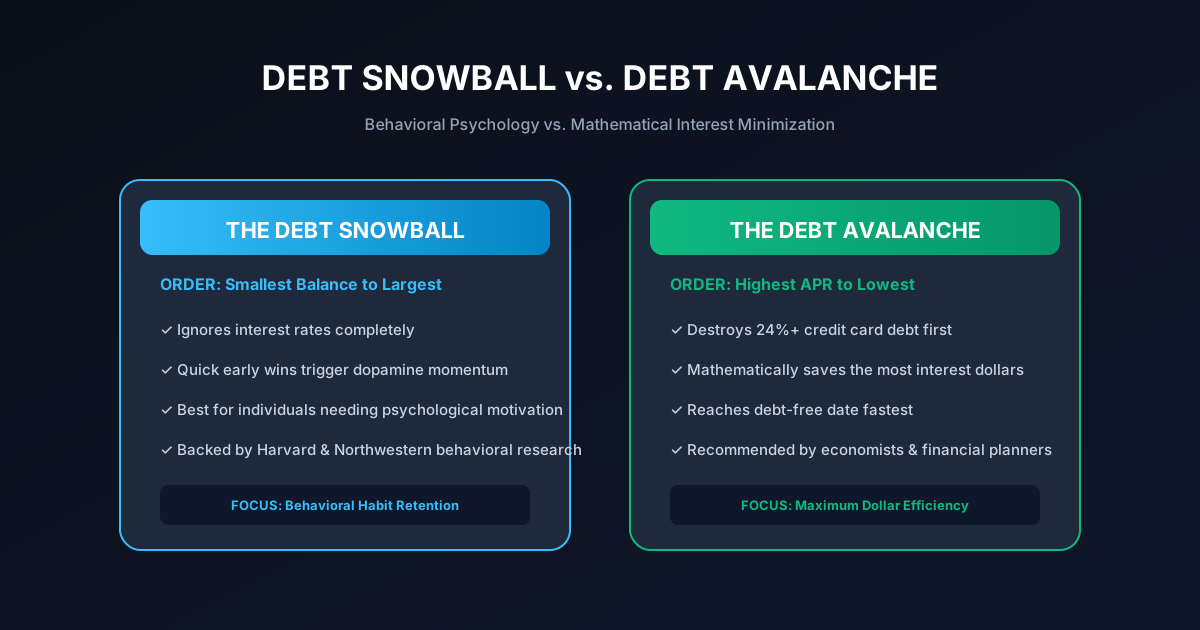
To break free from the compound interest trap, you need an aggressive, systematic framework. In personal finance, two dominant battle-tested methodologies have emerged: the Debt Snowball and the Debt Avalanche.
Below, we analyze the mathematical mechanics of each method, run a side-by-side simulation across a real-world multi-debt portfolio, examine 0% APR balance transfer arbitrage, and provide the exact psychological blueprint to become debt-free in record time.
1. Defining the Strategies: Behavioral Psychology vs. Pure Mathematics
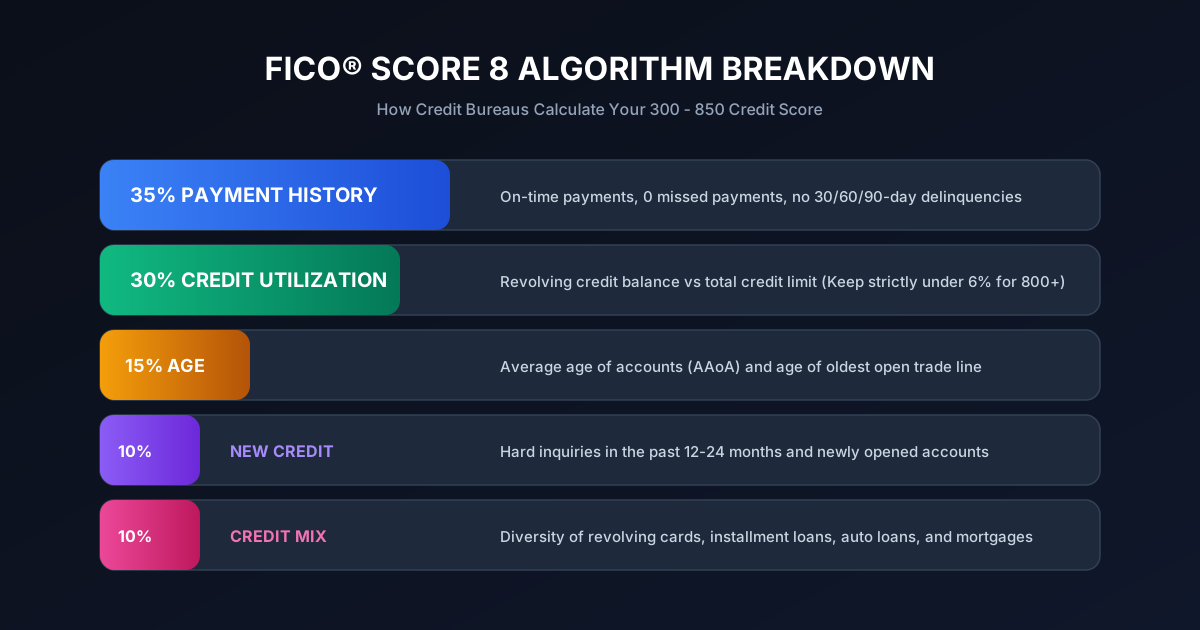 Figure 1: The dual benefit of debt elimination: Rapidly paying down revolving balances directly targets the 30% Credit Utilization pillar, driving immediate 45-80 point score increases.
The debate between the Snowball and Avalanche methods reflects the core tension of personal finance: human behavioral psychology versus pure mathematical optimization.
The Debt Snowball (Behavioral Momentum)
Popularized by personal finance author Dave Ramsey, the Debt Snowball strategy prioritizes emotional momentum and dopamine feedback loops:
- You list all your non-mortgage debts in order from smallest balance to largest balance, completely ignoring interest rates.
- You pay the minimum required payments on every debt except the smallest balance.
- You direct every single surplus dollar into paying off the smallest balance as aggressively as possible.
- Once the smallest debt is completely wiped out, you take its entire former payment amount and roll it ("snowball" it) into the next smallest debt balance.
The Debt Avalanche (Mathematical Interest Minimization)
Favored by economists, mathematicians, and certified financial planners, the Debt Avalanche strategy prioritizes pure interest expense minimization:
- You list all debts in order from highest interest rate (APR) to lowest interest rate, completely ignoring balance sizes.
- You pay minimums on every account except the debt carrying the highest interest rate.
- You direct all surplus capital toward destroying the highest-interest debt first.
- Once the highest-APR debt reaches zero, you roll its payment into the next highest APR account.
flowchart TD
    subgraph Snowball ["Debt Snowball (Behavioral Wins)"]
        S1["Rank by Balance Size (Smallest to Largest)"] --> S2["Attack Smallest Balance First"]
        S2 --> S3["Quick Early Wins Trigger Dopamine & Habit Retention"]
    end
    subgraph Avalanche ["Debt Avalanche (Pure Math)"]
        A1["Rank by Interest Rate (Highest APR to Lowest)"] --> A2["Attack Highest APR First"]
        A2 --> A3["Minimizes Every Cent Paid to Credit Card Companies"]
    end
2. Side-by-Side Simulation: A Real-World $45,000 Debt Portfolio
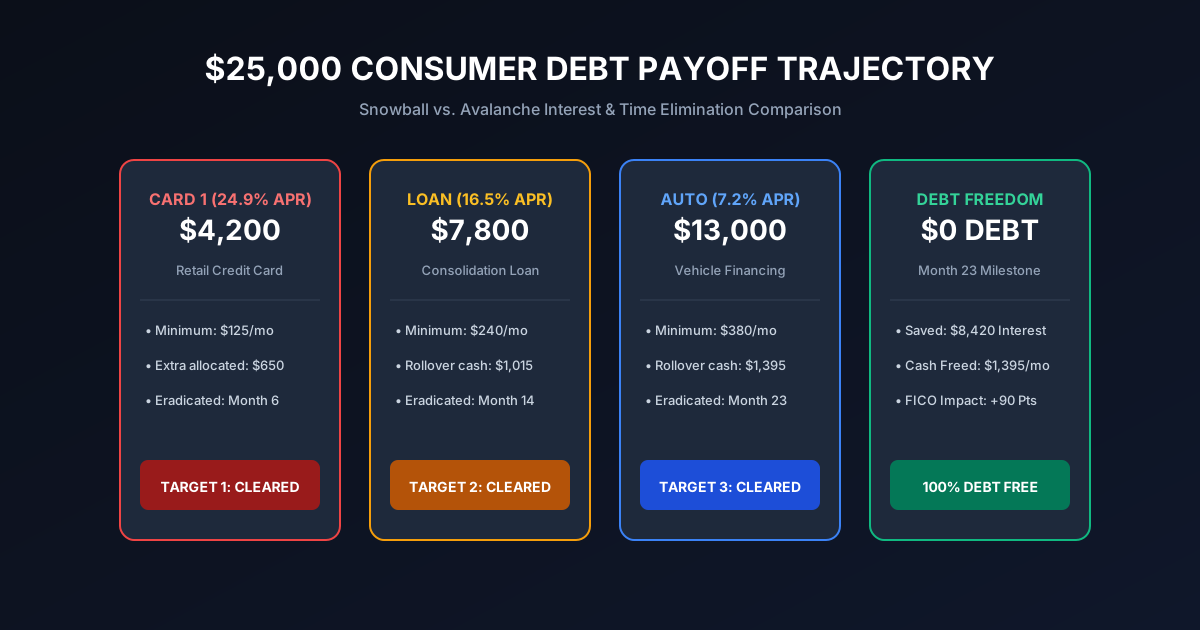 Figure 2: Visual payoff milestone trajectory across multi-tiered high-interest debt, showing accelerated cash flow velocity as each obligation is systematically eliminated.
To compare the real-world performance of both strategies, let us evaluate an individual, Alex, who carries $45,000 in total consumer liabilities across four common account types, with $1,500 available each month to dedicate to debt service:
Alex's Debt Breakdown:
- Credit Card A: Balance: $3,500 | APR: 26.99% | Min Payment: $105
- Credit Card B: Balance: $7,500 | APR: 22.49% | Min Payment: $190
- Personal Loan: Balance: $14,000 | APR: 13.50% | Min Payment: $360
- Auto Loan: Balance: $20,000 | APR: 6.25% | Min Payment: $435
- Total Minimum Payments Required: $1,090/month
- Surplus Acceleration Capital: $410/month ($1,500 total budget - $1,090 minimums)
Comparative Results Matrix
| Metric | Minimum Payments Only | Debt Snowball Method | Debt Avalanche Method | The Avalanche Advantage |
|---|---|---|---|---|
| Total Interest Paid | $34,812.40 | $11,842.15 | $10,214.80 | Saves $1,627.35 Extra |
| Debt-Free Date | 19 Years, 4 Months | 36 Months (3.0 Yrs) | 34 Months (2.8 Yrs) | 2 Months Faster |
| First Debt Elimination | Month 42 | Month 6 (Quick Win) | Month 6 (Card A had high APR) | Tied in this scenario |
| Second Debt Elimination | Month 94 | Month 14 | Month 13 | 1 Month Faster |
Critical Takeaways from the Simulation:
- Both Systems Crush the Minimum Payment Trap: Either method eliminates the debt in approximately 3 years and saves over $23,000 in interest compared to paying minimums.
- The Avalanche Saves More Money: The Avalanche saved an extra $1,627.35 in cold cash and reached the finish line two months sooner because it eliminated the predatory 26.99% and 22.49% cards before touching the low-interest auto loan.
- The Lesson: While Avalanche is mathematically superior, the dollar difference ($1,627 over 3 years) is modest enough that if someone requires psychological quick wins to stay committed, the Snowball is a valid choice.
3. What Does Academic Behavioral Research Say?
Why does the Debt Snowball remain so popular despite the mathematical superiority of the Debt Avalanche?
A landmark study published in the Journal of Marketing Research analyzed thousands of consumer debt repayment journeys over multiple years. The researchers discovered:
Consumers who utilized the Debt Snowball strategy were statistically significantly more likely to eliminate their entire debt portfolio than those who utilized the Debt Avalanche.
The "Goal Gradient Effect"
Psychologists explain this phenomenon through the Goal Gradient Effect:
- Human motivation increases exponentially as the perceived distance to a goal decreases.
- Under the Debt Avalanche, if an individual's highest-APR debt happens to be a massive $25,000 personal loan, they might pay aggressively for 18 straight months without eliminating a single account. This lack of tangible progress often leads to mental exhaustion, "debt fatigue," and eventual abandonment of the plan.
- Under the Debt Snowball, wiping out a small $800 medical bill or $1,200 store credit card within 60 days provides an immediate psychological victory. It proves the system works, builds self-efficacy, and generates momentum to tackle larger debts.
4. The 0% APR Balance Transfer Arbitrage
If you carry high-interest credit card debt (18% to 29% APR), you can accelerate either repayment method by executing a 0% APR Balance Transfer.
How It Works
Leading credit card issuers offer promotional balance transfer cards featuring 0% introductory APR for 15, 18, or 21 months:
- You apply for a balance transfer card with a promotional 0% period.
- You transfer your high-interest balances from your existing cards to the new card.
- During the 15 to 21 month promotional window, 100% of every dollar you pay goes directly toward principal reduction, with zero cents diverted to interest.
The Balance Transfer Fee Math
Balance transfer cards charge an upfront Balance Transfer Fee, typically 3% to 5% of the transferred amount.
- Example: Transferring a $10,000 balance with a 3% fee adds a $300 one-time fee, bringing your starting balance to $10,300.
- The Comparison: At a 24% APR on your current card, that $10,000 balance would accumulate $2,400 in interest over 12 months.
- The Net Savings: $$\text{Net Savings} = $2,400\text{ (Interest Avoided)} - $300\text{ (Transfer Fee)} = \mathbf{+$2,100\text{ in Pure Savings}}$$
Critical Warning: If you fail to pay off the transferred balance before the 0% promotional window expires, the remaining balance resets to standard commercial APRs (often 22% to 28%). Never use a balance transfer unless you have a strict, disciplined monthly budget calculated to hit $0 before the promotional deadline.
5. The 5 Rules of Flawless Debt Elimination
Regardless of whether you choose the Snowball or Avalanche, follow these five non-negotiable rules:
1. Stop Creating New Debt (Freeze the Cards)
You cannot dig your way out of a hole while continuing to dig deeper. Remove credit cards from digital wallets (Apple Pay, Google Pay, Amazon 1-Click) and physically freeze or lock the cards. Transition to a debit card or cash system for daily expenses throughout your debt-payoff journey.
2. Maintain a $1,000 "Starter" Emergency Fund
Never attempt to pay off debt with zero liquid savings in the bank. If your car blows a tire or you face an unexpected $400 emergency room copay without savings, you will be forced to swipe a credit card, breaking your psychological momentum. Keep a $1,000 to $1,500 starter emergency fund in a separate high-yield savings account before throwing extra cash at debt.
3. Automate Minimum Payments
Set every active debt account to automated minimum monthly payment on the payment due date. This guarantees you will never incur a $40 late fee or suffer a devastating 60-point drop in your credit score from an accidental missed payment.
4. Direct 100% of Windfalls Toward Principal
Funnel unexpected cash inflows—annual tax refunds, employment bonuses, cash gifts, proceeds from selling unused household items—directly into your active debt target. A single $2,000 windfall can shorten your repayment timeline by several months.
5. Always Specify "Apply to Principal"
When making extra payments above the minimum, verify that your loan servicer applies the extra funds directly toward the Principal Balance rather than advancing the next month's payment due date ("Paid Ahead Status").
6. Debt Consolidation Loans vs. Debt Settlement vs. Bankruptcy
When debt balances become overwhelming, consumers frequently encounter aggressive advertising for third-party debt relief solutions. It is vital to understand the structural differences:
1. Fixed-Rate Debt Consolidation Loans
- How It Works: An unsecured personal loan from a bank, credit union, or digital lender (such as SoFi, Marcus, or Upgrade) used to pay off multiple credit card balances simultaneously.
- The Math: If you consolidate $20,000 in credit card balances averaging 24% APR into a 3-year personal loan at 11.5% fixed APR, your monthly payment drops and you save thousands in interest.
- The Trap: More than 60% of consumers who consolidate credit card debt run their credit card balances right back up within 24 months because they addressed the symptom (the loan rate) without fixing the behavior (overspending).
2. Debt Settlement (Debt Relief Programs)
- How It Works: Commercial debt settlement companies instruct you to stop paying your creditors entirely for 3 to 6 months until accounts default and charge off, attempting to negotiate a lump-sum settlement for 40% to 60% of the balance.
- The Damage: This strategy obliterates your credit score, triggers aggressive collection lawsuits, and any forgiven debt exceeding $600 is classified by the IRS as taxable ordinary income (Form 1099-C). Avoid debt settlement companies unless facing imminent bankruptcy.
3. Chapter 7 vs. Chapter 13 Bankruptcy
- Chapter 7 (Liquidation): Discharges non-secured liabilities (credit cards, medical bills) completely within 4 to 6 months for low-income filers who pass the means test. Remains on your credit report for 10 years.
- Chapter 13 (Wage Earner Plan): A court-mandated 3-to-5 year restructuring plan where you repay a portion of debt based on disposable income. Remains on your credit report for 7 years.
7. The "Hybrid Snowball" Approach
If you are torn between the emotional power of the Snowball and the mathematical savings of the Avalanche, you can implement the Hybrid Snowball:
- Phase 1 (The Initial Quick Win): Take your single smallest balance (under $1,000) and wipe it out immediately within 30 to 45 days. This provides the psychological dopamine hit and proves you can execute the system.
- Phase 2 (The High-APR Pivot): Once that first account is destroyed, immediately transition to the Avalanche method and attack your highest-interest credit cards (20%+ APR) to protect your capital from compound interest.
- Phase 3 (The Low-Interest Finish): Once all double-digit APR debts are eliminated, finish off remaining single-digit loans (auto loans, student loans) using either method comfortably.
8. Post-Debt Wealth Velocity: Redirecting Payments into Compounding
 Figure 3: Long-term exponential wealth curve when former monthly debt payments are re-routed into broad-market index funds and compounding equities.
The ultimate reward of eliminating consumer debt is the sudden release of cash flow velocity.
Consider Alex from our earlier simulation. Alex was paying $1,500 every single month to service debt. The day that final auto loan hit zero, that $1,500 monthly payment did not evaporate—it was liberated.
If Alex redirects that exact same $1,500 monthly payment into a low-cost S&P 500 index fund (VOO) compounding at a historical 8% average annual return:
- In 5 Years: Alex accumulates $110,240.
- In 10 Years: Alex accumulates $274,400.
- In 20 Years: Alex accumulates $883,500.
- In 30 Years: Alex accumulates over $2.2 million.
Eliminating debt is not about deprivation; it is the mathematical prerequisite to becoming a multi-millionaire.
9. Comprehensive Frequently Asked Questions (FAQ)
Should I invest in the stock market while paying off debt?
It depends entirely on the interest rate of the debt:
- Debts above 8% APR (Credit cards, personal loans): Prioritize paying off the debt first. A guaranteed 24% return from paying off a credit card beats the historical average 8% to 10% return of the stock market every single time.
- Debts below 5% APR (Low-interest mortgages, student loans): Pay minimums and invest extra capital into broad index funds, where historical market returns outpace the cost of debt.
- The Exception: Always contribute enough to your employer 401(k) to capture a 100% company match, which provides an immediate 100% return on your money that outstrips even high-interest credit card debt.
Does paying off a collection account remove it from my credit report?
Not automatically. Paying a collection account marks the status as "Paid Collection" or "Settled Collection," but the derogatory record can remain on your credit report for up to 7 years from the original delinquency date. To have it removed completely, negotiate a written "Pay-for-Delete" agreement with the collection agency prior to submitting payment.
Can I negotiate a lower interest rate with my credit card company?
Yes. Call the customer service number on the back of your card, ask to speak with the retention or account assistance department, and politely explain that you are reviewing competitive balance transfer offers. If you have an established history of on-time payments, card issuers will frequently grant a temporary 6-to-12 month APR reduction of 5% to 10%.
What is the Statute of Limitations on credit card debt?
Each state has a specific Statute of Limitations (SOL)—typically ranging from 3 to 6 years (and up to 10 years in select states)—which establishes the legal time window during which a creditor or third-party collection agency can successfully sue you in civil court for an unpaid debt.
- Once the SOL expires, the debt becomes "time-barred." The collector may still contact you to request payment, but they cannot legally obtain a court judgment or garnish wages.
- The Payment Trap: Making even a tiny $5 payment or in some states verbally acknowledging the debt can inadvertently reset the statute of limitations clock, reviving the creditor's full legal ability to sue you. Always verify your state's SOL before interacting with aged collection accounts.
Should I tap my 401(k) retirement balance to pay off credit cards?
Almost never. Taking a 401(k) loan or hardship withdrawal to pay off credit cards introduces severe risks:
- Opportunity Cost: You rob your future self of decades of tax-sheltered compound growth.
- Immediate Repayment Risk: If you leave your job or are laid off, many employer 401(k) loan terms mandate that the balance must be repaid in full within 60 to 90 days, or it is classified as a taxable distribution subject to ordinary income taxes and a mandatory 10% IRS early withdrawal penalty.
- Bankruptcy Exemption Loss: Under federal law (ERISA), funds held in a 401(k) are 100% shielded from civil creditors and bankruptcy judgments. Liquidating protected retirement assets to pay unsecured debt that could otherwise be discharged in bankruptcy is an irreversible financial error.