How to Reach an 800 Credit Score: FICO Scoring Secrets & Utilization Strategies
A step-by-step blueprint to reaching an elite 800+ FICO credit score. Learn how the credit scoring algorithm works, the statement date payment hack, and legal dispute steps.

Your credit score is the single most influential mathematical metric in your personal financial life. A credit score is not merely a badge of financial responsibility; it is an economic leverage tool that dictates the cost of debt, insurance premiums, rental approvals, utility security deposits, and even employment background checks.
The difference between a 640 (Fair) credit score and an 780+ (Exceptional) credit score over an adult lifetime exceeds $100,000 to $250,000 in interest expenses alone. On a standard $400,000 30-year fixed-rate home mortgage, an individual with an elite credit score secures interest rates that are 0.75% to 1.50% lower than a borrower with mediocre credit. That percentage difference translates to $200 to $450 in lower monthly payments, saving more than $120,000 in interest over the life of the loan.
Contrary to conventional myths, reaching a top-tier credit score of 760 to 800+ does not require decades of aging or carrying perpetual balances on credit cards. By understanding the underlying mathematical formulas of the Fair Isaac Corporation (FICO) and VantageScore scoring models, you can systematically optimize your file and engineer 50 to 100+ point gains in 30 to 90 days.
 Figure 1: The compounding cost of subprime borrowing: An 800+ FICO score saves over $120,000 to $250,000 in lifetime mortgage, auto, and revolving interest charges compared to a 640 credit score.
1. Deconstructing the Scoring Models: FICO vs. VantageScore
Before attempting to optimize your score, you must identify which algorithm your prospective lender evaluates.
- FICO Score (Used in 90%+ of Lending Decisions): Developed by Fair Isaac Corporation in 1989. Lenders evaluate specific iterations depending on the loan category:
- FICO Score 8 & 9: Standard benchmark for credit card underwriting and personal lines of credit.
- FICO Auto Scores (2, 4, 5, 8, 9): Weighted heavily toward prior auto installment payment history.
- FICO Classic Mortgage Scores (Equifax Beacon 5.0, Experian/Fair Isaac Version 2, TransUnion Classic 04): The mandatory scoring engines enforced by Fannie Mae and Freddie Mac for residential mortgage securitization.
- FICO 10 & 10T: Newer models incorporating trended data, analyzing your balance trajectories over the preceding 24 months.
- VantageScore (Used by Free Monitoring Apps): Created jointly by the three major credit reporting agencies (Equifax, Experian, and TransUnion) in 2006. Platforms like Credit Karma display VantageScore 3.0 or 4.0. While VantageScore provides a helpful directional proxy, mortgage and auto lenders rarely utilize it for capital approval.
2. The 5 Pillars of the FICO Mathematical Algorithm
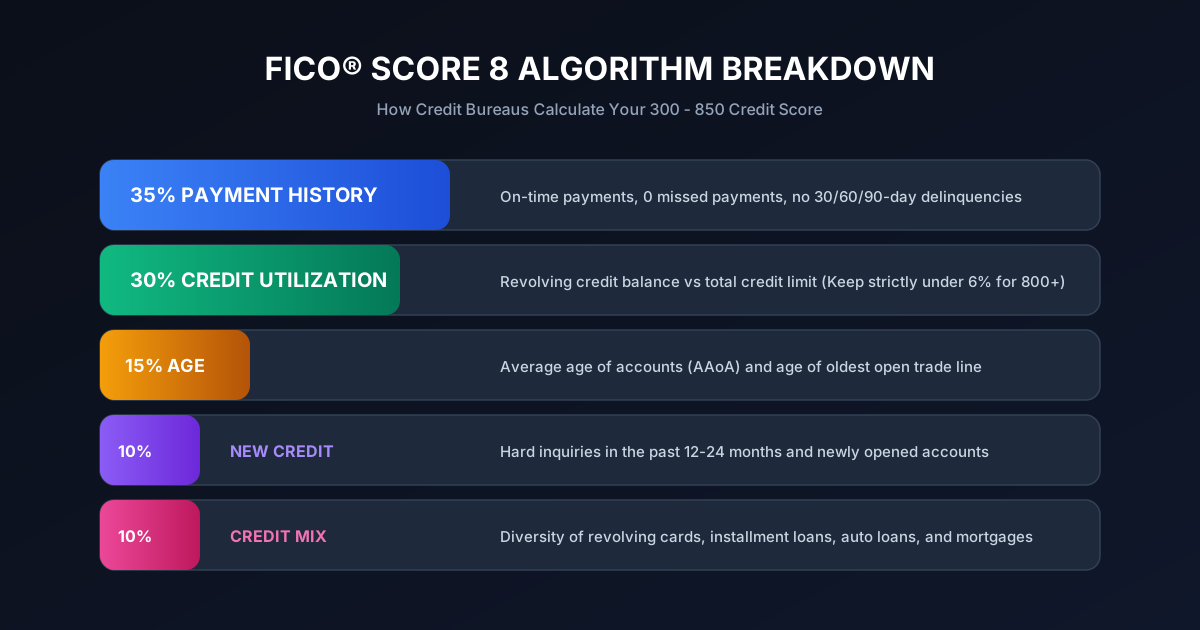 Figure 2: The exact mathematical weighting of the FICO 8 algorithm. Over 65% of your total credit score is determined strictly by Payment History (35%) and Credit Utilization (30%).
The classic FICO algorithm aggregates data points across five distinct mathematical buckets, each assigned a precise percentage weighting:
``` FICO Algorithm Weighting: ├── 35% -> Payment History (On-time consistency, severity of delinquencies) ├── 30% -> Amounts Owed / Credit Utilization (Total revolving balances vs limits) ├── 15% -> Length of Credit History (Average age of accounts, oldest line) ├── 10% -> Credit Mix (Balance between revolving cards and installment loans) └── 10% -> New Credit Inquiries (Hard inquiries recorded within 12 months) ```
Pillar 1: Payment History (35% Weighting — 297.5 Max Points)
Payment history represents the foundation of your score. The scoring algorithm evaluates:
- Recency of Delinquency: A 30-day late payment recorded 45 days ago will drop a 780 score by 60 to 110 points immediately. That same late mark recorded 4 years ago exerts only a minor drag.
- Severity of Delinquency: Derogatory severity scales from 30 days late, to 60 days, 90 days, 120 days, charge-off, collection status, and legal judgment.
- Frequency: Multiple delinquent marks across multiple lines trigger automated risk multipliers, signaling systemic solvency distress.
Pillar 2: Amounts Owed & Revolving Utilization (30% Weighting — 255 Max Points)
This is the single most volatile, fastest lever you control. Unlike payment history, which takes years to season, credit utilization has no memory in standard FICO 8 models.
If your utilization is 68% today and you pay the balance down to 2% tomorrow, your credit score updates with full point restoration the moment the next statement closes.
Pillar 3: Length of Credit History (15% Weighting — 127.5 Max Points)
The algorithm evaluates three sub-metrics:
- The age of your oldest active account.
- The average age of all your accounts combined (AAoA).
- The time elapsed since you opened specific account types.
Pillar 4: Credit Mix (10% Weighting — 85 Max Points)
Lending algorithms penalize mono-line borrowers who possess only credit cards or only student loans. Top scores require a verified capacity to service both revolving credit (credit cards, personal lines of credit) and installment credit (auto loans, mortgages, student loans).
Pillar 5: New Credit Inquiries (10% Weighting — 85 Max Points)
Evaluates hard inquiries initiated when you submit a formal application for credit. A hard inquiry remains on your report for 24 months, but FICO algorithms calculate point penalties exclusively for inquiries logged within the past 12 months (typically 3 to 7 points per inquiry).
3. The Statement Closing Date Hack: Crushing Revolving Utilization
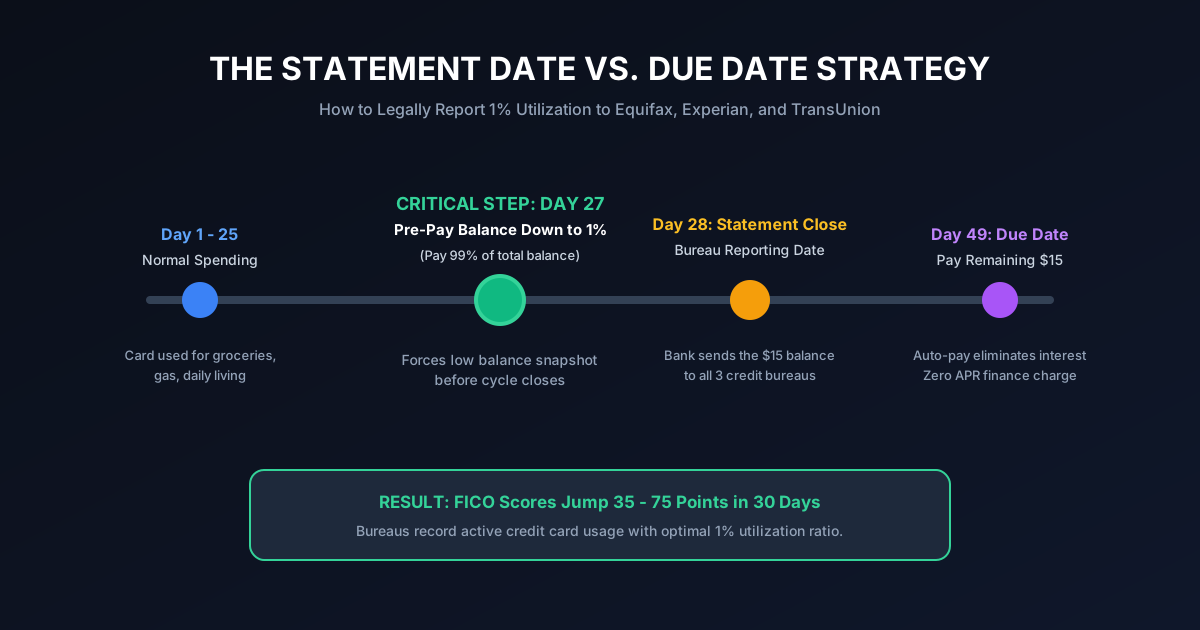 Figure 3: The 30-day reporting timeline hack. Paying 99% of your card balance 48-72 hours before the Statement Closing Date forces the card issuer to report 1% utilization to the 3 credit bureaus.
The single most common mistake responsible consumers make is conflating their Payment Due Date with their Statement Closing Date.
How the Reporting Trap Works
- Suppose you possess a single credit card with a $5,000 credit limit.
- Throughout the billing cycle, you charge $2,500 in business travel, groceries, and utilities.
- Your Payment Due Date is October 25.
- Your Statement Closing Date is October 1.
If you wait until October 24 to pay your balance in full to avoid interest charges, you believe you are practicing excellent credit management. However, on October 1, the credit card company generates your monthly statement balance of $2,500 and transmits that exact figure to Experian, Equifax, and TransUnion.
Your credit report reflects: $$\text{Revolving Utilization} = \frac{$2,500}{$5,000} = 50%$$
A 50% utilization ratio triggers algorithmic risk flags, docking your credit score by 30 to 65 points, despite the fact that you paid zero interest and zero late fees.
The All Zero Except One (AZEO) Protocol
To achieve the absolute mathematical maximum points for Pillar 2 (Amounts Owed), elite credit engineers deploy the All Zero Except One (AZEO) method:
- Identify the Statement Closing Dates for every open revolving card on your profile (visible on your paper statement or mobile banking PDF).
- Pay Every Card Down to $0.00 at least 3 business days prior to that card's statement closing date.
- Leave Exactly One Card with a small, nominal balance between $10 and $20 (representing less than 1% of that card's credit limit).
- When the statements generate, every card reports a $0 balance to the bureaus, except for one card reporting 1%.
- The Result: The algorithm avoids the "zero revolving activity penalty" (which occurs when literally all cards report $0) while registering an aggregate utilization below 1%, unlocking the maximum possible points for that category.
4. Utilization Brackets: The Exact Mathematical Breakpoints
The FICO algorithm does not evaluate credit utilization linearly. Instead, it utilizes discrete tier thresholds for both individual cards and aggregate credit limits:
| Revolving Utilization Tier | Score Impact | Algorithm Classification | Recommended Action |
|---|---|---|---|
| 0.01% - 8.99% | Maximum Point Bonus (+40 to +80 pts) | Elite / Negligible Default Risk | Maintain via AZEO Method |
| 9.00% - 28.99% | Neutral / Baseline | Standard Consumer Buffer | Acceptable for non-application months |
| 29.00% - 49.99% | Minor Penalty (-15 to -35 pts) | Elevated Borrowing Risk | Pay down before applying for loans |
| 50.00% - 89.99% | Severe Penalty (-40 to -75 pts) | Liquidity Distress Signal | Shift payments to clear immediately |
| 90.00% - 100%+ | Critical Penalty (-80 to -120+ pts) | Imminent Delinquency Risk | Request limit increases or consolidate |
Pro Tip: Credit utilization is calculated both on an individual card basis and on an aggregate total portfolio basis. If you hold three cards with limits of $10,000, $10,000, and $1,000, and max out the $1,000 card while the others are at zero, your aggregate utilization is under 5%, but the individual 100% maxed-out card will trigger an individual-line utilization penalty. Keep every line under 29% (and ideally under 9%).
5. Authorized User Piggybacking: Borrowing Decades of History
Under federal regulatory guidelines established by the Equal Credit Opportunity Act (ECOA) Regulation B, credit card issuers are required to report account performance data for secondary authorized users.
How Piggybacking Works
If a family member (spouse, parent, or trusted relative) maintains a credit card with:
- Zero Late Payments over its entire history,
- A high credit limit (e.g., $15,000 to $30,000),
- An established account age (e.g., 8 to 15+ years),
- A consistently low utilization ratio (under 5%),
They can contact their issuer and add you as an authorized user.
The Impact on Your Profile
Within 30 to 45 days of being added, the issuing institution transmits the entire historical record of that account to your credit file.
- Your Average Age of Accounts (AAoA) increases dramatically.
- Your Total Available Credit expands, instantly diluting your aggregate utilization.
- Your file inherits up to a decade of verified on-time payment records.
Crucial Rule: The authorized user does not need to receive, activate, or spend on the physical card. The card can remain safely in the primary holder's possession. Ensure the primary cardholder understands that any missed payments on their end will also report to your file.
6. Removing Inaccuracies Under the Fair Credit Reporting Act (FCRA)
According to a landmark study by the Federal Trade Commission (FTC), one in four consumers had an error on their credit report that might affect their credit score. Under the Fair Credit Reporting Act (15 U.S.C. § 1681), you possess statutory legal rights to enforce accuracy, completeness, and verification on your file.
Common Illegal or Erroneous Items
- Accounts Re-Aged Beyond Statutory Limits: Under Section 605 of the FCRA, most negative derogatory marks (collections, late payments, charged-off accounts) must be permanently purged from your credit file after 7 years from the original date of delinquency (DOFD). Bankruptcies (Chapter 7) must be deleted after 10 years.
- Zombie Debt (Sold Collections): When original creditors sell defaulted paper to third-party collection agencies, agencies often improperly alter the date of delinquency to keep the mark active.
- Identity & File Merging: Individuals with common names or shared suffixes (Jr., Sr., III) frequently have relatives' delinquent accounts mistakenly merged into their bureau reports.
The 3-Step Statutory Dispute Blueprint
```mermaid flowchart TD Step1["Step 1: Pull AnnualCreditReport.com Raw Disclosures"] --> Step2["Step 2: Identify Discrepancies Across Experian, Equifax, TransUnion"] Step2 --> Step3["Step 3: Draft Formal FCRA § 611 Dispute Letters"] Step3 --> Step4["Step 4: Transmit via USPS Certified Mail with Return Receipt"] Step4 --> Step5["Step 5: Bureaus Must Investigate & Verify or Delete Within 30 Days"] ```
- Pull Official Bureau Disclosures: Avoid relying on consumer monitoring apps for disputes. Download your full statutory credit disclosures directly from AnnualCreditReport.com.
- Draft a Formal Written Dispute Letter: Never use the automated online dispute portals on credit bureau websites. Online portals force you to select generic pre-selected dispute checkboxes and frequently waive your right to sue under federal arbitration clauses.
- Cite Statutory Mandates: Draft a physical letter citing FCRA Section 611 (15 U.S.C. § 1681i). Demand that the consumer reporting agency provide physical verification of the debt, including the original signed credit agreement and accurate payment history ledger from the original furnisher.
- Send via Certified Mail with Return Receipt Requested: Send your dispute package to the designated dispute addresses of Experian, Equifax, and TransUnion via USPS Certified Mail. This establishes a legal date-stamped paper trail.
- The 30-Day Statutory Deadline: Under federal law, the credit bureau has exactly 30 days from the date of delivery to investigate the dispute with the data furnisher. If the data furnisher fails to verify the accuracy of the record with physical documentation within 30 days, the bureau is legally mandated to permanently delete the trade line.
7. Hard Inquiry Management: Shopping Windows and Deduction Logic
Consumers frequently avoid shopping for the best mortgage or auto loan rates out of fear that multiple inquiries will devastate their credit score.
The Rate Shopping De-Duplication Window
FICO engineers recognized this dilemma and built a specific deduplication buffer into their algorithms:
- Mortgage, Auto Loan, and Student Loan Inquiries: The algorithm treats all inquiries within a designated window as a single inquiry.
- Window Duration:
- In older FICO versions: Any inquiries occurring within a 14-day window are consolidated into one single inquiry for scoring purposes.
- In modern FICO 8 and 9 models: The shopping window extends to 45 days.
- 30-Day Buffer: FICO models completely ignore all mortgage, auto, and student loan inquiries for the first 30 days after they occur. You can safely compare quotes from 10 different mortgage lenders within 30 days without your score moving a single point during the underwriting process.
Crucial Distinction: Rate-shopping deduplication applies exclusively to installment loans (mortgages, auto loans). It does not apply to revolving credit cards. If you apply for 5 credit cards in one afternoon, your report will log 5 independent hard inquiries, immediately docking your score by 15 to 35 points.
8. The 60-Day Score Acceleration Roadmap
Here is the exact weekly timeline to implement these algorithmic optimizations:
Days 1 to 7: Diagnostics & Balance Audit
- Download full statutory disclosures from AnnualCreditReport.com across all three bureaus.
- Document every active credit line: Current balance, credit limit, statement closing date, and interest rate.
- Calculate current aggregate utilization: $\sum \text{Balances} / \sum \text{Limits}$.
Days 8 to 21: Utilization Compression & Limit Expansion
- Request soft-pull credit limit increases across all cards older than 12 months with clean payment histories.
- Shift scheduled payments to occur 3 business days prior to each card's respective statement closing date.
- Implement the AZEO protocol: Pay all cards to $0, leaving exactly one card reporting a $15 balance.
Days 22 to 45: Piggybacking & Dispute Initiation
- Have a primary family member add you as an authorized user on an unblemished, high-limit, aged tradeline.
- Transmit formal FCRA § 611 dispute letters via USPS Certified Mail for any reporting discrepancies.
Days 46 to 60: Verification & Final Optimization
- Review updated bureau disclosures following the 30-day statutory dispute window.
- Verify deletion of unverified trade lines.
- Monitor score update as newly compressed utilization figures report across bureaus.
9. Comprehensive Frequently Asked Questions (FAQ)
Should I close old credit cards I no longer use?
Almost never. Closing an established credit card damages your score in two ways:
- It eliminates that card's available credit limit, instantly raising your aggregate utilization ratio across your remaining cards.
- While closed accounts remain on your FICO report for up to 10 years before dropping off, closing cards halts ongoing positive aging. The optimal strategy is to keep zero-annual-fee cards open, charge a single small recurring subscription (such as a $5 recurring charge) set to auto-pay in full every month, and keep the line active indefinitely.
Does carrying a small balance month-to-month improve my score?
No. This is the single most pervasive myth in personal finance. Carrying an unpaid balance into the next month does not increase your FICO score by a single point; it simply costs you 20% to 29% in unnecessary APR compound interest. The FICO algorithm rewards you for reporting a balance on your statement closing date, not for carrying that balance past the payment due date. Always pay your full statement balance before the due date to avoid interest while still capturing full credit score rewards.
How many credit cards should I have to reach an 800 score?
FICO profile analytics indicate that consumers with scores above 800 maintain an average of 4 to 7 active revolving credit cards, alongside 1 to 2 installment loans (such as an auto loan or mortgage). Having only one card limits your total available credit ceiling and makes your utilization volatile.
How long does a 30-day late payment hurt your credit score?
A 30-day delinquency remains on your credit report for up to 7 years from the original date of delinquency. However, the point damage decreases sharply over time. The most significant point drag occurs in the first 12 to 24 months. After 24 months of consistent on-time payments across all other lines, your score can recover a substantial portion of the lost points.