Certificate of Deposit (CD) Ladders: How to Lock In Yields Before Fed Rate Cuts
A comprehensive operational guide to building rolling CD ladders, locking in multi-year fixed APYs, and immunizing cash reserves against declining Federal Reserve interest rate cycles.
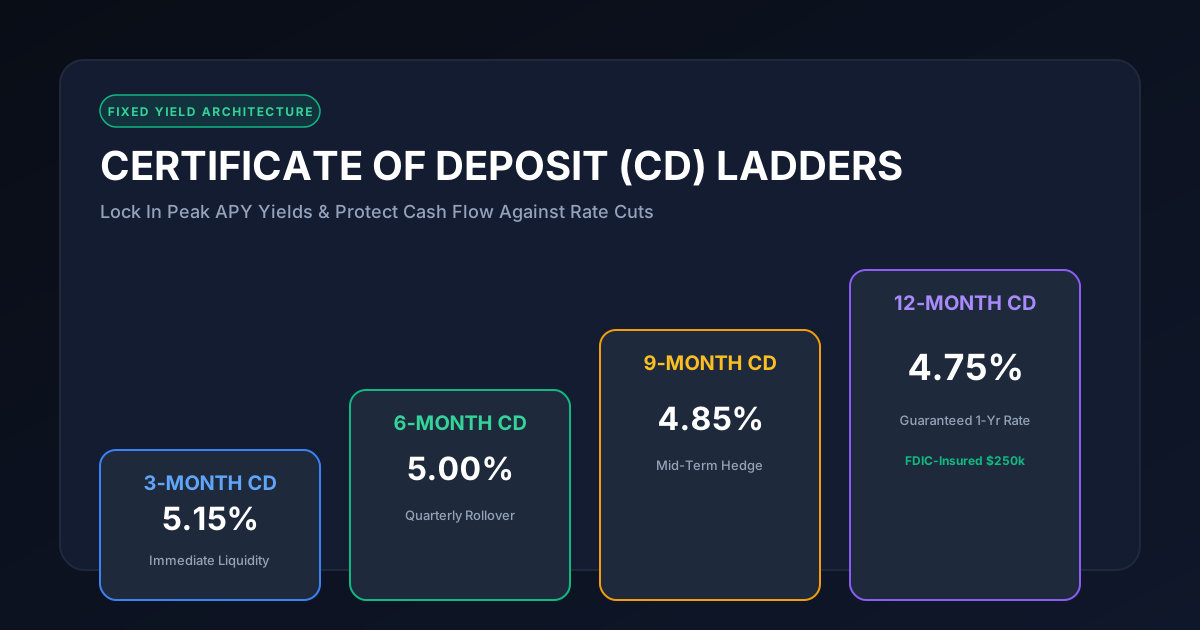
Certificate of Deposit (CD) Ladders: How to Lock In Yields Before Fed Rate Cuts
When central banks shift monetary policy toward monetary easing, retail savers face a rapid decline in risk-free yield. High-yield savings accounts (HYSAs) and money market funds (MMFs) provide exceptional liquidity, but their yields are fundamentally floating-rate instruments. The moment the Federal Open Market Committee (FOMC) slashes the federal funds target rate, savings account annual percentage yields (APYs) reprice downward within 24 to 48 hours.
To protect accumulated capital and secure predictable, risk-free cash flow, fixed-income strategists deploy a Certificate of Deposit (CD) ladder. A CD ladder divides a cash allocation into equal tranches across staggered maturity dates. This structure locks in elevated APYs on longer-dated paper while delivering predictable liquidity intervals every quarter, entirely eliminating the risk of locking away liquid capital during an unexpected expense.
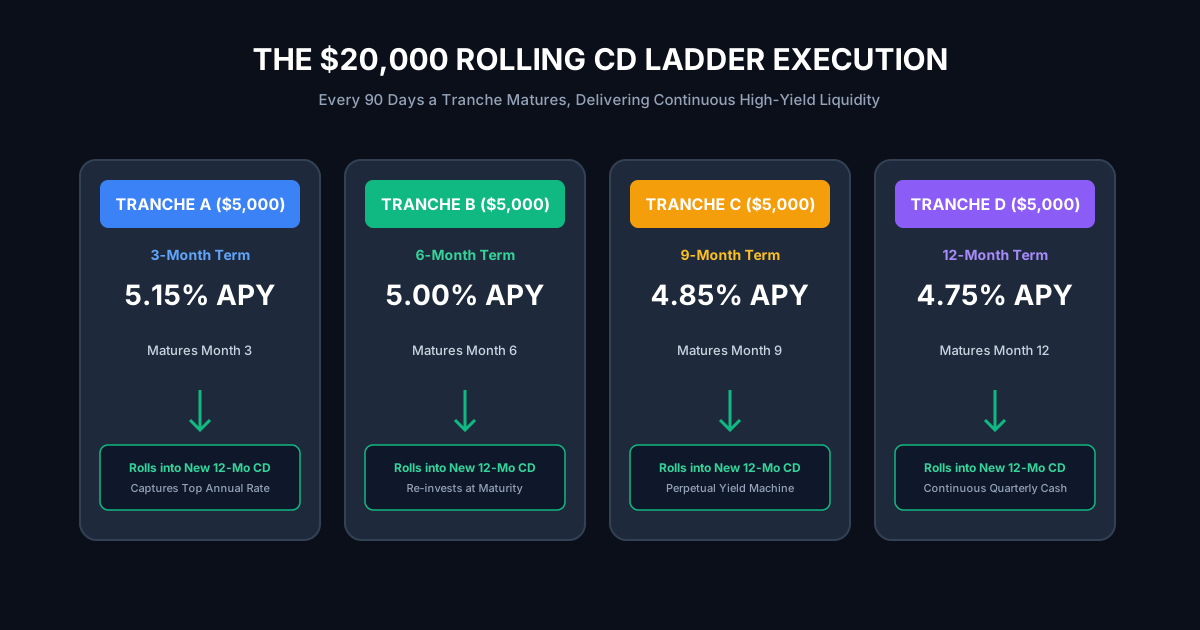 Figure 1: The architecture of a four-tranche rolling CD ladder. Staggering capital across 3, 6, 9, and 12-month maturities ensures recurring liquidity every 90 days while securing fixed top-tier APYs.
1. Mechanics of Fixed vs. Variable Cash Yields
To understand why a CD ladder is mathematically mandatory during economic turning points, one must dissect the relationship between bank asset-liability management and retail deposit pricing.
A high-yield savings account is a demand deposit governed by a variable APR. Commercial banks utilize deposits to fund short-term loans, overnight reverse repos, and floating-rate commercial paper. Because bank lending yields fall immediately when the Federal Reserve lowers borrowing costs, banks protect net interest margins (NIM) by instantly cutting deposit rates paid to consumers.
In contrast, a Certificate of Deposit is a legally binding term contract. When you purchase a 12-month CD yielding 4.75% APY:
- The depository institution is legally obligated to pay that exact contractual APY through the final second of maturity, regardless of whether the Federal Reserve cuts benchmark rates by 50, 100, or 250 basis points.
- The depositor agrees to leave the principal untouched for the designated duration, under penalty of accrued interest forfeiture upon premature liquidation.
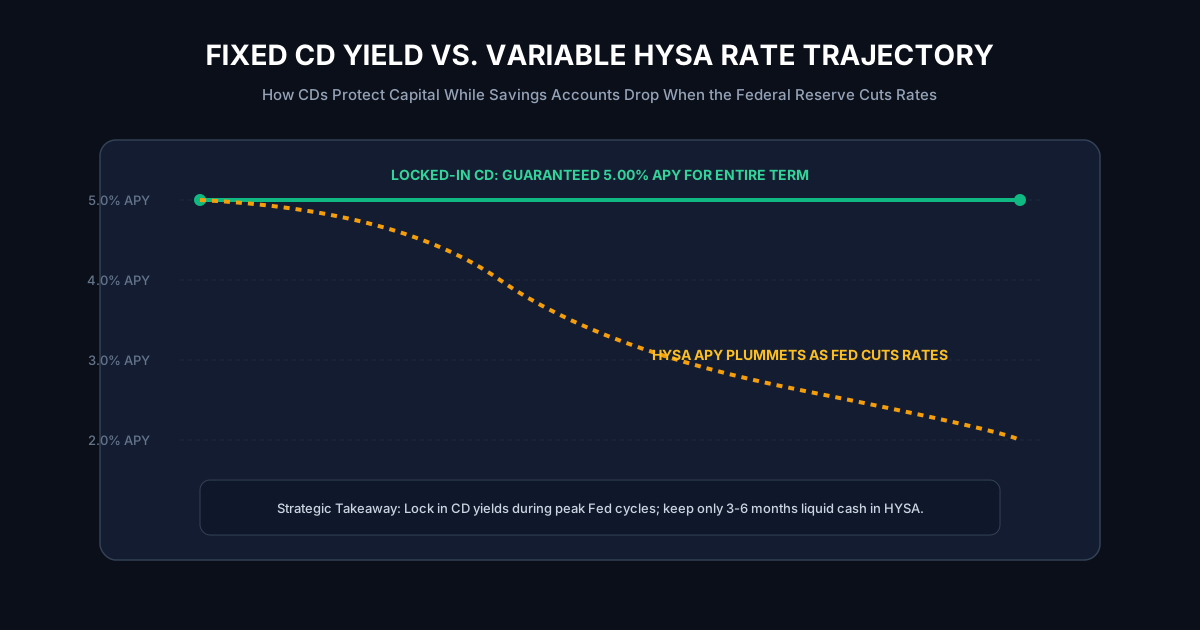 Figure 2: Rate trajectory across monetary easing cycles. Variable savings yields drop alongside Fed cuts, while fixed-term certificates maintain contractual income streams.
Consider a depositor holding $50,000 in cash reserves. In a falling rate environment where benchmark rates decline from 5.25% to 3.25% over eighteen months:
- Scenario A (100% in HYSA): The effective average yield drops to 3.75%, generating $2,812 in cumulative interest over the period.
- Scenario B (CD Ladder Locked at 5.00%): The fixed terms hold the payout steady, generating $3,750 in cumulative interest. The structural difference puts an extra $938 of risk-free, post-tax cash into the investor's pocket with zero additional credit risk.
2. Structuring the Classic Four-Tranche 12-Month Ladder
The foundational CD ladder utilizes four tranches across a one-year horizon. This model balances maximum fixed APY capture with quarterly cash liquidity.
Assume an investor allocates $20,000 of intermediate cash reserves (such as a house down payment fund or the secondary layer of an emergency reserve):
| Tranche | Allocation | Term Length | Initial APY | Maturity Date | Rollover Action |
|---|---|---|---|---|---|
| Tranche 1 | $5,000 | 3 Months | 5.15% | Month 3 | Roll into new 12-Month CD |
| Tranche 2 | $5,000 | 6 Months | 5.00% | Month 6 | Roll into new 12-Month CD |
| Tranche 3 | $5,000 | 9 Months | 4.85% | Month 9 | Roll into new 12-Month CD |
| Tranche 4 | $5,000 | 12 Months | 4.75% | Month 12 | Roll into new 12-Month CD |
The Rolling Perpetual Engine
The true power of this architecture activates at the end of Month 3:
- At Month 3: Tranche 1 matures. The investor collects $5,000 principal plus accrued interest. If the capital is not needed for personal liquidity, it is reinvested into a new 12-Month CD (which matures at Month 15).
- At Month 6: Tranche 2 matures. It is reinvested into another new 12-Month CD (maturing at Month 18).
- At Month 9: Tranche 3 matures and rolls into a new 12-Month CD (maturing at Month 21).
- At Month 12: Tranche 4 matures and rolls into a new 12-Month CD (maturing at Month 24).
By the end of Year 1, an extraordinary structural transformation occurs: Every single dollar in the portfolio is earning the higher 12-month CD rate, yet a full 25% of the total portfolio ($5,000) unlocks every 90 days. The investor enjoys long-term yields with short-term liquidity intervals.
3. Mathematical Analysis of Early Withdrawal Penalties
A primary hesitation among retail investors is the fear of tying up cash when an emergency strikes. However, evaluating the mathematical reality of bank early withdrawal penalties (EWPs) reveals that CDs are significantly more liquid and less punitive than widely assumed.
Under federal banking regulations, institutions establish clear schedules for premature withdrawal. Typical penalty structures across major online direct banks (Ally, Marcus, Discover, Capital One) include:
- CD terms of 12 months or less: 90 days of simple interest.
- CD terms of 13 to 24 months: 180 days of simple interest.
- CD terms of 25 to 60 months: 270 to 365 days of simple interest.
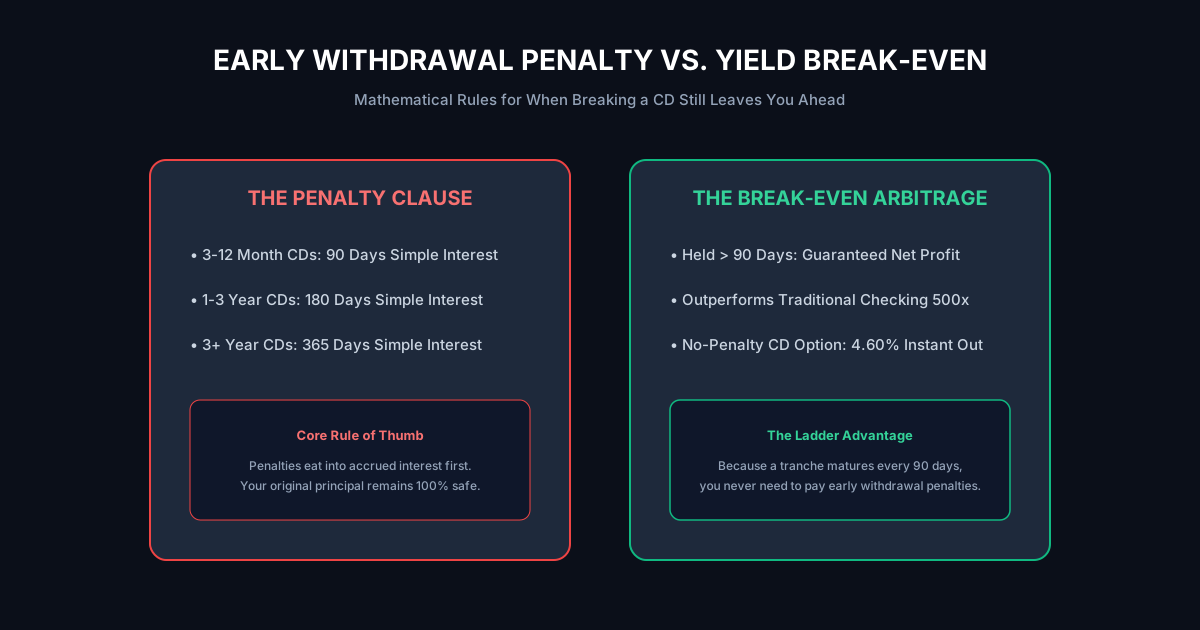 Figure 3: Penalty mechanics versus capital preservation. Early withdrawal penalties only forfeit accrued interest; your initial cash principal remains 100% protected.
The Break-Even Arbitrage Equation
Suppose you place $10,000 into a 12-month CD yielding 5.00% APY ($500 annual payout, or $41.66 per month). The penalty for early termination is 90 days of simple interest ($125).
Let us calculate the net financial outcome if an emergency forces you to break the certificate at Month 6: $$ ext{Gross Interest Earned (6 Months)} = 6 imes $41.66 = $250.00$$ $$ ext{Early Withdrawal Penalty} = 3 imes $41.66 = $125.00$$ $$ ext{Net Cash Distributed} = $10,000 + ($250.00 - $125.00) = $10,125.00$$
Even after breaking the CD halfway through its term, the net effective yield equals 2.50% annualized on the capital. Crucially, the bank never touches the original $10,000 principal. Federal law prevents standard penalties from eroding deposited capital unless stated under extreme zero-interest grace periods.
Furthermore, if market interest rates collapse during those six months and prevailing savings accounts are paying only 2.00%, the broken CD still returned more net cash than leaving the money in a degraded floating-rate account.
4. Multi-Year CD Ladders for Sinking Funds & Education Planning
While a 12-month ladder suits rolling liquidity, investors targeting designated multi-year outlays—such as a wedding, college tuition, or real estate acquisition—should construct a 3-Year or 5-Year Capital Preservation Ladder.
The 3-Year Annual Ladder Model
Assume an allocation of $30,000 earmarked for a commercial down payment in thirty-six months:
- Tranche 1: $10,000 into a 1-Year CD (4.75% APY)
- Tranche 2: $10,000 into a 2-Year CD (4.50% APY)
- Tranche 3: $10,000 into a 3-Year CD (4.30% APY)
Tactical Execution Advantages:
- Elimination of Sequence-of-Returns Risk: Equity markets experience severe drawdowns of 20% to 35% on average once every four to five years. Putting money needed within 36 months into the stock market exposes the principal to catastrophic timing failure. A CD ladder ensures mathematical certainty down to the exact dollar.
- Compound Reinvestment: Annual interest payouts can be automatically deposited into your high-yield checking account or redirected into the next maturing tranche, compounding total returns.
5. Brokered CDs vs. Bank Direct CDs: Navigating the Secondary Market
When constructing advanced ladders, sophisticated allocators distinguish between Bank Direct CDs and Brokered CDs purchased through brokerages such as Charles Schwab, Fidelity, or Vanguard.
Direct Bank CDs
Purchased directly through retail online banks (e.g., Ally, Synchrony, Marcus).
- FDIC Insurance: Pass-through coverage up to $250,000 per depositor per institution.
- Liquidation: Liquidated via early withdrawal penalty paid directly to the bank.
- Minimums: Generally low ($0 to $500).
Brokered CDs
Issued by banks nationwide and distributed through centralized clearing houses via brokerages.
- No Early Withdrawal Penalty: You cannot break a brokered CD with the issuer. Instead, you trade it on the secondary market.
- Interest Rate Sensitivity: If prevailing interest rates fall after purchase, your fixed-rate brokered CD appreciates in market value. You can sell it on the secondary market for a capital gain. Conversely, if rates rise, selling prematurely results in a market discount.
- FDIC Diversification: A retail investor can hold $2,000,000 in FDIC insurance under a single brokerage login by holding $250,000 CDs across eight different issuing banks.
For pure risk-free simplicity, direct bank CDs with transparent 90-day penalty clauses are preferable for personal cash management. For high-net-worth liquidity exceeding $250,000, brokered CDs offer unparalleled operational efficiency.
6. No-Penalty CDs: The Hybrid Strategic Alternative
For investors who demand complete optionality, several top-tier digital banks offer No-Penalty Certificates of Deposit.
A No-Penalty CD functions identically to a standard term certificate, with one critical distinction:
- Beginning on Day 7 following initial funding, the depositor is permitted to withdraw the full balance plus all accrued interest without forfeiting a single penny.
- The APY is fixed for the duration (typically 7 to 11 months).
The Strategic Trade-Off
In exchange for immediate zero-cost liquidity, no-penalty CDs generally price their APY roughly 25 to 40 basis points below standard certificates. For example, if a standard 12-month CD yields 4.90%, the 11-month No-Penalty CD might yield 4.55%.
When to Deploy No-Penalty CDs:
- Uncertain Personal Timelines: You anticipate buying a home within six to nine months, but the closing date is unfixed.
- Volatile Federal Reserve Decisions: If macroeconomic data creates binary outcomes for interest rates, placing money in a no-penalty CD locks in today's rate while leaving you free to break the certificate without penalty if rates unexpectedly climb.
7. Operational Step-by-Step Implementation Guide
Follow this disciplined protocol to launch and maintain your CD ladder with minimal friction:
Step 1: Establish Your Core Emergency Cash Buffer
Never allocate your entire cash reserve into CDs. Maintain one to two months of essential living expenses in an instant-access High-Yield Savings Account linked directly to your primary checking account. This cash handles routine monthly variance, bills, and minor surprises.
Step 2: Audit Yield Spreads Across FDIC-Insured Institutions
Survey top online banks and credit unions. Ensure every target institution maintains active FDIC or NCUA insurance. Compare standard 3, 6, 9, and 12-month yields. Look for institutions that offer automatic maturity alerts and simple electronic transfers.
Step 3: Fund the Four Initial Tranches Simultaneously
Open the accounts and fund all four buckets on the same day. Label each account clearly in your financial dashboard (e.g., CD Ladder - Tranche 1 (3 Mo), CD Ladder - Tranche 2 (6 Mo)).
Step 4: Configure Maturity Instructions Immediately
Most banks default to an automatic renewal clause at maturity, rolling your funds into an identical term at whatever the prevailing market rate happens to be.
- Log into your portal immediately after funding.
- Set maturity alerts to 14 days prior to expiration.
- For Tranche 1 (3-Month), configure the instructions to transfer principal and interest into a new 12-Month CD or transfer out to your checking account if capital needs have changed.
Step 5: Tax Optimization for High Earners
CD interest is taxed at ordinary income rates at federal and state levels during the year it is credited. For investors residing in high-tax states (California, New York, New Jersey), holding Treasury Bills (T-Bills) through a brokerage ladder provides a direct alternative that is 100% exempt from state and local income taxes. Always calculate your after-tax yield spread before committing significant capital.
8. Summary Checklist: The CD Ladder Playbook
To capitalize on market cycles and immunize your savings against rate compression, maintain these core tenets:
- Lock in fixed yields when macroeconomic indicators point toward easing or benchmark rate cuts.
- Stagger maturities quarterly to ensure cash liquidity every 90 days without breaking certificates.
- Reinvest maturing short tranches into 12-month certificates to compound long-term returns.
- Treat early withdrawal penalties as an affordable insurance premium, knowing that your original principal remains completely safe.
- Review your cash architecture semi-annually to rebalance between floating HYSAs, rolling CDs, and market investments.
By systematizing your cash reserves through a rolling CD ladder, you permanently escape the cycle of chasing volatile promotional yields, securing reliable, optimized returns on every liquid dollar you own.
9. Comparative Rate Arbitrage: Treasury Direct T-Bills vs. CDs vs. Fixed Annuities
When allocating liquid capital, sophisticated savers compare bank CDs against competing risk-free and government-backed cash alternatives.
Treasury Bills (T-Bills)
Issued directly by the US Department of the Treasury through TreasuryDirect or secondary brokerage accounts:
- State and Local Tax Exemption: T-Bill interest is 100% exempt from all state and local income taxes. For a saver residing in California (13.3% top bracket) or New York City (10.9% state + 3.87% city), a 4.50% T-Bill yield delivers a higher net after-tax return than a 5.10% bank CD.
- Extreme Liquidity: The US Treasury market is the most liquid debt market globally. You can liquidate T-Bills instantly during market hours with negligible bid-ask spread and zero penalty fees.
Multi-Year Guaranteed Annuities (MYGAs)
Issued by life insurance corporations rather than commercial banks:
- Tax-Deferred Compounding: Interest inside a non-qualified MYGA compounds tax-deferred until withdrawal, making it popular for high-net-worth retirees in peak earning years.
- Liquidity Restrictions: Subject to state guaranty association limits rather than federal FDIC insurance, and withdrawals prior to age 59½ face a 10% IRS penalty in addition to surrender charges.
10. Callable vs. Non-Callable Brokered CDs: The Hidden Reinvestment Trap
When browsing secondary CD offerings through Vanguard, Fidelity, or Charles Schwab, allocators will observe CDs offering yields 30 to 75 basis points above standard retail bank rates. These are almost invariably Callable CDs.
A Callable CD grants the issuing bank the contractual right—at its sole discretion—to "call" (redeem) the certificate after an initial non-call protection window (typically 3 to 6 months):
- If market interest rates collapse, the bank terminates the CD, returns your principal, and stops paying the elevated yield.
- You are left holding cash precisely when all prevailing reinvestment yields have fallen across the economy.
- Conversely, if market rates climb to 7%, the bank will never call the CD, leaving you locked into a below-market yield.
Operational Rule: When building a long-term CD ladder intended to protect yields during monetary easing, strictly filter for Non-Callable CDs. Never forfeit your rate lock in exchange for a temporary teaser spread.
11. Inflation Defense and Real After-Tax Yield Calculations
A primary risk of fixed-income instruments is the erosion of purchasing power caused by the Consumer Price Index (CPI). To evaluate whether a CD ladder is truly building wealth, apply the Real After-Tax Yield Equation: $$ ext{Real After-Tax Yield} = left[ ext{Nominal APY} imes (1 - ext{Marginal Tax Rate}) ight] - ext{Inflation Rate}$$
Scenario Modeling Across Federal Tax Brackets
Suppose an investor locks into a 12-month CD yielding 5.00% APY while annualized headline CPI stands at 2.60%:
| Tax Bracket | Federal + State Rate | Nominal APY | Nominal After-Tax Yield | Real Net Yield (After Inflation) |
|---|---|---|---|---|
| Moderate Bracket | 22% Fed + 0% State | 5.00% | 3.90% | +1.30% Net Purchasing Power Gain |
| Middle Bracket | 24% Fed + 5% State (29%) | 5.00% | 3.55% | +0.95% Net Purchasing Power Gain |
| Top Bracket | 37% Fed + 10% State (47%) | 5.00% | 2.65% | +0.05% Capital Preservation Baseline |
Even after federal and state income taxes and inflation, the CD ladder preserves capital purchasing power while eliminating equity market drawdown volatility.
12. Frequently Asked Questions: CD Ladder Operations
What happens if the bank fails while my money is locked in a CD?
As long as the institution is FDIC-insured (for banks) or NCUA-insured (for credit unions) and your total deposits at that institution remain under the statutory $250,000 threshold ($500,000 for joint accounts), your principal and all accrued interest through the date of failure are 100% insured by the full faith and credit of the United States government. The FDIC typically resolves failed institutions over a weekend, either transferring your CD to an acquiring bank with terms intact or issuing an electronic payout within 48 to 72 hours.
Can I add money to an existing CD once it is opened?
Standard certificates of deposit do not permit ongoing deposits. The principal amount funded on Day 1 remains fixed. However, select institutions offer "Add-On CDs" allowing incremental contributions. For true zero-based cash management, opening a new certificate for each additional chunk of savings preserves distinct maturity dates.
Should I choose monthly interest payouts or compound interest at maturity?
If you require passive income to cover living expenses, select monthly electronic distribution into your primary checking account. If you are building capital for a future purchase, select automatic compounding inside the certificate, which allows interest to earn interest, maximizing the effective APY.