Best Index Funds for Beginners: How to Build a Low-Cost Global Portfolio
A clear guide to low-cost index investing. Compare top index funds like VOO, VTI, and FXAIX, learn why expense ratios matter, and set up a balanced 3-fund portfolio.
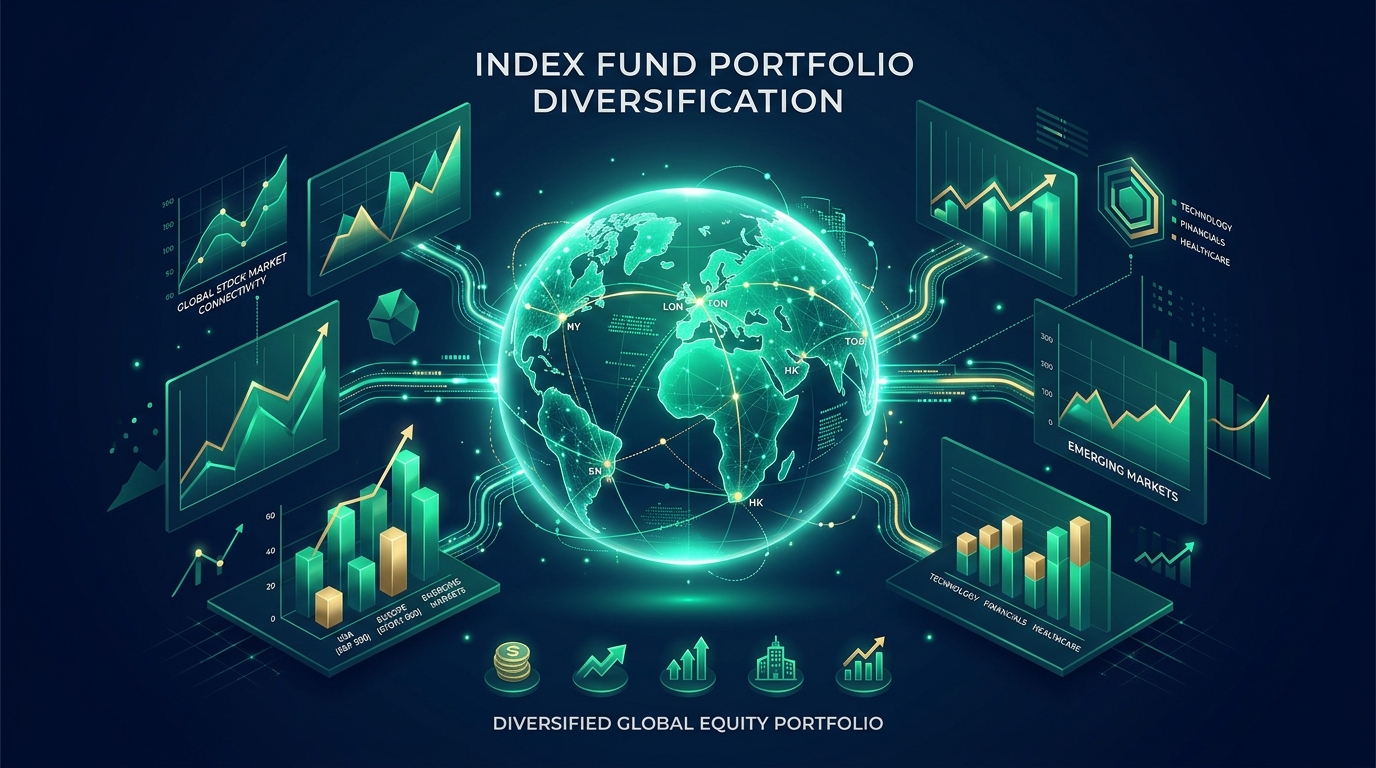
Investing does not require picking individual winning stocks, analyzing quarterly earnings reports, or attempting to time macroeconomic interest rate cycles. In fact, more than five decades of academic financial research prove that attempting to outsmart the broad market is an almost guaranteed recipe for long-term underperformance.
Pioneered by Vanguard founder John C. Bogle in 1976, index fund investing represents the most reliable, statistically validated mechanism for everyday individuals to capture compound market wealth. By purchasing a tiny fractional slice of hundreds or thousands of profitable corporations through an ultra-low-cost index fund, you eliminate single-company bankruptcy risk, slash administrative fees to near zero, and capture the natural upward productivity of the global economy.
Below, we examine the empirical historical data behind passive indexing, the compounding math of expense ratios, a head-to-head breakdown of the world's most popular funds (VOO vs. VTI vs. VT), tax considerations for both US and international investors, and the exact steps to build an automated, all-weather investment portfolio.
1. The Statistical Truth: Active Management vs. Passive Indexing
 Figure 1: The mathematical power of broad-market compounding: Over 92% of actively managed funds fail to beat the passive S&P 500 index over a 15-year holding period.
Wall Street spends billions of dollars every year marketing high-fee mutual funds, hedge funds, and private wealth management services, claiming their proprietary analysts can "beat the market."
The empirical data tells an entirely different story.
The SPIVA Scorecard Data
Every year, S&P Dow Jones Indices publishes the SPIVA (S&P Indices Versus Active) Scorecard, evaluating the performance of actively managed equity funds against their respective benchmark indexes.
Across multiple market cycles over the past two decades:
- Over a 1-year horizon, roughly 60% to 70% of active large-cap fund managers underperform the S&P 500 index.
- Over a 5-year horizon, that underperformance rate climbs to 78%.
- Over a 10-year horizon, 85% to 90% of active managers trail the simple passive index.
- Over a 15-year horizon, more than 92% of all professional fund managers fail to beat the S&P 500, even after factoring in their advanced trading algorithms, Bloomberg terminals, and Wall Street research departments.
flowchart LR
    A["Active Managers (15-Year Horizon)"] --> B["92%+ Underperform the S&P 500 Index"]
    A --> C["< 8% Match or Exceed Index (Mostly Luck / Survivorship Bias)"]
    D["Passive S&P 500 Index Fund (VOO / FXAIX)"] --> E["Guaranteed to Capture 100% of Market Return Minus 0.03% Fee"]
The conclusion of financial economics is clear: Do not look for the needle in the haystack. Simply buy the entire haystack.
2. The Compounding Math of Expense Ratios
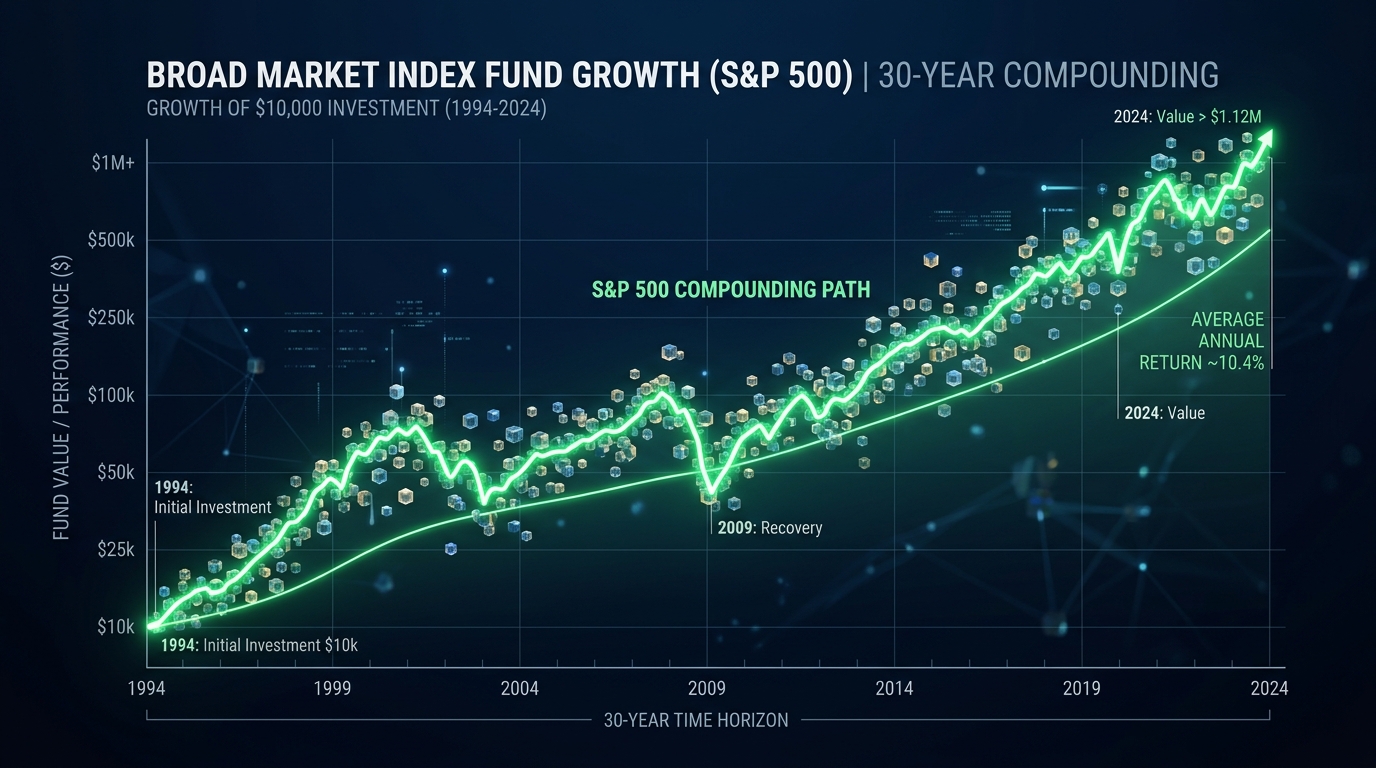 Figure 2: The wealth-destroying impact of investment management fees: a 1.00% fee strips away over 25% of total terminal wealth over 30 years compared to Vanguard's 0.03% expense ratio.
An Expense Ratio represents the annual fee charged by an investment fund to cover administrative management, portfolio rebalancing, and operational costs. It is expressed as an annualized percentage deducted directly from the fund's total assets under management (AUM).
While a fee of 1.00% may sound negligible to a beginner, over a 30-year investing horizon, that fee acts as a devastating compound drag on your final wealth.
The 30-Year Wealth Destruction Simulation
Assume two investors, Investor A and Investor B, each invest $10,000 upfront and contribute $1,000 per month over a 30-year horizon with an identical underlying gross annualized market return of 8.00%:
- Investor A chooses an ultra-low-cost passive index fund (e.g., Vanguard VOO or Fidelity FXAIX) with an expense ratio of 0.03% (Net Return: 7.97%).
- Investor B chooses a standard actively managed mutual fund recommended by a bank advisor with an expense ratio of 1.00% (Net Return: 7.00%).
| Metric | Investor A (0.03% Expense Ratio) | Investor B (1.00% Expense Ratio) | The Hidden Cost of Fees |
|---|---|---|---|
| Total Capital Contributed | $370,000 | $370,000 | $0 |
| Portfolio Value at Year 10 | $206,120 | $193,884 | -$12,236 |
| Portfolio Value at Year 20 | $649,850 | $573,770 | -$76,080 |
| Portfolio Value at Year 30 | $1,607,432 | $1,319,862 | -$287,570 in Lost Wealth |
Key Financial Takeaway: That seemingly tiny 1.00% fee consumed over $287,000 in compound wealth from Investor B's retirement nest egg. The fund manager took home over a quarter-million dollars of the investor's profit while taking 0% of the market risk.
3. The Core Index Fund Heavyweights Compared
When selecting your foundational equity index fund, three flagship instruments dominate institutional and retail portfolios:
1. Vanguard S&P 500 ETF (Ticker: VOO)
- Underlying Benchmark: S&P 500 Index (500 leading large-cap US corporations representing ~80% of total US market capitalization).
- Expense Ratio: 0.03% ($3 per year for every $10,000 invested).
- Top Holdings: Microsoft, Apple, NVIDIA, Amazon, Alphabet, Meta, Berkshire Hathaway.
- Mutual Fund Equivalent: Vanguard VFIAX, Fidelity FXAIX (0.015% fee), Schwab SWPPX (0.02% fee).
- Primary Advantage: Holds the highest-quality, most profitable balance sheets in global corporate history with massive economic moats.
2. Vanguard Total Stock Market ETF (Ticker: VTI)
- Underlying Benchmark: CRSP US Total Market Index (3,700+ US corporations spanning Large-Cap, Mid-Cap, and Small-Cap equities).
- Expense Ratio: 0.03%.
- Composition: ~82% Large-Cap (identical to VOO), ~12% Mid-Cap, ~6% Small-Cap.
- Mutual Fund Equivalent: Vanguard VTSAX, Fidelity FSKAX, Schwab SWTSX.
- Primary Advantage: Total domestic economic representation. If an emerging mid-cap company grows rapidly, VTI captures that growth before it ever qualifies for the S&P 500 index.
3. Vanguard Total World Stock ETF (Ticker: VT)
- Underlying Benchmark: FTSE Global All Cap Index (9,800+ stocks across 47 developed and emerging nations).
- Expense Ratio: 0.07%.
- Geographic Allocation: ~60% United States, ~40% International (Europe, Japan, UK, Canada, Emerging Markets).
- Primary Advantage: Ultimate global diversification. Protects your wealth in the event the US equity market underperforms foreign developed markets over a multi-decade span.
Head-to-Head Comparison Matrix
| Feature | S&P 500 (VOO / FXAIX) | Total US Stock (VTI / FSKAX) | Total World (VT / VWRA) |
|---|---|---|---|
| Number of Holdings | ~503 Companies | ~3,700 Companies | ~9,800 Companies |
| Market Cap Coverage | Large-Cap Only (~80% US) | Large, Mid, & Small (~100% US) | 100% Global Investable Market |
| Expense Ratio | 0.03% | 0.03% | 0.07% |
| International Exposure | Indirect (~30% global revenue) | Indirect (~30% global revenue) | Direct 40% International Equities |
| Historic 20-Yr Correlation | 0.99 with VTI | 0.99 with VOO | 0.88 with VOO |
| Best Suited For | Pure large-cap efficiency | Maximum domestic diversification | Passive "one-and-done" global indexing |
Does VOO vs. VTI Actually Matter?
Over 10-, 20-, and 30-year spans, the statistical correlation between VOO and VTI is approximately 0.99. Because market-cap weighting dictates that large companies make up over 80% of both funds, their total return performance is almost identical.
Picking either VOO or VTI and contributing consistently matters 100x more than debating the fractional differences between the two.
4. The Classic Boglehead 3-Fund Portfolio
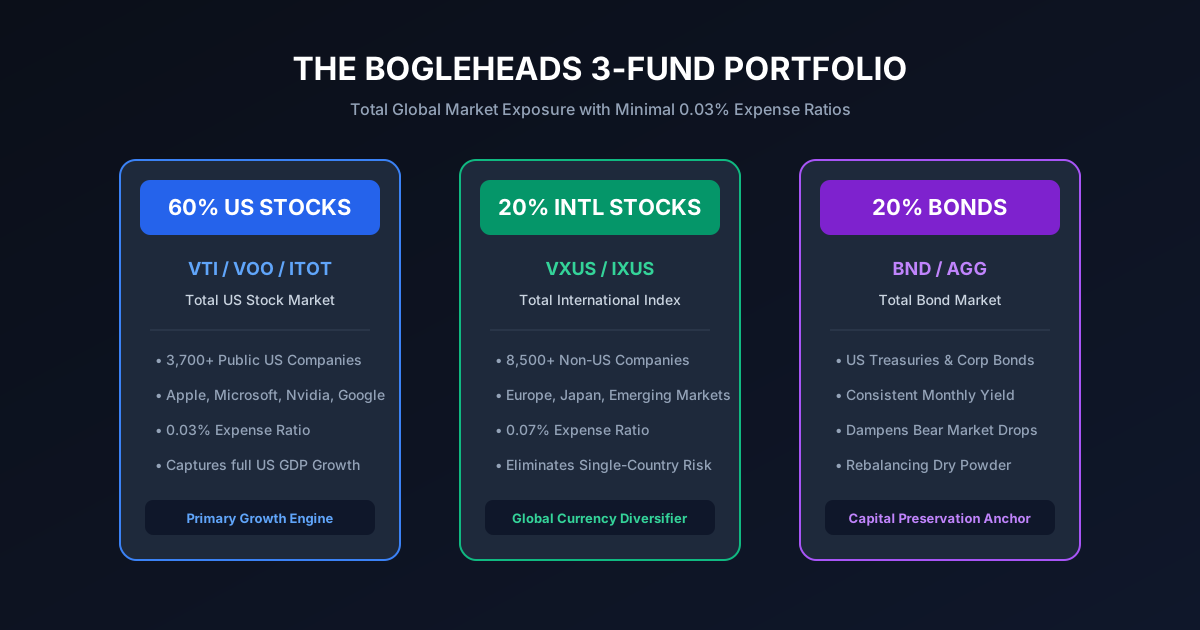 Figure 3: The standard Bogleheads 3-Fund asset allocation: 60% Total US Stock Market (VTI), 20% Total International Stock Market (VXUS), and 20% Total Bond Market (BND).
For investors seeking an all-weather portfolio designed to withstand recessions, inflations, and bear markets, the Boglehead Three-Fund Portfolio is the gold standard of modern asset allocation.
It consists of three simple, ultra-low-cost building blocks:
- Total US Stock Market Index (e.g., VTI or VOO)
- Total International Stock Market Index (e.g., VXUS)
- Total Bond Market Index (e.g., BND)
The Classic 3-Fund Allocation:
├── 60% -> US Total Equities (VTI) -> High Domestic Growth Engine
├── 20% -> International Equities (VXUS) -> Global Currency & Valuation Hedge
└── 20% -> Total US Bond Market (BND) -> Volatility Dampener & Liquidity Buffer
Age-Based Allocation Rule of Thumb
- Investors in their 20s & 30s: 80% to 90% Equities (VOO/VTI + VXUS) and 10% to 0% Bonds. You have decades to ride out market corrections and require maximum equity compounding.
- Investors in their 40s & 50s: 70% Equities and 30% Bonds. Introducing fixed income smooths portfolio volatility as your retirement date approaches.
- Investors in Retirement: 50% Equities and 50% Bonds/Cash Equivalents. Focus transitions from capital accumulation to wealth preservation and sequence-of-returns risk mitigation.
5. Crucial for Global & Non-US Investors: Ireland-Domiciled UCITS ETFs
If you reside outside the United States (in the UK, Europe, Middle East, Asia, or Latin America), buying US-domiciled ETFs like VOO or VTI introduces two serious legal and tax risks:
1. US Withholding Tax on Dividends
Under US tax code, non-resident foreign investors are subject to a statutory 30% withholding tax deducted automatically from all US company dividend disbursements.
2. US Federal Estate Tax (The 40% Death Tax)
US-sited assets held by non-resident aliens that exceed $60,000 in aggregate value are subject to US federal estate taxes of up to 40% upon the investor's death.
The UCITS Solution (Irish Domicile)
To legally optimize your tax structure, non-US investors should purchase UCITS (Undertakings for Collective Investment in Transferable Securities) ETFs domiciled in Ireland:
- 15% Dividend Tax: Ireland maintains a double-tax treaty with the United States that slashes the US dividend withholding tax from 30% down to 15%.
- Zero US Estate Tax Exposure: Irish-domiciled funds are treated as non-US assets, completely shielding your estate from the 40% US federal estate tax.
- Top Irish UCITS Tickers:
- VUAA / VUSA: Vanguard S&P 500 UCITS ETF (Accumulating / Distributing)
- VWRA / VWRD: Vanguard FTSE All-World UCITS ETF (Accumulating / Distributing)
Pro Tip on Accumulating (Acc) Funds: In many European and Asian jurisdictions, selecting an Accumulating (Acc) ETF like VWRA means dividends are automatically reinvested back into the fund's net asset value without triggering taxable events in your home country.
6. Dollar-Cost Averaging (DCA) vs. Lump-Sum Investing
A major psychological hurdle for beginners is deciding how to deploy accumulated cash into the market:
- Dollar-Cost Averaging (DCA): Dividing an investment balance into equal installments over regular intervals (e.g., investing $1,000 every Monday for 10 weeks).
- Lump-Sum Investing: Depositing 100% of available capital into the market immediately on day one.
What Vanguard's Research Discovered
Vanguard published a landmark historical study comparing Lump-Sum vs. DCA across historical rolling 12-month periods in US, UK, and Australian markets:
- Lump-Sum Investing outperformed DCA approximately 68% of the time.
- Why? Because stock markets spend more time rising than falling. Delaying capital entry means sitting in low-yielding cash while corporate earnings compound.
The Behavioral Compromise
While pure mathematics favors Lump-Sum, human psychology often cannot tolerate the regret of investing a lump sum right before a 10% market correction.
If holding cash causes analysis paralysis, adopt a strict 3-to-6 month DCA schedule. Commit to investing an exact dollar amount on the 1st and 15th of each month on automated schedule, completely independent of headlines or financial news commentary.
7. The 5-Step Execution Guide to Buying Your First Index Fund
- Select a Low-Cost Institutional Brokerage:
- US Investors: Vanguard, Fidelity, or Charles Schwab. (All offer $0 trading commissions and fractional share purchases).
- International / Expat Investors: Interactive Brokers (IBKR) or Swissquote.
- Open the Correct Account Type:
- Prioritize tax-advantaged retirement accounts (Roth IRA or Traditional 401(k)) before placing capital in a taxable brokerage account.
- Execute an Electronic Fund Transfer (ACH): Link your primary checking account and transfer your starting deposit ($100 to $1,000+).
- Place a Market or Limit Order: Search for ticker VOO (or VTI), enter the dollar or share amount, and execute your order during standard market trading hours (9:30 AM to 4:00 PM EST).
- Enable Automatic Dividend Reinvestment (DRIP): Check the box in your brokerage settings to enroll in DRIP (Dividend Reinvestment Plan). Every quarterly dividend payment will automatically purchase additional fractional shares, compounding your holdings without manual intervention.
8. Annual Rebalancing & Tax-Loss Harvesting Strategies
To preserve your target asset allocation over long horizons, you must periodically rebalance your holdings.
The Mechanics of Annual Rebalancing
Over time, different asset classes perform at varying rates. For example, during a strong equity bull market, your stock allocation may expand from your target of 70% up to 82%, while your bond allocation shrinks from 30% to 18%. This unintended shift exposes your portfolio to greater downside volatility than your risk tolerance accommodates.
Two Proven Rebalancing Rules:
- The Calendar Rule: Rebalance once annually on a fixed, non-emotional date (such as every January 5 or your birthday).
- The 5/25 Opportunistic Rule: Rebalance whenever an asset class deviates by more than 5% absolute or 25% relative from its target weight.
Tax-Free Rebalancing Secret: If you contribute new money every month, do not sell winning assets in taxable accounts (which triggers capital gains taxes). Instead, simply direct your new monthly contributions into whichever asset class is lagging until balance is restored organically.
Tax-Loss Harvesting (TLH) in Taxable Accounts
In taxable investment accounts, market downturns present a major wealth-saving opportunity through Tax-Loss Harvesting:
- When the market dips and an index fund drops below your purchase basis, you sell the losing position to crystallize a tax loss.
- You immediately reinvest the sale proceeds into a correlated, but not substantially identical index fund (for example, switching from Vanguard S&P 500 VOO into Vanguard Total Market VTI or Schwab S&P 500 SCHX).
- The Benefit: Under IRS rules (IRC § 1211), you can use harvested capital losses to offset up to $3,000 of ordinary taxable income each calendar year, and roll forward all remaining excess losses indefinitely to offset future investment capital gains.
- The Wash-Sale Rule Warning: Under IRC § 1091, you cannot buy back the exact same ticker within 30 days before or after the sale date, or the tax loss is completely disallowed. Swapping between VOO and VTI safely navigates wash-sale rules while keeping you 100% invested in the market recovery.
9. Comprehensive Frequently Asked Questions (FAQ)
What happens if the stock market crashes right after I invest?
Do nothing and continue buying. Over the past 100 years, the US stock market has survived the Great Depression, World War II, the 1970s stagflation, the 2000 Dot-Com crash, the 2008 Great Financial Crisis, and the 2020 pandemic. In 100% of historical cases, diversified broad-market indexes eventually recovered to reach new all-time highs. A market correction is simply a temporary discount sale on the world's most productive assets.
How much money do I need to start investing in index funds?
Thanks to modern brokerage fractional share investing, you can begin with as little as $1.00. Platforms like Fidelity and Interactive Brokers allow you to buy $10 or $50 of a fund like VOO even if a single whole share trades at $500+.
How do I make money from an index fund?
Index funds generate wealth in two distinct ways:
- Capital Appreciation: As the underlying companies increase their earnings and book values, the per-share price of the ETF rises over time.
- Quarterly Dividends: Corporations in the index pay out quarterly cash dividends from their profits, which are deposited directly into your brokerage account or automatically reinvested into more shares via DRIP.
Can an index fund go to zero?
For an S&P 500 index fund (VOO) to go to zero, all 500 of the largest corporations in the United States—including Apple, Microsoft, Amazon, Berkshire Hathaway, and JPMorgan Chase—would have to go completely bankrupt simultaneously. In such an unprecedented apocalyptic scenario, paper money and financial systems would cease to function entirely. For all practical purposes, broad-market index funds carry zero existential solvency risk.