The 50/30/20 Budget Rule: How to Automate Your Cash Flow and Savings
A practical framework for the 50/30/20 budget rule. Learn how to divide net income into needs, wants, and savings, adjust for high-cost cities, and automate accounts.
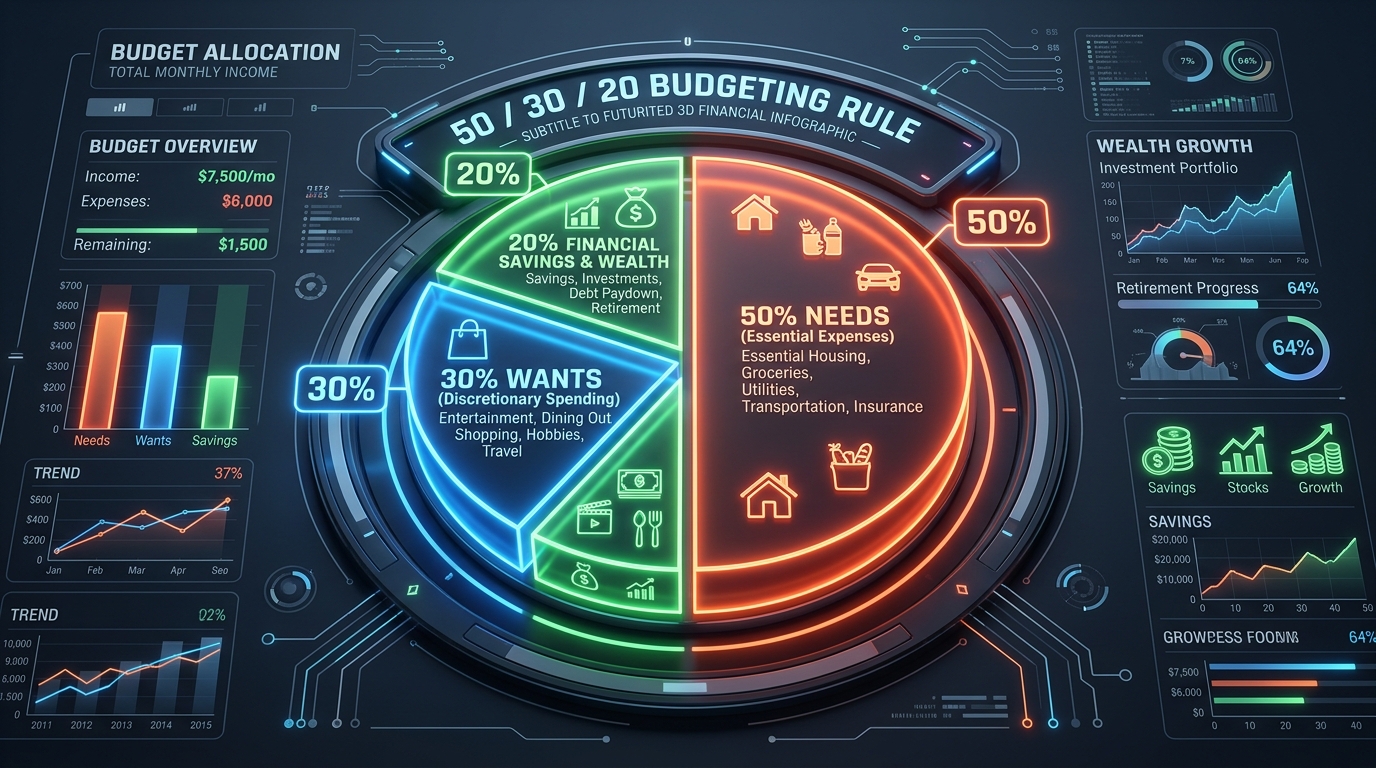
Most traditional household budgets fail for the exact same reason crash diets fail: they are restrictive, guilt-inducing, mathematically tedious, and require micromanaging every single cent down to a cup of coffee. Tracking receipt line items into dozens of hyper-specific categories creates decision fatigue and administrative burnout within 90 days.
Popularized by Senator Elizabeth Warren and her daughter Amelia Warren Tyagi in their Harvard-backed research treatise All Your Worth: The Ultimate Lifetime Money Plan, the 50/30/20 budgeting rule is the most intuitive, sustainable cash flow framework ever designed.
Rather than treating budgeting as financial deprivation, the 50/30/20 model acts as an allocative guardrail. It provides complete, guilt-free permission to enjoy your money today while establishing an automated, non-negotiable wealth-building pipeline for tomorrow.
Below, we examine the exact mathematical definitions of the three buckets, adjustments for high cost-of-living metropolitan areas, an automated multi-account banking infrastructure, and step-by-step cash flow formulas across multiple income brackets.
1. The Core Architecture: Net Take-Home Pay Allocation
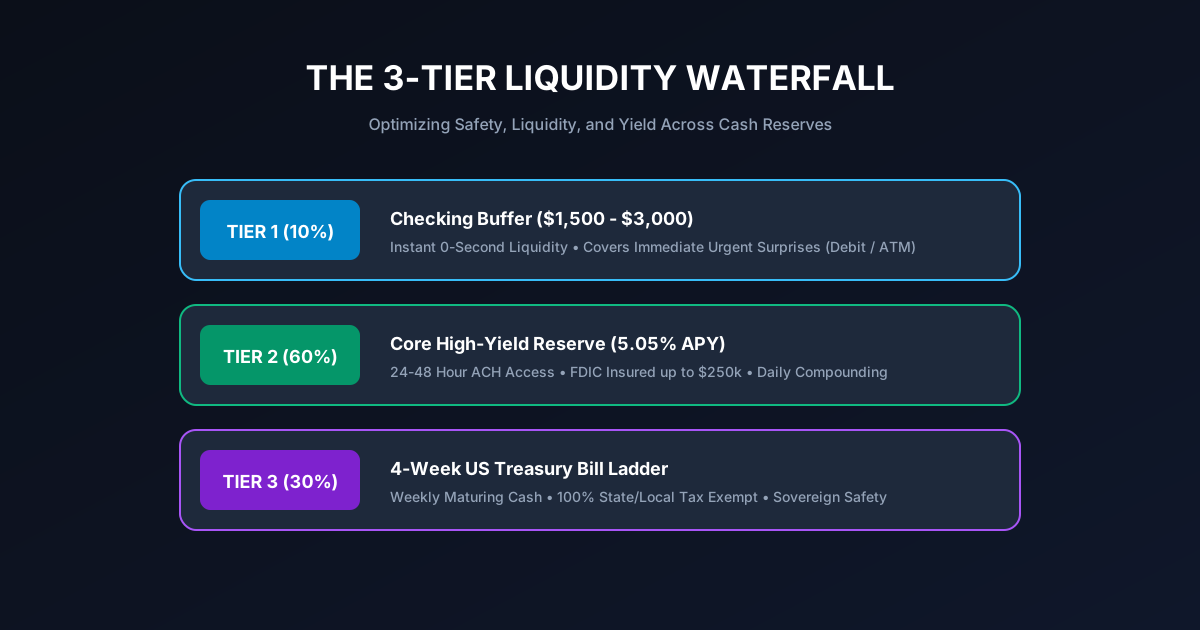 Figure 1: The liquidity foundation: Building a multi-tier cash reserve buffer ensures unexpected expenses never derail your monthly 50/30/20 cash flow execution.
The 50/30/20 rule divides your Net Take-Home Pay (not your gross nominal salary) into three clean, non-overlapping financial buckets:
Net Take-Home Cash Flow:
├── 50% -> Essential Needs (Non-negotiable survival overhead)
├── 30% -> Discretionary Wants (Guilt-free lifestyle choices)
└── 20% -> Financial Acceleration (Savings, investments, extra debt principal)
The Crucial Net Pay Calculation Rule
To apply the framework accurately, you must define Net Take-Home Pay: $$\text{Net Take-Home Pay} = \text{Gross Salary} - \text{Mandatory Payroll Taxes (Federal, State, FICA/Medicare)}$$
What About Pre-Tax 401(k) Deductions?
If you currently contribute 6% of your gross pay to an employer 401(k) to capture a company match, that money is deducted before your paycheck deposits into your checking account.
- To calculate your true 50/30/20 percentages, add that 401(k) contribution back into your net pay, and categorize that amount as already fulfilling part of your 20% Financial Acceleration bucket.
2. Bucket 1: The 50% "Needs" Category (Survival Overhead)
The Needs category encompasses all non-negotiable expenses that are strictly required for physical survival, shelter, and maintaining active employment.
The Litmus Test for a "Need": If you lost your job tomorrow, would continuing to pay this expense be mandatory to keep a roof over your head, food on the table, your health intact, and your utilities active? If the answer is no, it is a Want, not a Need.
What Belongs in the 50% Needs Bucket:
- Housing Overhead: Monthly rent or mortgage payment (including property taxes, homeowners insurance, and private mortgage insurance - PMI).
- Core Utilities: Electric, natural gas/heating, water, trash disposal, and a basic residential internet connection (essential for modern remote employment).
- Staple Groceries: Raw ingredients, basic food staples, and household hygiene products. (Note: Gourmet restaurant meals, food delivery apps, and artisan coffee are strictly classified as Wants).
- Basic Transportation: Monthly auto loan payment, statutory vehicle insurance, fuel, essential routine maintenance, or municipal public transit passes.
- Healthcare & Medicine: Health insurance premiums, non-negotiable prescription copays, and vital medical treatments.
- Minimum Mandatory Debt Payments: Minimum payments on student loans, credit cards, and personal loans. (Crucial distinction: Minimum payments protect your credit score and avoid legal default, so they are categorized under Needs. Any extra principal payments above the minimum belong in the 20% Savings/Debt bucket).
3. Bucket 2: The 30% "Wants" Category (Guilt-Free Discretionary)
The Wants bucket is what makes the 50/30/20 rule psychologically sustainable over a multi-decade career. Many rigid financial advisors tell people to eliminate lattes, restaurants, and entertainment entirely. The 50/30/20 rule rejects this toxic austerity.
If your Needs are capped at 50% and your Savings are locked at 20%, you have full permission to spend 100% of your 30% Wants bucket on whatever brings you happiness, with zero guilt, zero shame, and zero tracking of individual receipts.
What Belongs in the 30% Wants Bucket:
- Dining out, cafes, craft cocktails, and food delivery services.
- Streaming subscriptions (Netflix, Spotify, HBO, Disney+).
- Vacations, weekend trips, flights, and hotel bookings.
- Hobbies, gaming setups, musical instruments, and golf greens fees.
- High-end designer clothing, shoes, and luxury personal care.
- Gym memberships, boutique fitness studios, and personal trainers.
- Home decor upgrades, electronics, and gadget upgrades.
4. Bucket 3: The 20% "Financial Acceleration" Category (Wealth Velocity)
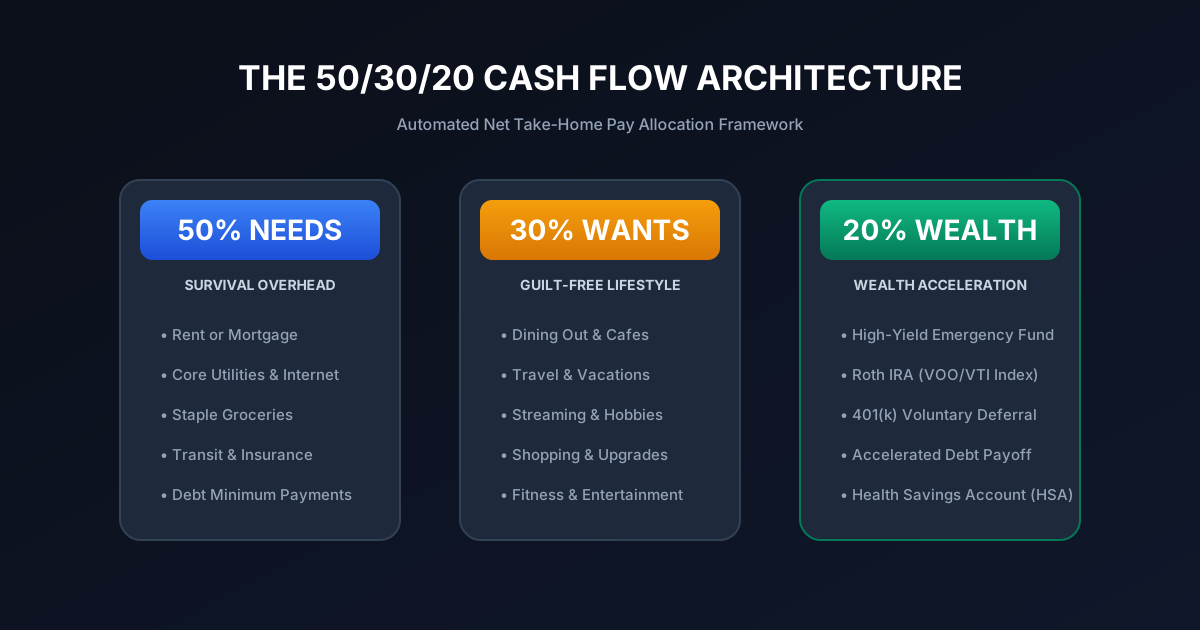 Figure 2: The classic 50/30/20 allocation blueprint: 50% for core survival overhead, 30% for guilt-free lifestyle expenses, and 20% dedicated to high-yield debt elimination and wealth building.
This is the engine where financial freedom, early retirement, and compound wealth are manufactured. Every dollar allocated here directly improves your personal net worth balance sheet.
What Belongs in the 20% Financial Acceleration Bucket:
- Emergency Reserve Funding: Systematic contributions to a High-Yield Savings Account (HYSA) until you possess 3 to 6 months of living expenses.
- Tax-Advantaged Retirement Contributions: Contributions to a Roth IRA, Traditional IRA, or voluntary employee 401(k) contributions beyond the company match.
- Accelerated Debt Destruction: Extra principal payments above the mandatory minimums targeted at high-interest credit cards, personal loans, or private student debt.
- Taxable Brokerage Index Investing: Automated monthly purchases of broad-market index funds (such as Vanguard S&P 500 VOO or Total Market VTI).
5. Mathematical Income Allocations Across Tax Brackets
Here is how the 50/30/20 allocation translates in real dollars across various monthly take-home earnings:
| Monthly Net Take-Home | 50% Needs Cap | 30% Wants Budget | 20% Wealth & Debt | Annual Capital Accumulated | 20-Year Compounded Wealth (8% Return) |
|---|---|---|---|---|---|
| $3,000 / month | $1,500 | $900 | $600 | $7,200 / year | $341,400 |
| $4,500 / month | $2,250 | $1,350 | $900 | $10,800 / year | $512,100 |
| $6,000 / month | $3,000 | $1,800 | $1,200 | $14,400 / year | $682,800 |
| $8,000 / month | $4,000 | $2,400 | $1,600 | $19,200 / year | $910,400 |
| $12,000 / month | $6,000 | $3,600 | $2,400 | $28,800 / year | $1,365,600 |
The Compound Interest Reality: Investing your 20% allocation ($1,200/mo on a $6,000 net income) into a low-cost S&P 500 index fund compounding at an average 8% annualized return produces over $680,000 in 20 years and over $1.6 million in 30 years. The 20% bucket turns average earners into self-made millionaires.
6. High Cost of Living (HCOL) Adaptations: 60/20/20 and 70/15/15
The most common criticism of the 50/30/20 framework is: "I live in New York, San Francisco, London, or Toronto. My rent alone is 45% of my paycheck. 50% for Needs is mathematically impossible!"
This is a valid structural critique. In Tier-1 metropolitan markets, housing and transportation overhead often consume 60% or more of net pay. If you find yourself in this environment, do not abandon the system—adapt the ratios.
High Cost-of-Living Alternatives:
├── 60/20/20 -> 60% Needs / 20% Wants / 20% Savings (Preserves Wealth Engine)
├── 70/15/15 -> 70% Needs / 15% Wants / 15% Savings (High Cost Triage Phase)
└── 50/15/35 -> 50% Needs / 15% Wants / 35% Savings (Aggressive FIRE Strategy)
The Non-Negotiable HCOL Rule: Never Sacrifice the Savings Bucket First
When housing costs surge, the natural human temptation is to keep Wants at 30% and shrink Savings down to 5%. This is a dangerous trap.
If your Needs require 60% of your net pay, compress your Wants down to 20% so your Savings bucket remains protected at 20%. Sacrificing your future wealth to subsidize dining out and weekend entertainment locks you into living paycheck-to-paycheck indefinitely.
7. The Automated 3-Account Banking Blueprint
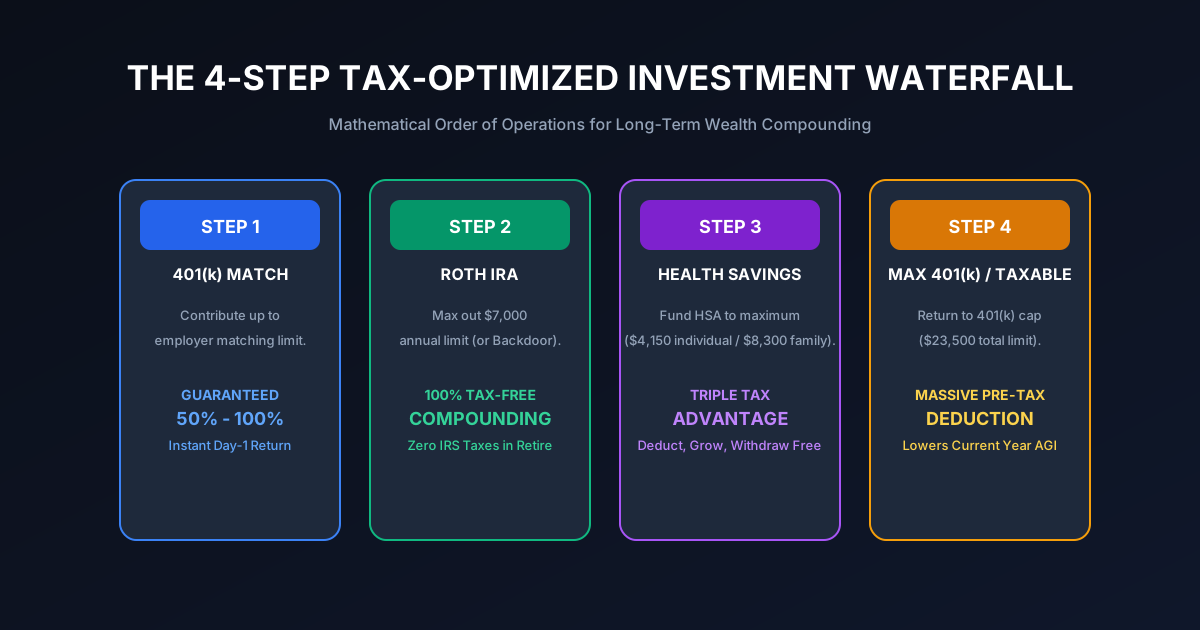 Figure 3: Automated direct-deposit routing: splitting paychecks automatically across operating checking, discretionary cards, and tax-advantaged investment accounts on day one.
The secret to effortless execution is eliminating human willpower from the equation. Build this automated multi-account infrastructure:
flowchart TD
    Paycheck["Direct Deposit Paycheck (100% Net Income)"] --> Hub["Account 1: Checking Hub (Fixed Needs - 50%)"]
    Hub -->|"Automated Transfer (Payday + 1)"| Wants["Account 2: Discretionary Debit Card (Wants - 30%)"]
    Hub -->|"Automated Transfer (Payday + 1)"| HYSA["Account 3: High-Yield Savings & Brokerage (Wealth - 20%)"]
    Hub --> FixedBills["Mortgage, Rent, Utilities, Debt Minimums Paid Automatically"]
    Wants --> DailySpend["Groceries Out, Coffee, Entertainment, Shopping"]
    HYSA --> Compounding["Emergency Fund (5% APY) & Index Funds (VOO)"]
- Account 1: The Bills & Needs Hub (Checking Account): 100% of your paycheck deposits here. All fixed bills (mortgage, rent, utilities, insurance, loan minimums) are set to auto-pay from this account. 50% of your income stays here.
- Account 2: The Guilt-Free Lifestyle Card (Separate Checking/Debit Card): On the day after payday, an automated recurring transfer moves exactly 30% into this account. This is the only debit card you carry for dining, shopping, and entertainment. When this balance reaches $0, your discretionary spending halts until the next paycheck. You never have to log receipts because the account balance is your budget.
- Account 3: The Wealth Fortress (High-Yield Savings & Brokerage): On payday + 1, an automated transfer sweeps 20% into your High-Yield Savings Account and investment brokerage. The money is invested before you ever have the chance to spend it.
8. Step-by-Step Implementation Audit
Step 1: Calculate Your 90-Day Trailing Baseline
Download bank statements from the past three months. Categorize every transaction into Needs, Wants, and Savings. Calculate your actual baseline percentages.
Step 2: Plug the "Subconscious Bleed"
Identify recurring subscription services, unused gym memberships, or insurance policies that have crept upward. Re-shop your auto and homeowners insurance rates once per year; this single 30-minute phone call frequently saves $400 to $800 annually.
Step 3: Implement the 72-Hour Rule on Discretionary Purchases
Whenever you feel the impulse to buy a "Want" item costing more than $100, enforce an intentional 72-hour cooling-off delay. If you still genuinely desire the item after three full days, purchase it guilt-free from your 30% bucket. In over 60% of cases, the dopamine urge subsides and you keep the capital.
8. Detailed Real-World Case Study: The $5,200/Month Allocation
To observe the 50/30/20 framework in action, consider Marcus, a 31-year-old healthcare professional with a monthly net take-home pay of $5,200:
Marcus's Baseline Allocation Targets:
- Needs Cap (50%): $2,600 / month
- Wants Budget (30%): $1,560 / month
- Financial Goals (20%): $1,040 / month
Detailed Line-Item Breakdown:
1. Needs Bucket ($2,540 Actual / $2,600 Target - Under by $60):
- Rent (1-Bedroom Apartment): $1,550
- Utilities (Electric, Gas, Water, Internet): $190
- Groceries & Household Essentials: $420
- Car Note & Auto Insurance: $380
- Health Insurance Copays & Prescriptions: $0 (covered by employer)
- Total Needs: $2,540 (48.8% of Net Pay — Passes the 50% Rule)
2. Wants Bucket ($1,520 Actual / $1,560 Target - Under by $40):
- Dining Out & Weekend Socializing: $650
- Subscriptions (Netflix, Spotify, Cloud Storage): $45
- Fitness Membership & Rock Climbing: $135
- Travel & Vacation Sinking Fund: $450
- Personal Shopping & Gadgets: $240
- Total Wants: $1,520 (29.2% of Net Pay — Zero Guilt Spending)
3. Financial Goals Bucket ($1,140 Actual / $1,040 Target - Above by $100):
- High-Yield Savings Emergency Fund: $300
- Roth IRA Contribution (VOO Index Fund): $583.33 ($7,000 Annual Max)
- Extra Principal on Student Loan: $256.67
- Total Financial Acceleration: $1,140 (21.9% of Net Pay)
The 10-Year Result:
By maintaining this exact balance without feeling deprived, Marcus accumulates over $180,000 in liquid and invested assets within a single decade, completely pays off his student debt, and lives with zero financial anxiety.
9. 50/30/20 vs. Other Budgeting Philosophies Compared
| Budgeting Methodology | Core Philosophy | Time Commitment | Best Suited For | Key Weakness |
|---|---|---|---|---|
| 50/30/20 Rule | High-level percentage guardrails | Low (15 mins/mo) | Moderate to high earners seeking sustainable balance | Struggles in extreme high-cost rent markets |
| Zero-Based Budgeting (YNAB) | Give every single dollar a specific job | High (Daily tracking) | Individuals in financial triage or deep debt | High friction; causes user burnout |
| The "Anti-Budget" | Automatically invest 20%, spend whatever is left | Lowest (0 mins/mo) | High earners with low fixed overhead | No visibility into discretionary spending leaks |
| Cash Envelope System | Physical paper cash in labeled envelopes | Moderate (Weekly cash pulls) | Chronic credit card overspenders | Inconvenient in a digital cashless economy |
Overcoming the "Sticky Expenses" Trap: The Fixed-Cost Audit
When individuals struggle to fit their living overhead into the 50% "Needs" envelope, the root cause is almost invariably what behavioral economists call "sticky fixed costs." Sticky expenses are contractual obligations signed during previous periods that cannot be adjusted on a daily basis: auto lease commitments, high-tier smartphone financing plans, multi-year gym memberships, and rent.
To systematically lower your fixed-cost baseline, execute a quarterly "Fixed-Cost Contract Audit":
- Auto Insurance Shopping Protocol: Insurance underwriters utilize algorithmic risk models that adjust rates continually. Contacting an independent insurance broker every 12 months to gather quotes from multiple top-tier carriers routinely uncovers identical liability and comprehensive coverage for $400 to $800 less annually.
- Cellular and Broadband Rationalization: Modern Mobile Virtual Network Operators (MVNOs) like Mint Mobile, Visible, or US Mobile utilize identical Verizon, AT&T, and T-Mobile cellular towers at a fraction of the cost (## 10. Comprehensive Frequently Asked Questions5 to $25 per line vs. $85 per line on legacy post-paid plans). Transitioning a two-person household saves over ## 10. Comprehensive Frequently Asked Questions,400 annually with zero difference in mobile coverage.
- Escrow and Property Tax Appeals: Homeowners can formally appeal municipal property tax assessments through their local county valuation board if comparable home sales in their immediate neighborhood suggest overvaluation. Successfully lowering an assessment immediately reduces monthly mortgage escrow requirements.
The Psychology of "Guilt-Free" Discretionary Spending
The single greatest failure point of traditional restriction-based budgeting (such as extreme couponing or line-item penny tracking) is decision fatigue and psychological rebound bingeing. When a budget treats every coffee, restaurant meal, or entertainment purchase as a moral failure, the individual inevitably abandons the system within 60 to 90 days.
The 50/30/20 framework resolves this fundamental psychological flaw through pre-commitment and isolation. By allocating 30% of net take-home pay into a dedicated lifestyle checking account with its own debit card, the individual has explicit, pre-authorized permission to spend every single cent in that bucket on whatever brings them joy—without tracking individual line items or feeling a shred of financial anxiety. Because the 50% essentials have already been covered and the 20% wealth allocation has already been automatically routed into index funds and savings on payday, how the remaining 30% is enjoyed has zero negative impact on long-term financial independence.
10. Comprehensive Frequently Asked Questions (FAQ)
What if my minimum debt payments and rent exceed 70% of my income?
You are in Financial Triage. When fixed overhead consumes 70%+ of net income, budgeting alone cannot solve the problem; it is an income and housing structural imbalance. You must take aggressive, non-standard measures: take on a room-mate, refinance debts, relocate to a lower-cost rental, or aggressively execute high-margin side income ventures to expand your gross income denominator.
How do annual bonuses and tax refunds fit into 50/30/20?
Treat windfalls as a compressed 50/30/20 event. If you receive a $5,000 tax refund:
- Direct $0 to $1,000 (0-20%) toward a guilt-free reward or celebration.
- Direct $4,000 (80%+) straight into your emergency reserve, debt principal, or index fund portfolio. Windfalls represent asymmetric opportunities to leapfrog your financial timeline.
Is the 50/30/20 rule suitable for business owners or freelancers with irregular income?
Yes, by utilizing an "Income Buffer Account." Deposit all volatile freelance and business revenue into a dedicated Business Checking Account. Pay yourself a fixed, predictable monthly "salary" into your personal checking account based on your lowest historical earning month. Run your personal 50/30/20 budget off that steady personal salary, leaving surplus cash in the business buffer during high-revenue months to smooth out dry seasons.
What should I do if my "Needs" are currently below 50%?
If you are fortunate to have low fixed overhead (e.g. living with roommates, owning a paid-off home, or earning a high income where essential expenses consume only 35% of take-home pay), do not automatically inflate your Wants to 45%.
- This is the phenomenon known as Lifestyle Creep.
- Instead, expand your Financial Acceleration bucket to 35% or 40%.
- Reallocating surplus margin into broad-market index funds and tax-sheltered accounts accelerates your financial independence timeline by a decade or more.
How often should I audit and re-evaluate my 50/30/20 percentages?
Audit your allocations semi-annually (every six months) and immediately following major life events (receiving a salary raise, moving apartments, paying off a vehicle loan, or having a child). A 30-minute semi-annual check-in ensures that recurring subscription price hikes or utility creep have not subtly pushed your fixed overhead above the 50% ceiling.